
Realistic forex trading goals are goals about your behaviour and your risk, not about a fixed amount of money per month. A profit target feels motivating, but on a small account it pushes you to take larger risks, force trades and break your own rules. This article explains why big targets hurt, what steady numbers look like, and how to set goals that you can actually control.
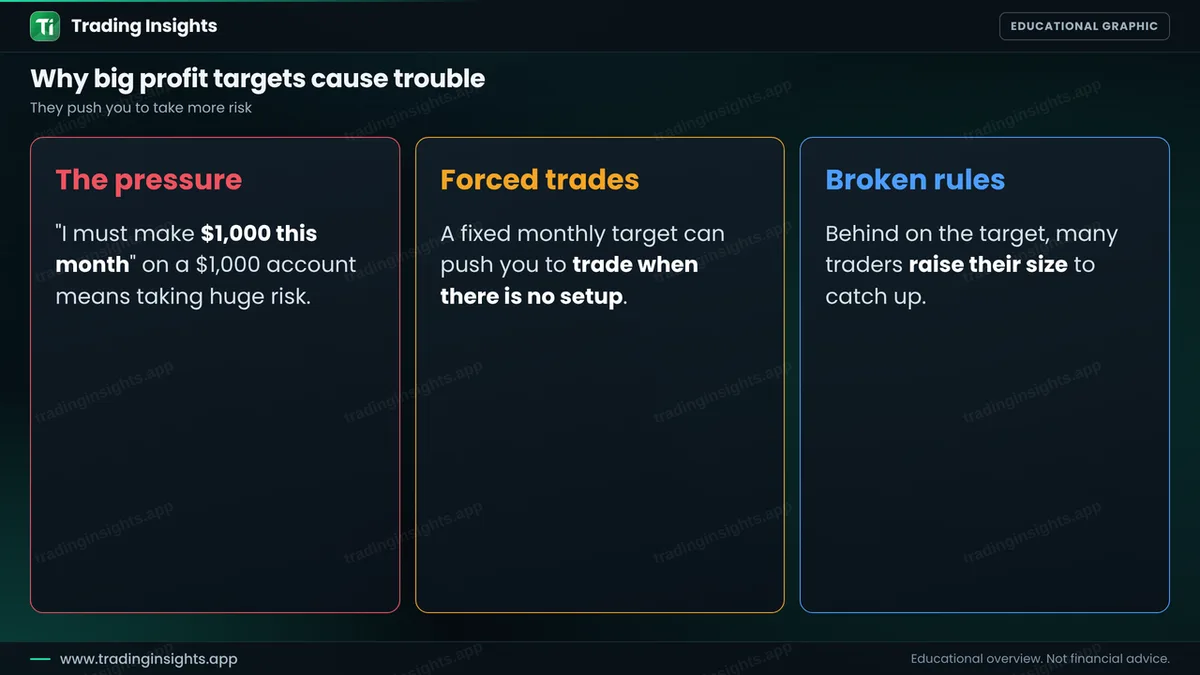
Why big profit targets cause trouble
Suppose that you have a $1,000 account and want to make $1,000 a month. That is a 100% monthly return, which would need a very high risk per trade. If the account is small, the only way to reach a large target is to take a large risk, which is how accounts are lost. See trading with a small account.
A fixed target also encourages you to trade when there is no setup, and to raise the size when you are behind. These are the roots of overtrading and revenge trading.
What realistic forex trading goals look like in numbers
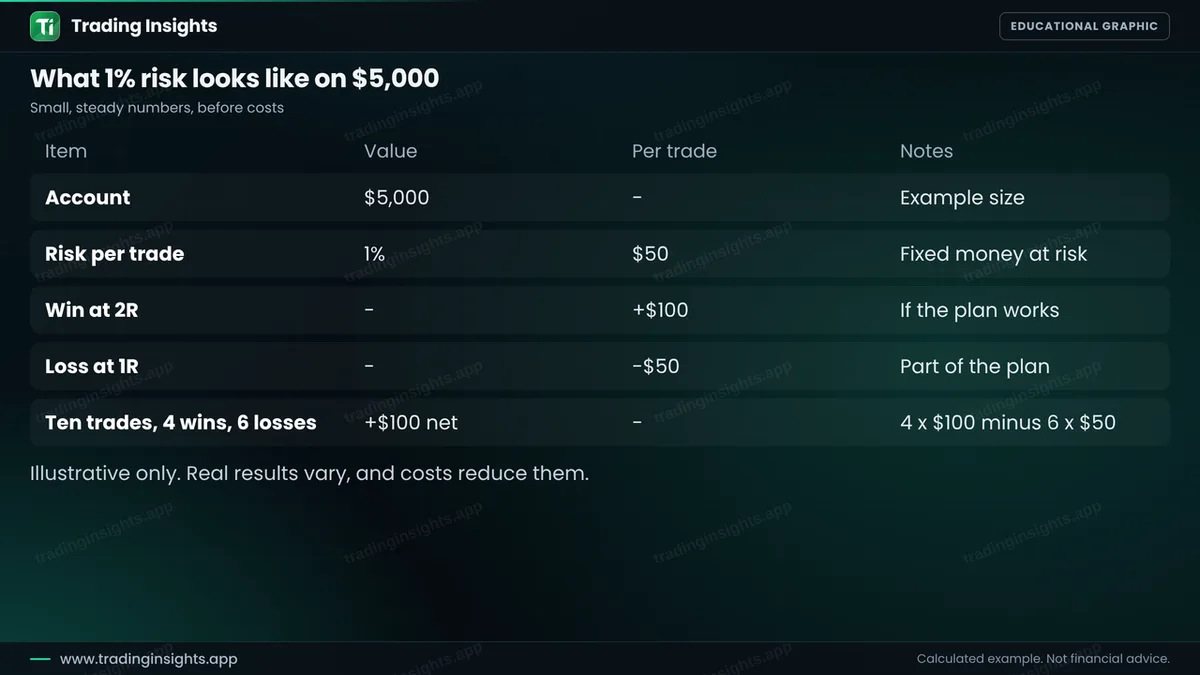
On a $5,000 account, a risk of 1% is $50 per trade. If you win 2R, you make $100, and if you lose 1R, you lose $50. Over ten trades with four wins and six losses, you would make 4 x $100 - 6 x $50 = $100, which is 2% of the account.
That is a very good result for a strategy with a 40% win rate, and yet it is a small sum. The numbers show why trading is a slow business on a small account. Spread and commission reduce the result. See forex trading costs and trading expectancy.
Results also come unevenly. A strategy can have months with losses, even if it is profitable over a year. See losing streaks in trading and drawdown and risk of ruin. A goal that ignores this variation can make a normal bad month feel like a failure.
Illustrative example: what an income goal really needs
This is an illustrative example, not a forecast. A trader wants $1,000 a month. Suppose a good month for a steady strategy is a 2% return, and assume the result is before costs.
The account needed is $1,000 / 0.02 = $50,000. On a $5,000 account, a 2% month is only $100, so the $1,000 goal is ten times too big. To close the gap by trading harder, the trader would have to risk about 10% per trade, and a short losing streak would then take a large part of the account.
The honest conclusion is to size the goal to the account: grow the skill first, add capital from your job over time, and treat early months as practice. A goal that fits the account keeps risk at 1% or less.
Three process goals you control
You cannot control the market, but you can control your behaviour. Good goals are about that:
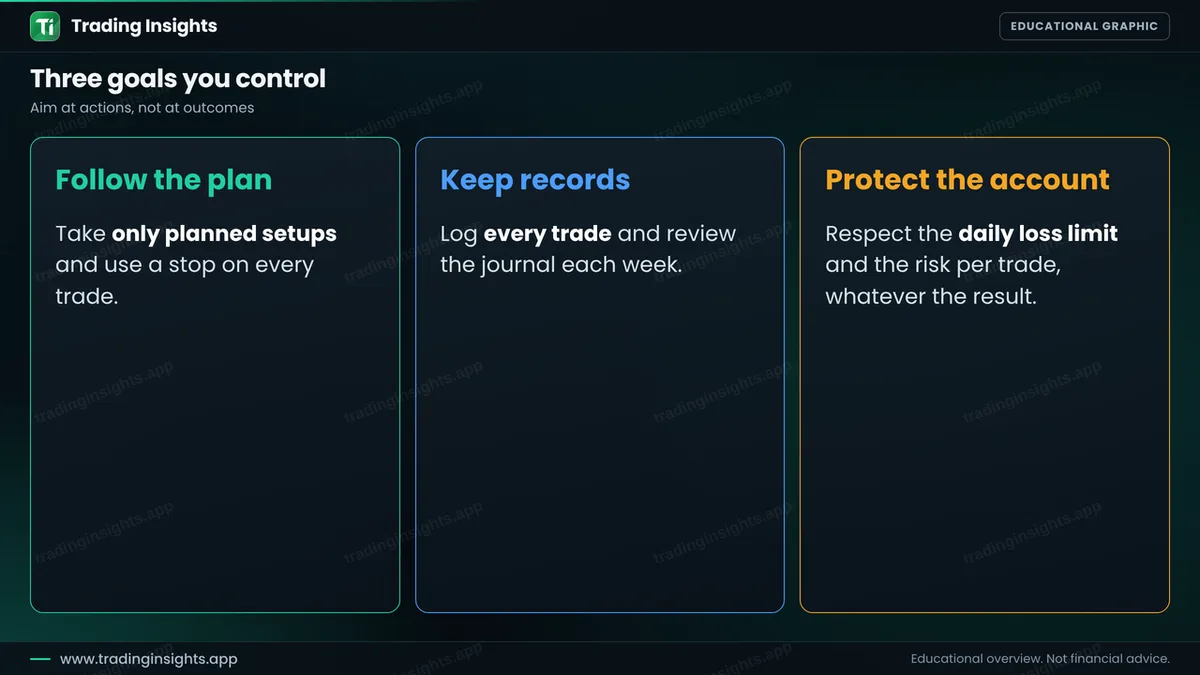
- Follow the plan. Take only planned setups, and use a stop on every trade. See how to build a forex trading plan.
- Keep records. Log every trade and review the journal each week. See the daily trading routine.
- Protect the account. Respect the risk per trade and the daily loss limit, whatever the result.
A trader who does these three things for a year has built the skill. The profits follow the skill, and the process is the only part that is fully under your control.
How to set a sensible trading target
- Start with the risk. Decide the risk per trade and the maximum drawdown that you can accept, then look at the results that these allow. The position size calculator helps with the first step.
- Use a long period. Think in terms of a year, not a week, and judge by many trades. See how to backtest.
- Treat the first months as tuition. Plan to learn, to test and to keep the loss small. See demo account vs live account.
- Do not count on trading income for bills until you have a long record of steady results.
- Revisit the goals every quarter, as your skill and account change.
- Be patient. See trading patience.
Common mistakes
- Setting a monthly income target on a small account. It forces oversized risk. Set a risk limit and a process goal instead.
- Judging a month by the profit instead of by the process. A few trades say little about skill. Score the behaviour and review the results over many trades.
- Raising the risk to catch up with a goal. This is how a bad month becomes a blown account. Keep the risk fixed, and if you are behind, take a break.
- Comparing your results with advertised returns. Such numbers are often selective and ignore risk. Compare yourself only with your own earlier records.
Frequently asked questions
How much can I realistically make trading forex?
It varies a lot, and many traders lose money. A steady strategy risking 1% per trade produces small percentage returns, which may be modest in dollars on a small account. Do not plan around a specific figure.
Is a monthly profit target a good idea?
It can push you to force trades or raise your risk. Goals about following the plan, keeping records and protecting the account are healthier. You can still track the monthly result, but as information, not as a deadline.
What is a sensible risk per trade?
Many traders risk 1% or less of the account on each trade. Choose a value you can accept losing many times in a row without changing your behaviour.
When should I trust trading income?
Only after a long record of steady results, and even then, do not rely on it for essential bills. Keep a separate cushion for living costs.
Your next step
Write down your three process goals and your maximum risk per trade on one page, then replace any profit target with them. Review the page at the end of each month.
This is education, not financial advice. Trading carries risk, and no method guarantees results. The charts are illustrative and not real market data.


