
Trading patience means waiting until your exact setup appears and doing nothing until then. It feels like wasted time, but it protects your account as much as a stop loss does. Good setups do not show up every hour, so a trader who can wait may take only a few trades a week, while one who cannot wait fills the gaps with weak ones.
Why waiting is hard
Every moment of the day the chart moves and looks like an opportunity. Screens, news and social media add to the feeling that you must be in a trade. There is also the wish to make up for a loss or to make a profit quickly.
Many of these feelings are the same ones described in FOMO in trading, overtrading and revenge trading. Patience is the answer to all three.
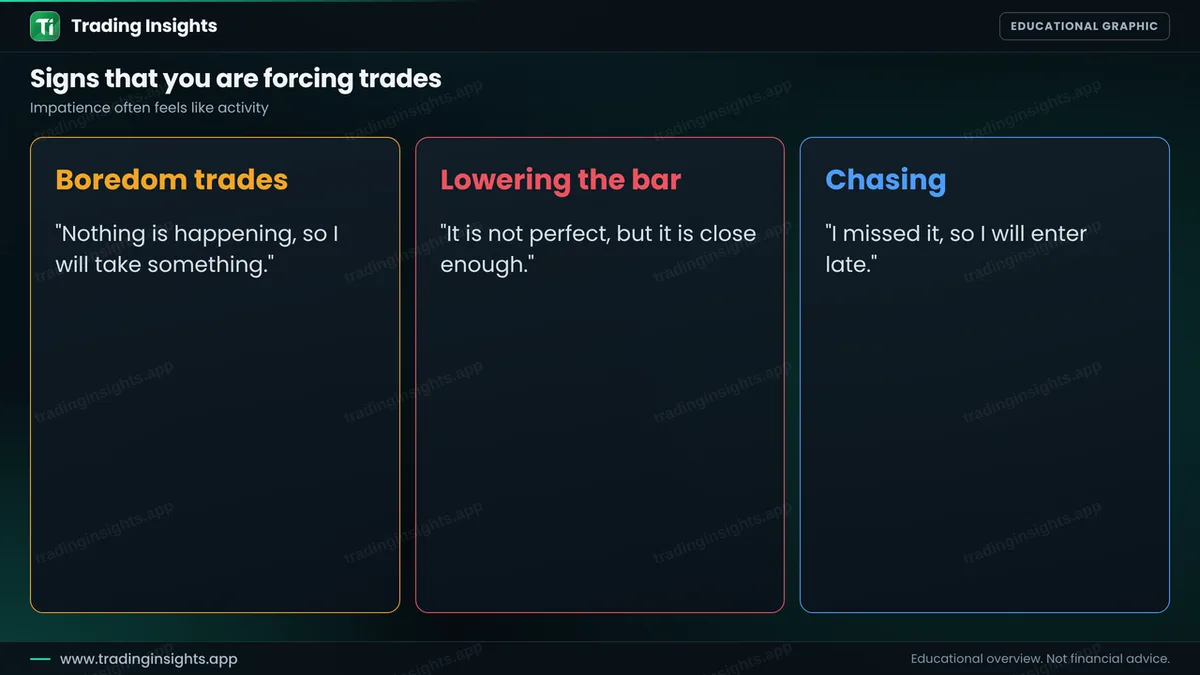
Signs that you are forcing trades
- Boredom trades. You trade because nothing is happening, not because a setup appeared.
- Lowering the bar. You accept a setup that "is almost there", missing one or two conditions of your plan.
- Chasing. You missed the entry, so you enter late, with a worse price and a wider stop.
A simple test: if you cannot say in one sentence which rule of your plan the trade satisfies, you are probably forcing it.
Illustrative example: what waiting does to a week
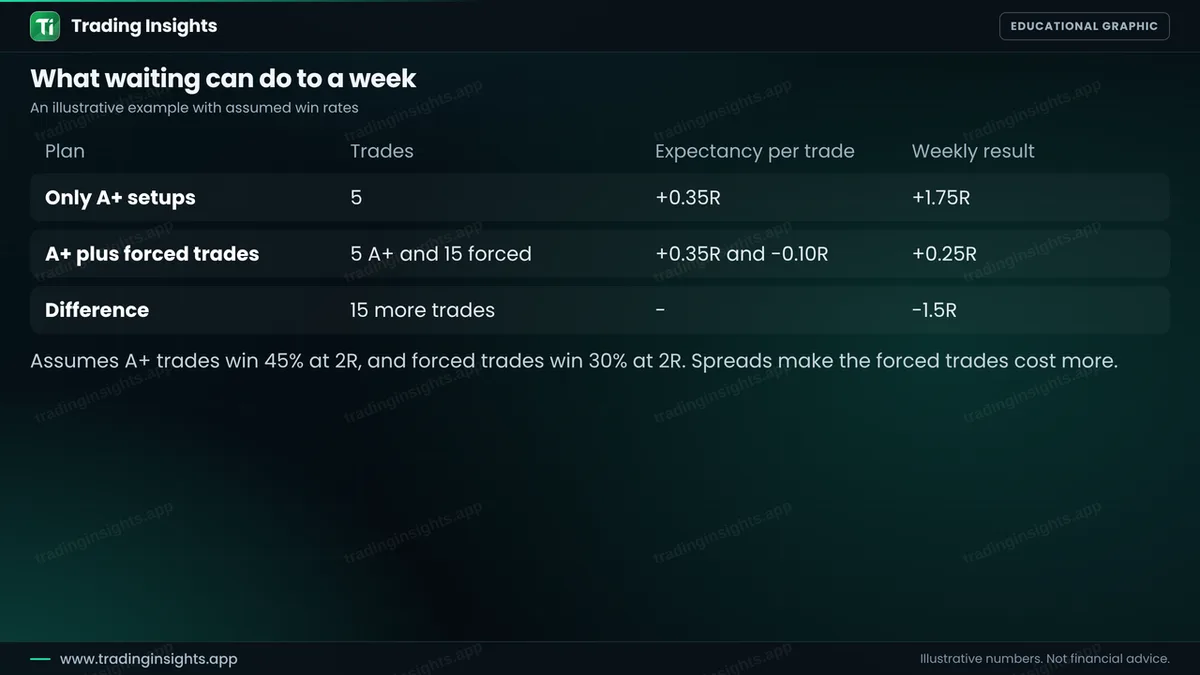
This is an illustrative example with assumed numbers. Suppose that your A+ setups win 45% of the time with a reward of 2R. The expectancy of each trade is 0.45 x 2 - 0.55 x 1 = +0.35R. Five such trades in a week give +1.75R.
Now suppose that you add 15 forced trades that win only 30% of the time at 2R. Their expectancy is 0.30 x 2 - 0.70 x 1 = -0.10R each, so 15 of them cost -1.5R. The week ends at +0.25R instead of +1.75R, and in real life the extra spreads and commissions make the gap even larger. For more on this idea, see trading expectancy and forex trading costs.
What an A+ setup looks like in practice
An A+ setup is one where every condition in your plan is met, not most of them. Suppose your rules say: trend on the H4 chart is up, price pulls back to a support level, and a bullish candle closes above the pullback high.
Price on EUR/USD reaches support, the signal candle closes, and you buy at 1.0850 with a stop at 1.0820 (30 pips) and a target at 1.0910 (60 pips), a 1 to 2 ratio. With a $10,000 account risking 1% ($100), the position size is $100 / (30 pips x $10 per pip per lot) = about 0.33 lot. A win pays about $200, and a loss costs about $100.
Notice that the trade took a few minutes to place and a few hours to wait for. That ratio is normal. You can check your own numbers with the position size calculator.
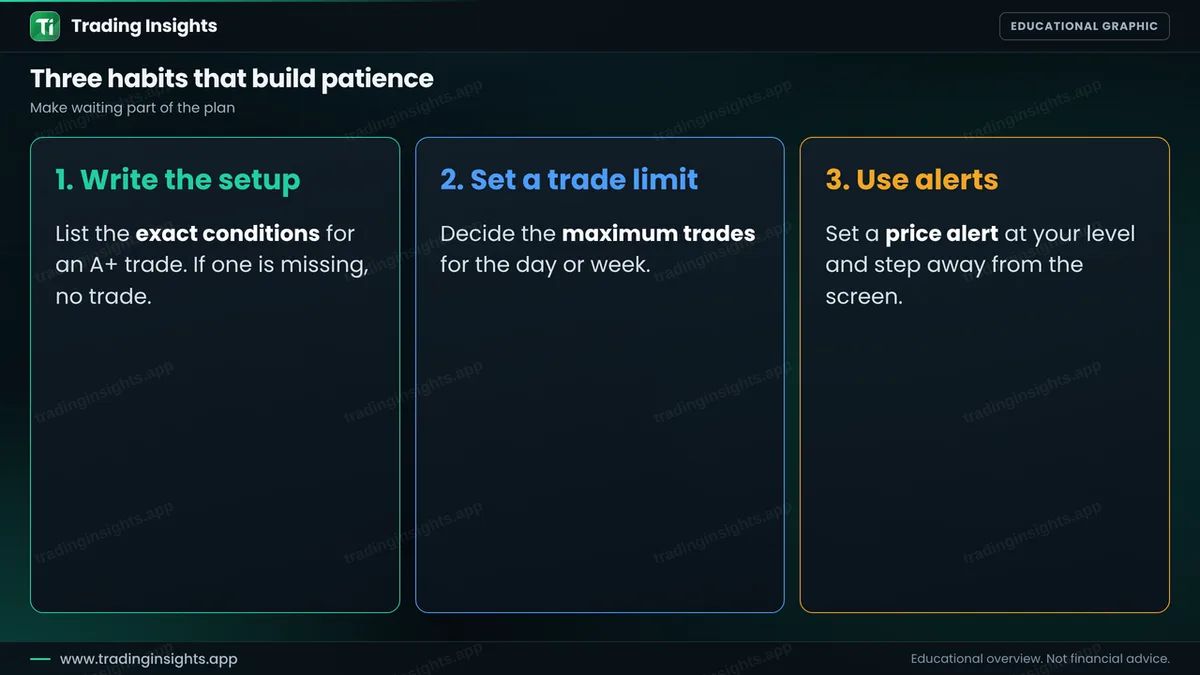
Three habits that build patience
- Write the setup. List the exact conditions for an A+ trade, for example trend, level, signal candle and ratio. If one is missing, there is no trade. Put it in your trading plan and use a checklist, as in the daily trading routine.
- Set a trade limit. Decide the maximum number of trades for a day or a week. When you reach it, stop.
- Use alerts. Set a price alert at your level and step away from the screen. You do not need to watch every tick, and it is easier to wait when you are not staring at the price.
How to be more patient when trading: other useful tips
- Use a higher timeframe. Fewer candles means fewer signals, and each one matters more. See top-down analysis.
- Count the no-trade days. In your journal, mark days when you did nothing because there was no setup, and treat them as a success.
- Review your weakest trades. Find out if they were forced, and what you were feeling at the time.
- Set a daily loss limit. It stops a series of weak trades from becoming a large loss. See daily loss limit.
- Test your setup. If you know how often it appears, you will know how long to wait. See how to backtest.
Common mistakes
- Counting a day without trades as wasted. No trade is a decision, and it often saves money. Mark it as a success in your journal.
- Lowering the standards after a few quiet days. Quiet stretches are normal. Keep the same checklist, or the weak trades will cost more than the wait.
- Entering late because of fear of missing out. A late entry has a worse price and a wider stop. Wait for the next pullback or skip it.
- Switching strategies when the setup does not appear. Check your backtest to see how long gaps between setups can last before you change anything.
Frequently asked questions
Why is patience important in trading?
Because good setups are not constant. Waiting for them avoids lower-quality trades that add costs and losses.
How many trades per week is right?
It depends on your strategy and timeframe. A strategy on higher timeframes may have only a few trades a week, and that is normal. Judge a week by the quality of the trades, not the number.
What should I do when there are no setups?
Do nothing, review your journal, study, or mark levels for later. No trade is a valid decision.
How can I stop forcing trades?
Write down the exact conditions of your setup, set a limit on the number of trades, and use alerts instead of watching the screen all day.
Your next step
Write your A+ setup as a checklist of four or five conditions and keep it next to your chart. Tomorrow, take a trade only if every box is ticked, and note in your journal each time you chose to wait.
This is education, not financial advice. Trading carries risk, and no method guarantees results. The charts are illustrative and not real market data.


