
Averaging down means adding to a position after price has moved against it, so that the average entry price improves. It feels sensible: if you liked the trade at 1.1000, you must like it more at 1.0950. The flaw is that the market has just told you the trade is not working, and you respond by increasing the size. The loss you can suffer grows exactly when you are wrong, and without a hard stop it has no ceiling.
Why it feels right and why it hurts
The appeal is arithmetic. After a second purchase at a lower price, the break-even level moves closer to the current price, so price only needs a partial recovery for the trade to end at zero. That is true, and it is the trap. Your position is larger, so each further pip against you costs more, and the account carries more risk than your plan allowed. See why deep drawdowns are hard to recover from for the maths of what a large loss demands afterwards.
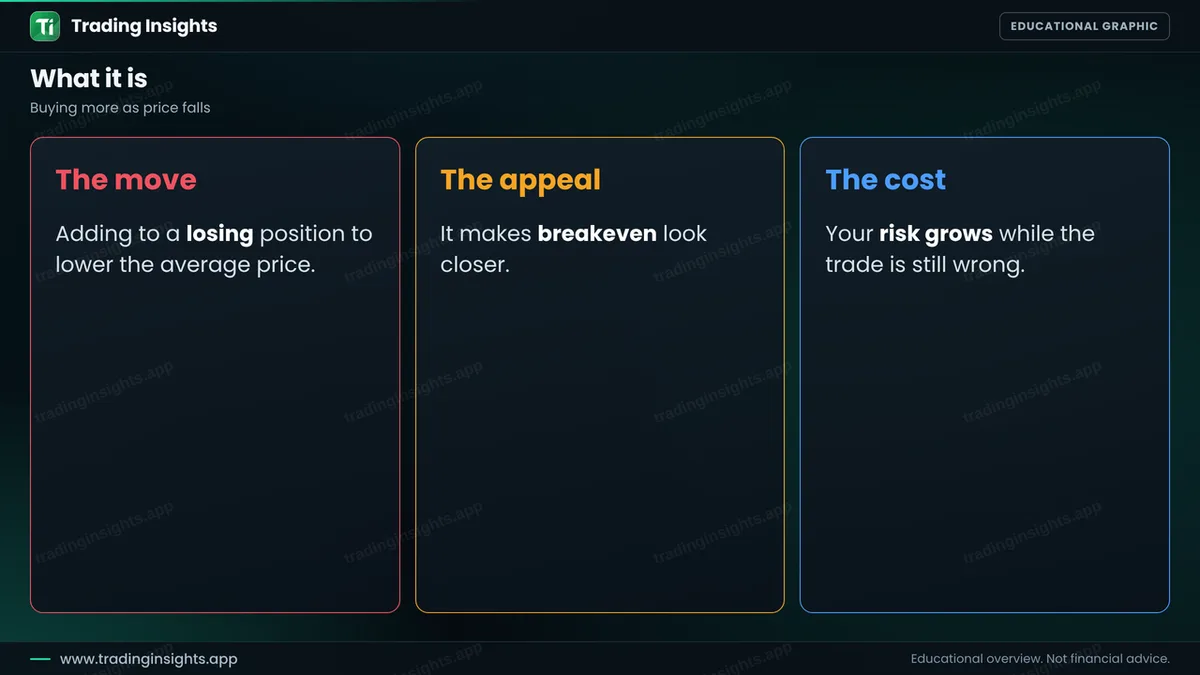
The psychology works against you too. Adding to a loser is often a way to avoid admitting a mistake. A stop-loss turns a wrong idea into a small, known cost. Averaging down turns it into a growing bet that the market will come back, and markets do not owe anyone a return to the entry price.
The mechanics of the extra risk
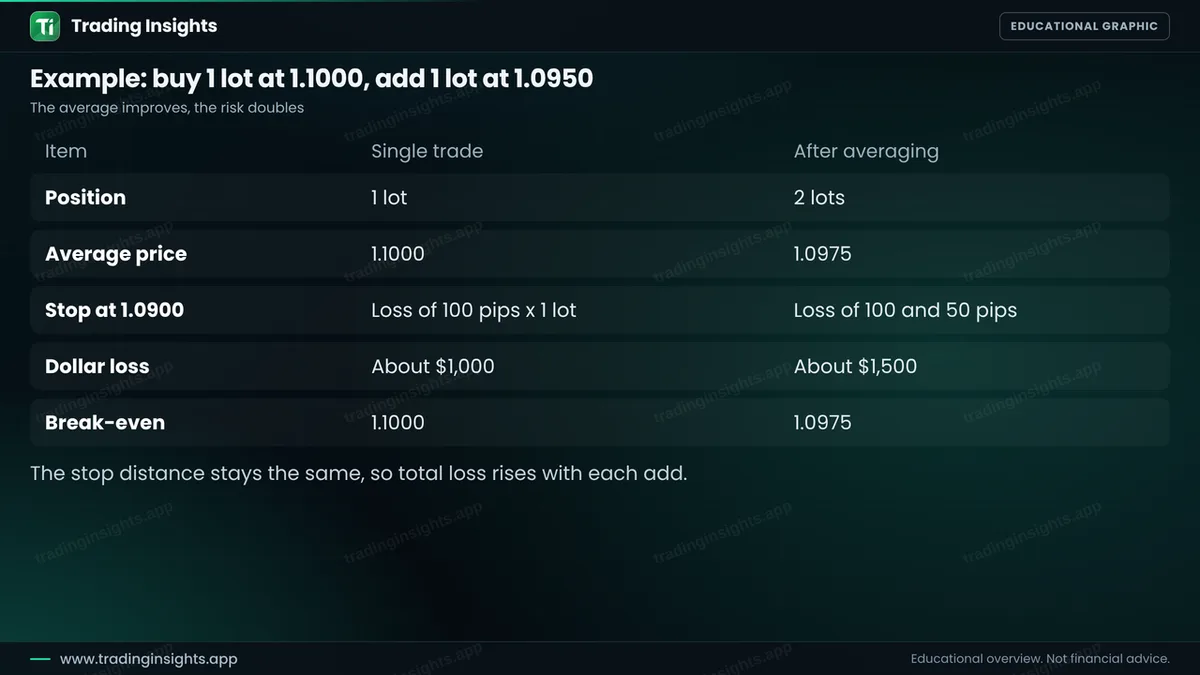
Suppose a trade carries a fixed stop. The loss at the stop equals the size times the distance. If you add the same size 20 pips lower and leave the stop where it was, the second half has a stop that is only 20 pips away, but the first half still loses its full distance. The total at the stop is larger than the one planned. If the stop is moved lower to make room, the risk grows again. In both cases the planned risk has been exceeded.
When adding is different from averaging down
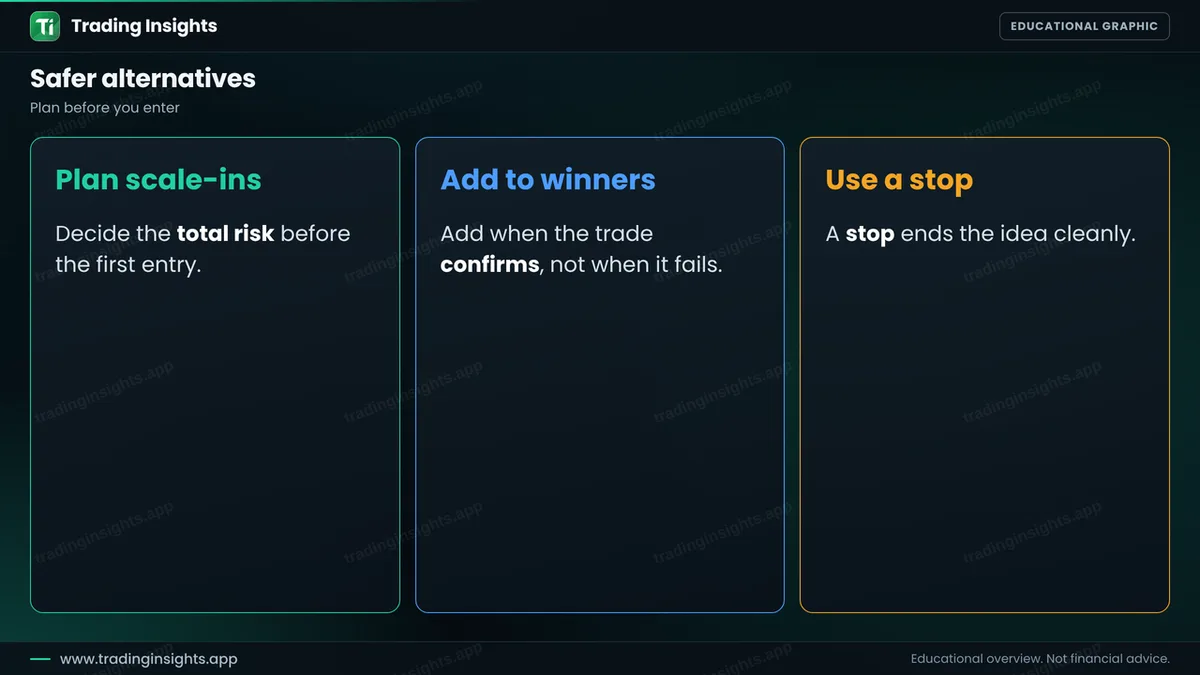
A planned scale-in is a separate technique. If you decide in advance that you will enter in two parts, size both parts so that the total loss at a single common stop equals your risk limit, and place the stop before you enter, you are not hoping. You are building a position. A useful test is to ask: if I were flat right now, would I open the second position at this price? If the answer is no, you should not add.
The distinction is who decides. In a planned entry, the plan decides, before the trade. In averaging down, the loss decides, after the trade has gone wrong. See also scaling into winning trades for the safer direction of adding.
A safer process
- Fix the total risk first. Decide the amount, such as 0.5% of the account, before you click.
- Place the stop where the idea is proved wrong, and keep it there. Never move it further away after adding.
- Size from the stop, using the position size calculator, so that one loss at the stop is the planned amount.
- Add only to winners, in smaller size, once price has confirmed the idea and the stop can be moved to protect the position.
- Accept the loss when the stop is hit, record it, and wait for a new setup rather than re-entering at once.
Two illustrative examples
Both examples are hypothetical. They use a $25,000 account risking 0.5% ($125) per trade.
Illustrative example 1: a win with fixed size and no adding
A trader buys AUD/USD at 0.6700 at a support level, with a stop at 0.6660 (40 pips) and a target at 0.6780 (80 pips). With a $25,000 account risking 0.5% ($125), the position size is $125 / (40 pips x $10 per pip per lot) = about 0.31 lot. A win of 80 pips pays about $248; a loss costs about $124.
Price rises and the target is reached. The trader never needed to add, because the risk was set correctly at the start. The result is twice the money risked, and the account ends above where it began.
Illustrative example 2: a loss made larger by averaging down
The same trader takes the same trade, but price falls to 0.6680 and the trader buys another 0.31 lot "to improve the average". The average entry is now 0.6690. With a $25,000 account risking 0.5% ($125), the position size is $125 / (40 pips x $10 per pip per lot) = about 0.31 lot. A win of 80 pips pays about $248; a loss costs about $124 for the original size alone.
The stop at 0.6660 is hit. The first 0.31 lot loses 40 pips, about $124. The second loses 20 pips, about $62. The total is about $186, or roughly 0.74% of the account instead of the planned 0.5%. Now suppose the trader had moved the stop to 0.6620 to "give it room": the same two positions would lose about $434 combined (80 pips on the first lot and 60 on the second), far beyond the plan. The better outcome was to accept $124 and move on.
Common mistakes
- Adding without a stop. With no exit, the loss can grow until the account is hit. Always set the stop before the first entry.
- Using the second entry to avoid taking a loss. This is hope, not strategy. Close the trade when the idea is invalid.
- Doubling the size each time. This is the martingale approach, and a short losing run can create a loss too large to survive. Keep size tied to a fixed risk percentage.
- Letting a small loss become a margin call. Larger positions use more margin and push the account towards forced closing. Check free margin and keep risk small.
- Moving the stop after adding. Changing the stop to fit the new position breaks the original risk plan. If the stop must move, the trade is no longer the one you planned.
Pre-trade checklist for adding to a position
- Did I define the total risk before the first entry?
- Is my stop set at a level that proves the idea wrong?
- Is the position I am adding to in profit, not in loss?
- Would I open this exact trade if I were flat now?
- After adding, is the total loss at the stop still within my risk limit?
- Have I checked margin and the spread cost of another entry?
Frequently asked questions
What is averaging down?
It means buying more of an asset after price falls, so the average entry price becomes lower. The aim is to bring break-even closer, but the position gets larger while the original idea is still failing.
Is averaging down always a mistake?
Adding to a loser without a plan and a stop is dangerous. A scale-in planned in advance, with fixed total risk and a common stop, is a different method and is acceptable if the numbers hold.
Why does it increase risk?
Because more money is exposed while price is moving against you. Each extra pip of adverse movement costs more than before, and the stop either stays and loses more or is moved and risks more.
What should I do instead?
Define your total risk first, use a stop that proves the idea wrong, and add only to winning trades. If the stop is hit, take the loss and wait for the next setup.
How does averaging down relate to the martingale?
A martingale doubles the position after every loss. Averaging down without a limit follows the same logic, and both can turn a series of small losses into one very large one.
This content is educational only and is not financial advice. Trading carries risk of loss, and adding to a losing trade can enlarge that loss quickly. The examples are hypothetical and not real market data.


