
Most trading accounts do not die from one bad trade. They die from one bad day, when a trader keeps trading to win back a loss, and each new trade is bigger and worse than the last. A daily loss limit is a simple rule that stops this. It says: if I lose this much today, I stop, and I come back tomorrow.
What is a daily loss limit?
It is a fixed amount or percent of your account that you are willing to lose in one day. When you reach it, you close your platform and stop trading until the next day. The limit is decided before the trading day, when you are calm. A common choice is two to three times your risk per trade. If you risk 1% on each trade, a limit of 3% means that three full losses end your day.
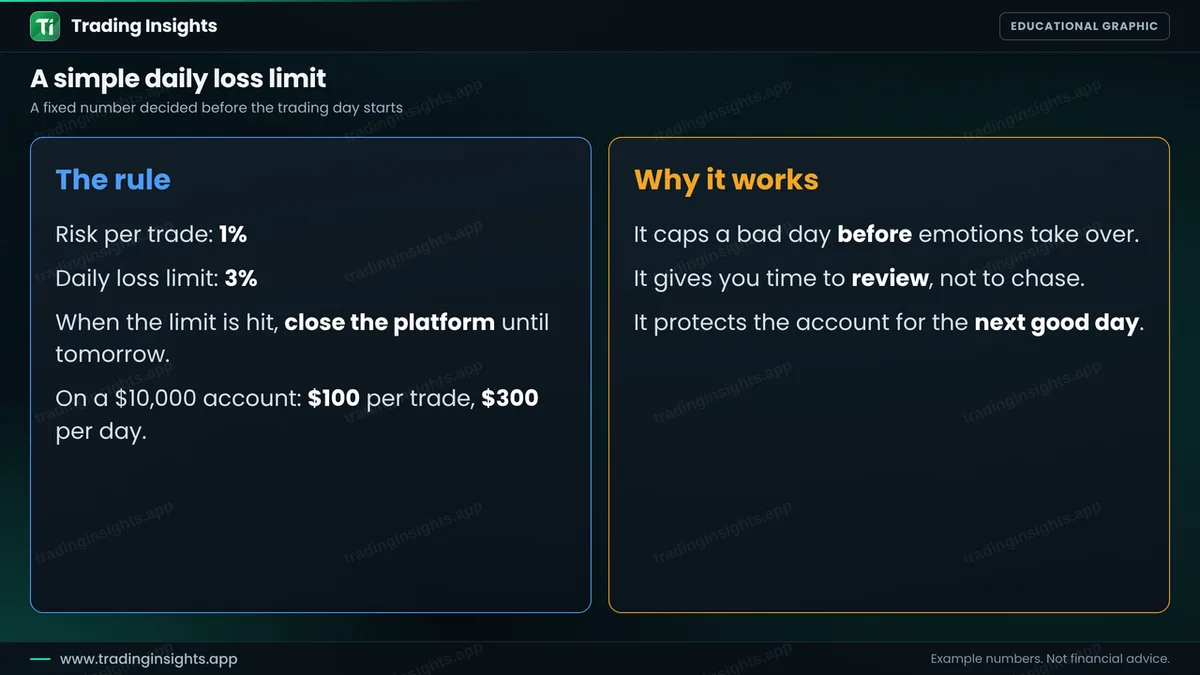
On a $10,000 account, 1% is $100 per trade, and a 3% daily limit is $300. The numbers are examples. Your own limit should fit your account, your strategy and your temperament.
Why losses are harder to recover than they look
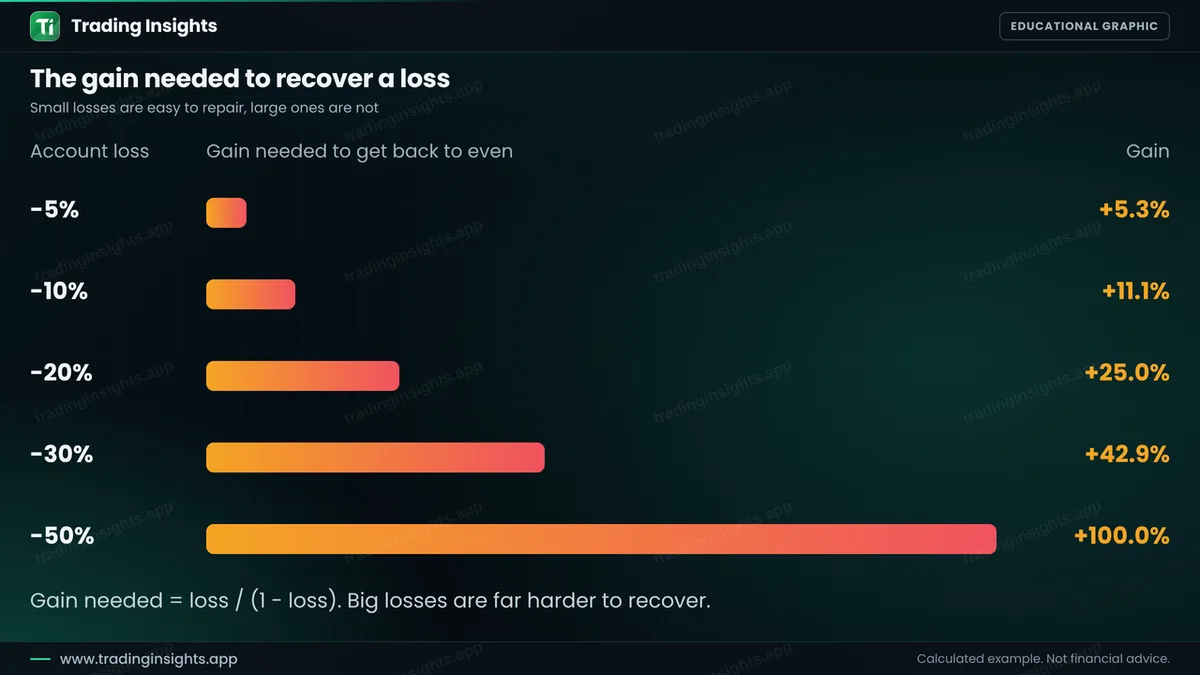
A loss of 10% needs a gain of 11.1% to get back to even. A loss of 50% needs a gain of 100%. The formula is simple: gain needed = loss / (1 - loss). This is the reason why large losses are so dangerous. A big loss is not only a bad day. It makes the road back much longer. See drawdown and risk of ruin.
The same bad day, with and without a limit
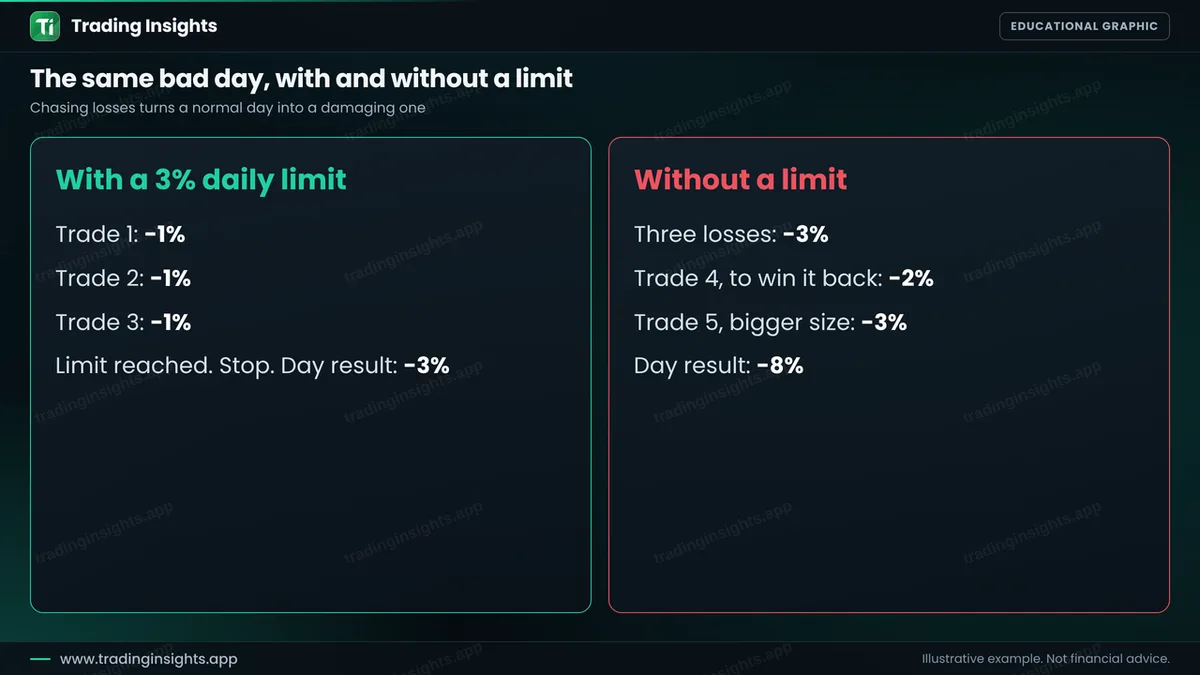
The example shows the point. Three losses in a row can happen even to a good strategy. See losing streaks. With a limit, the day ends at -3%. Without it, the trader tries to win the money back with bigger trades, and the day ends at -8%. This behaviour is called revenge trading, and the limit is a tool against it. Read more in revenge trading.
How to set your limit, step by step
- Decide your risk per trade. Many traders use 0.5% to 1%.
- Choose the daily limit. Two to three times the risk per trade is a common range.
- Write it down. Put it in your trading plan. See how to build a trading plan.
- Count open trades. If you have trades open, include their risk in the total.
- Make it automatic. Close the platform, or use a tool that blocks new orders after the limit.
- Review the day. After a limit day, write what happened in your journal before the next session.
You can use the position size calculator to size each trade so that the risk fits your rule.
Other limits to consider
- A weekly limit. For example, if you lose 6% in a week, stop until Monday.
- A limit on the number of trades. This helps against overtrading.
- A limit after consecutive losses. For example, a pause after three losses in a row.
Common mistakes
- Setting a limit and moving it when you are losing.
- Making the limit so large that it protects nothing.
- Making it so small that normal variance triggers it every day.
- Forgetting to count floating losses of open trades.
- Opening a second account to keep trading after the limit.
Frequently asked questions
What is a good daily loss limit?
Many traders use two to three times their risk per trade, for example 2% to 3% when risking 1%. The best number fits your strategy and your psychology.
Should I stop trading after I hit the limit?
Yes. The rule is only useful if you follow it. Close the platform and review the day instead of trading more.
Does a daily limit reduce my profits?
It can cut a few days short, but it also prevents the big losses that wipe out many good days. Over time, many traders find that it helps.
Is a weekly limit also needed?
It can help if you tend to lose over several days in a row. It is a second layer of protection.
Trading involves risk. This is education, not financial advice. The charts are illustrative and not real market data. Trading carries risk, and no method guarantees results.


