
A daily forex trading routine is a fixed set of checks before the market, before each order and after the session. It does not make you win every trade, but it makes your days similar, your decisions calmer and your mistakes easier to find. A good routine takes about ten minutes before trading and ten minutes after, and it can be a single page. This guide gives you a pre-market checklist, a five-question order check and an end-of-day review you can copy.
Why a trading routine helps
Many traders open the chart, look for something exciting, and trade. Some days it works and some days it does not, and they cannot say why. A routine removes much of this chaos.
A trading plan tells you what to trade. A routine tells you how to run your day. Together they protect you from the usual traps: trading without preparation, taking random setups, and repeating the same error without noticing. See how to build a forex trading plan for the plan itself.
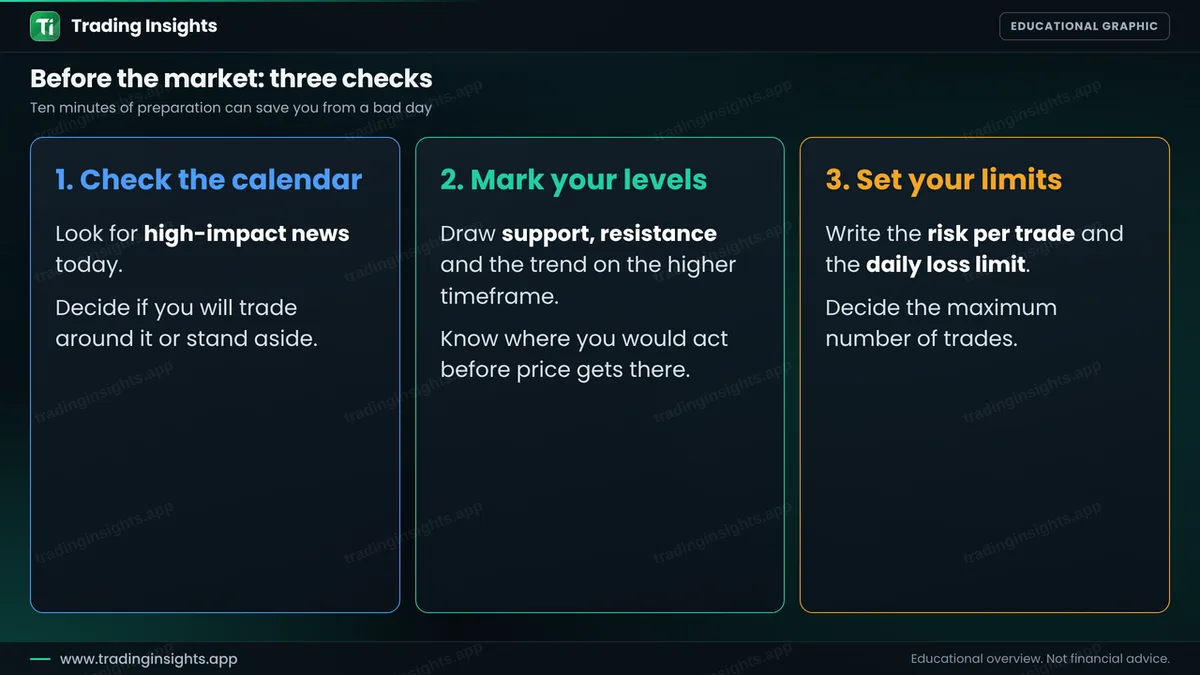
Pre-market checklist: three checks
- Check the calendar. Look for high-impact news in your pairs. Decide whether you will trade around it or stand aside. See trading forex news.
- Mark your levels. Start with the higher timeframe, then move down, as in top-down analysis. Mark support, resistance and the trend. Know where you would act before price gets there.
- Set your limits. Write down the risk per trade, the maximum number of trades and your daily loss limit. Decide these when you are calm, not in the middle of a trade.
Also check the session. Your plan may be best suited to the London or New York hours, so you do not need to watch the screen all day. See forex trading sessions.
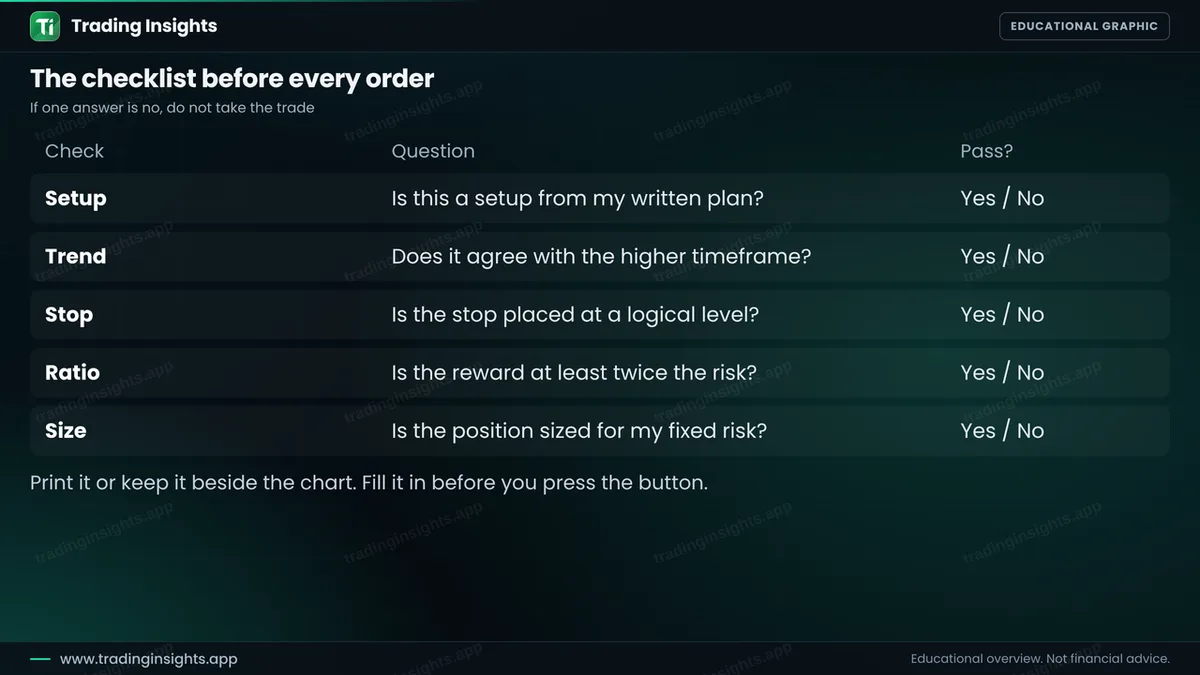
Before every order: five questions
A short checklist stops impulse trades. Ask yourself:
- Is this a setup from my written plan?
- Does it agree with the higher timeframe?
- Is the stop at a logical level?
- Is the reward at least twice the risk? See risk to reward ratio.
- Is the position sized for my fixed risk? See how to calculate position size.
Use the position size calculator to do the last step in seconds.
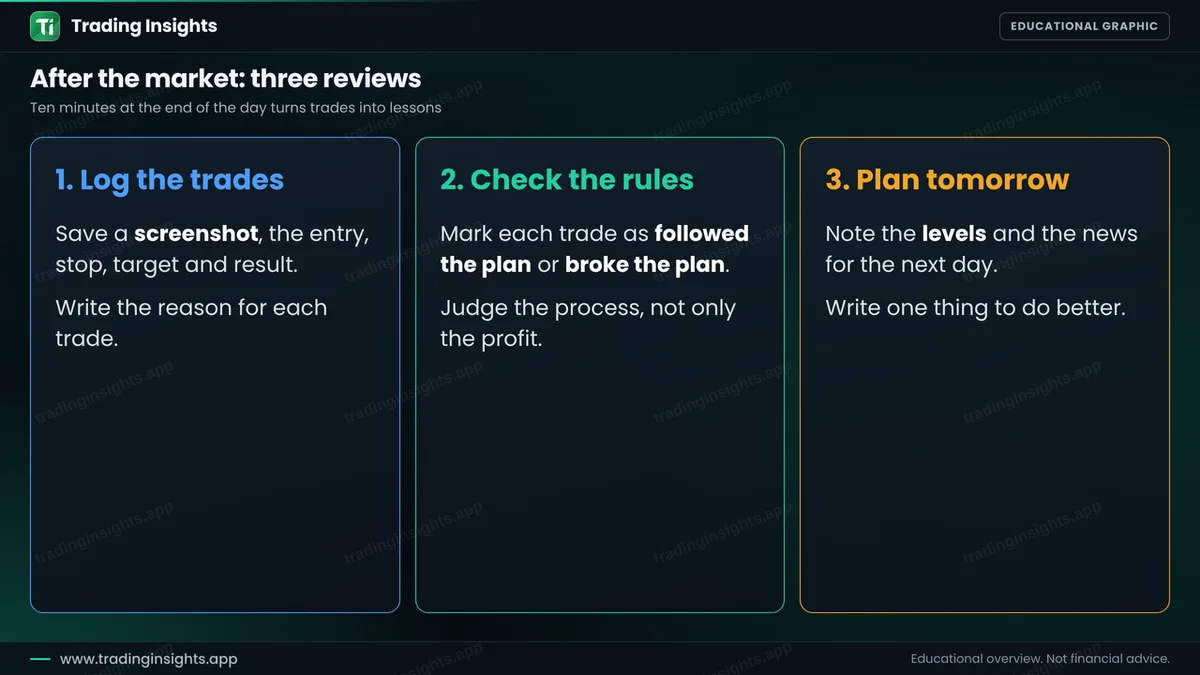
End-of-day review: three steps
- Log the trades. Save a screenshot, the entry, the stop, the target and the result. Write the reason for the trade in one line.
- Check the rules. Mark each trade as "followed the plan" or "broke the plan". A winning trade that broke the plan is still a problem, as explained in overconfidence in trading.
- Plan tomorrow. Note the levels, the news and one thing to do better.
Illustrative example: a day and a week in numbers
This is an illustrative example with simple numbers. With a $10,000 account risking 1% ($100) per trade, a trader sets a daily loss limit of 2% ($200) and a maximum of three trades. Trade one is a 30-pip stop on EUR/USD, sized at $100 / (30 pips x $10 per pip per lot) = about 0.33 lot. It loses about $100. Trade two also loses about $100, so the daily limit is reached and the trader stops, even though a third setup appears.
At the end of the week, the journal shows 10 trades: 4 wins of about 2R and 6 losses of 1R. The result is 4 x 2R - 6 x 1R = +2R, which is about $200 at $100 per R, or 0.2R per trade on average. A trader who ignored the limit and kept trading on the bad day could have turned a normal losing day into a much larger one.
A weekly addition
- Look at the numbers. Count the trades, the win rate and the average R. See trading expectancy.
- Find your most common mistake and make it the single focus of the next week.
- Rest. Take at least one full day away from the charts. Tired traders make poor decisions, see overtrading.
Keeping the routine simple
- Use a one-page checklist, not a long manual.
- Do the routine at the same time every day.
- Stop trading when you reach your limits, even if you feel good.
- After a bad day, do the review first and trade again only when you are calm. See revenge trading.
Common mistakes
- Skipping the routine on busy days. Those are the days it is most needed. Shorten it, do not drop it.
- Making the checklist so long that you stop using it. Keep it to one page and a handful of questions.
- Writing a journal but never reading it. Review it weekly and pick one thing to fix.
- Reviewing only the losing trades. Winners that broke the rules matter too. Review all of them.
Frequently asked questions
What should a forex trading routine include?
A pre-market check of news and levels, a checklist before each order, and an end-of-day review of the trades and the rules.
How long should the routine take?
About ten minutes before the market and ten minutes after it is enough for most traders.
Do I need a trading journal?
A journal makes the review much more useful, because you can see patterns in your behaviour. Even a simple spreadsheet or notebook is enough.
Can a routine improve my results?
It cannot guarantee profits, but it improves consistency and helps you find and fix repeated mistakes.
Your next step
Write a one-page checklist today with your three pre-market checks, your five order questions and your three review steps. Print it or pin it next to your screen, and use it for the next five trading days.
This is education, not financial advice. Trading carries risk, and a routine does not remove it. The charts are illustrative and not real market data.


