
Should you start with a demo account or with real money? Use both, in that order: a demo account is the right place to learn the platform and prove a plan, and a small live account is the right place to find out how you behave when money is at stake. A demo account is a very good tool, but it is not a copy of live trading. This article explains what a demo account can teach, what it cannot, and how to move to a live account without a shock.
What a demo account is
A demo account is a practice account that uses virtual money and real market prices. You can open trades, set stops and targets, and see your results without risking your own money. Most brokers offer one for free, although some limit it in time, so check the terms.
It looks and works like a live account, which makes it ideal for learning how a platform behaves. Think of it as a flight simulator: useful, safe, and not quite the same as the real aircraft.
What a demo account is good for
Use a demo account to learn the platform and the order types, see forex order types. Use it to test a strategy on live prices, and to practise position sizing and stops, see how to calculate position size. It is a safe place to make mistakes, and the mistakes cost nothing.
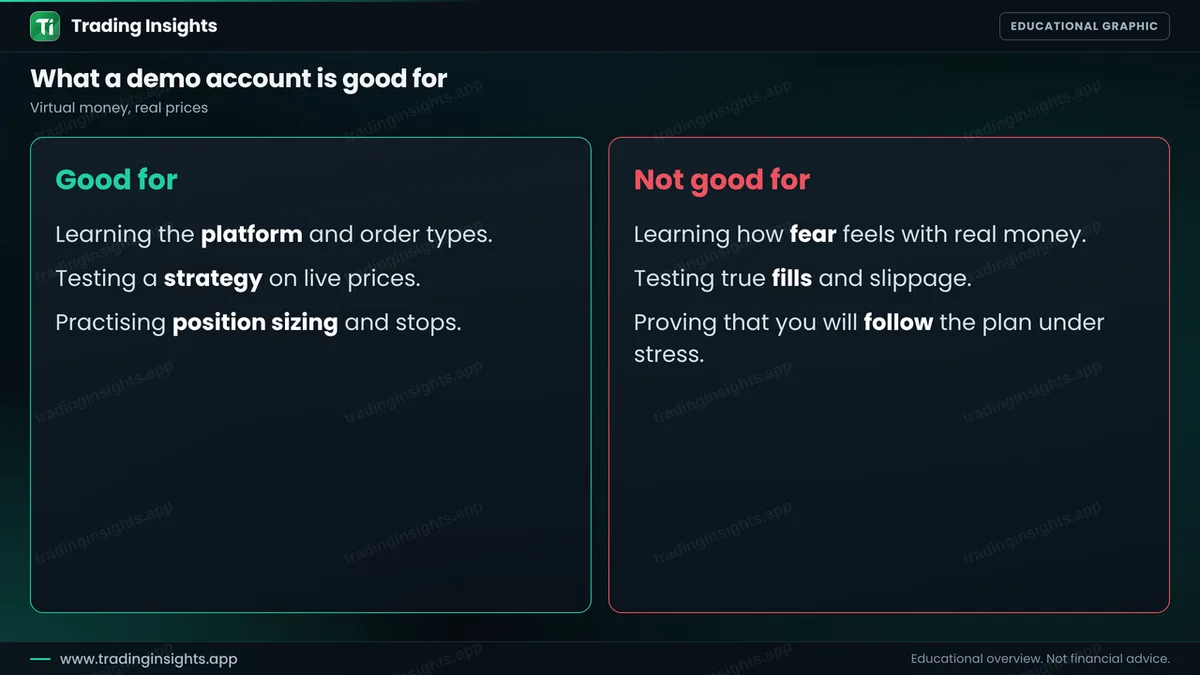
But it cannot teach you everything. Virtual money does not feel like real money, so you cannot learn how fear and greed affect your decisions. Order fills on demo are often perfect, so you may not learn about slippage. And it is easy to ignore your rules when nothing is at stake.
Demo vs live account: what changes
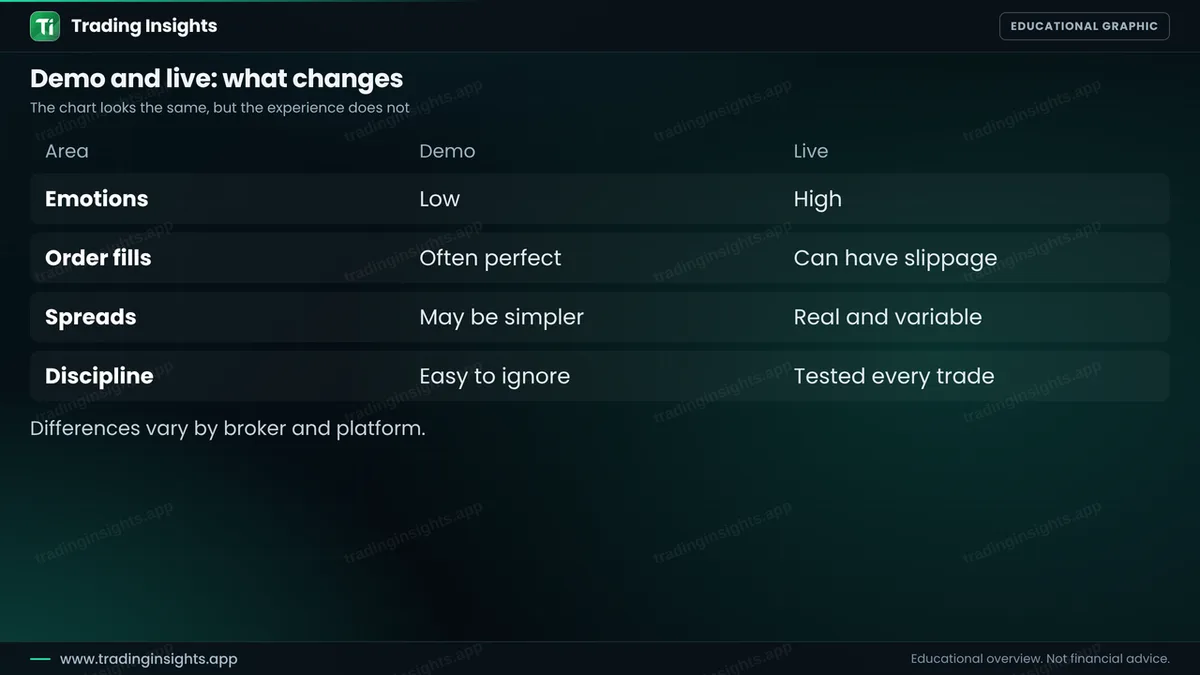
The biggest change is emotional. A trader who is calm on demo can freeze, rush or break rules on live, even with a tiny position. See trading hesitation and FOMO in trading.
The other differences are practical. Live accounts can have slippage and real, variable spreads, and the broker's rules apply to every order. The same strategy can therefore give slightly worse results live than it did on demo, even before emotions enter the picture.
How to move from demo to live in three steps
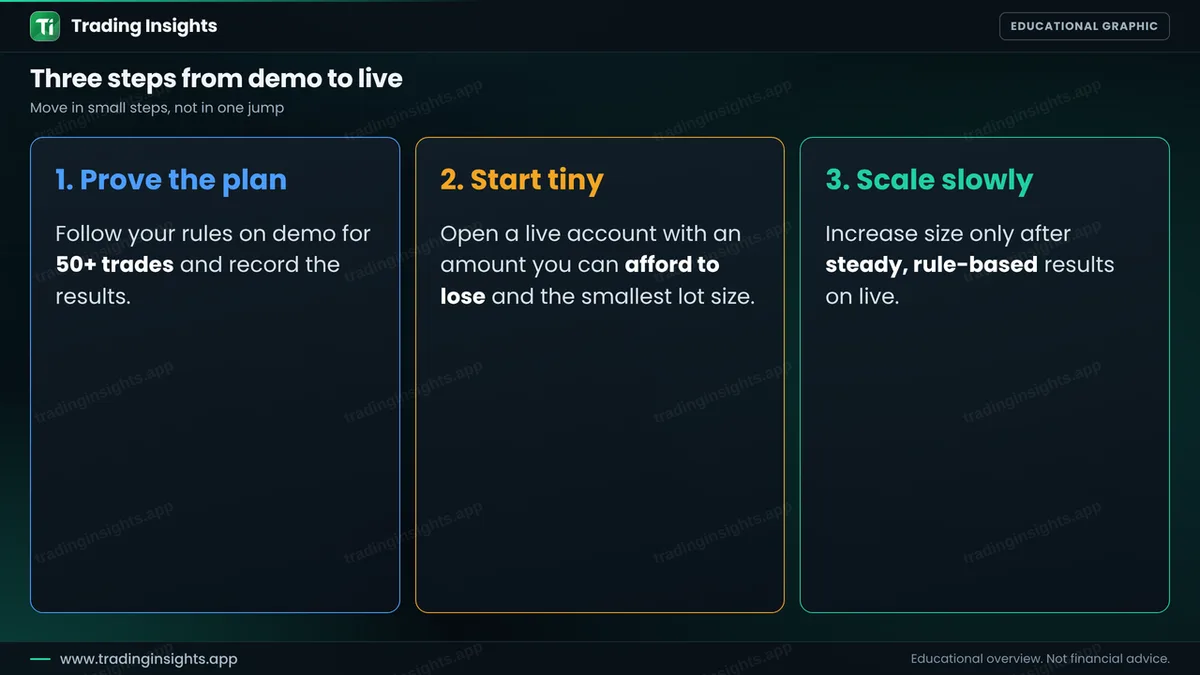
- Prove the plan on demo. Write a clear plan, see how to build a trading plan, and follow it for at least 50 trades. Record every result in a journal. If you cannot follow your rules on demo, you will not follow them on live.
- Start tiny on live. Open a live account with an amount you can afford to lose, and use the smallest lot size. The goal is to learn how you behave with real money, not to earn. See trading with a small account.
- Scale slowly. Increase the size only after a period of steady, rule-based results on live. Do not increase the risk per trade because of a few wins. See overconfidence in trading.
How to make demo more realistic
- Use a realistic balance. If you will trade $1,000, set the demo balance to $1,000, not $100,000.
- Risk a fixed percent. Use the same risk per trade you plan to use live.
- Keep a journal. Write the reason for each trade and the result.
- Respect your daily limit. See daily loss limit.
- Do not reset the account after a loss. Treat the demo money as real.
Illustrative example: the same trade at demo size and live size
This is an illustrative example, not a real trade. A trader plans to go live with $1,000. On demo, the balance was $100,000, so risking 1% meant $1,000 per trade, and the positions were huge. On live, 1% is only $10.
Take a EUR/USD buy with a 25-pip stop and a 50-pip target. With a $1,000 account risking 1% ($10), the position size is $10 / (25 pips x $10 per pip per lot) = 0.04 lot. A win pays about $20, and a loss costs about $10.
The numbers look small, and that is the point. The first weeks on live are for learning how a $10 loss feels, and whether you still follow your plan when it happens.
Common mistakes
- Staying on demo for years. Demo cannot teach emotional control. After you have proven the plan, move to a small live account.
- Going live after a few good demo days. A short streak proves little. Wait for at least 50 trades with a journal.
- Trading huge demo positions. If you would never open the size live, do not open it on demo. Match the balance and the risk per trade.
- Depositing too much on day one. Start with money you can afford to lose and the smallest lot size, then scale after steady results.
Frequently asked questions
Is a demo account free?
Most brokers offer demo accounts for free, although some limit them in time. Check the terms of your broker.
How long should I trade on demo?
Long enough to follow your plan for at least 50 trades and to show consistent results. The number of trades matters more than the number of days.
Are demo results the same as live results?
Not exactly. Demo does not include the emotions of real money, and fills and spreads can be different, so live results are usually harder.
Can I skip the demo account?
You can, but it is a free way to learn the platform and test a plan. If you go straight to live, use a very small size.
Your next step
Set your demo balance to the amount you plan to trade live, then size every trade with the position size calculator and log it in a journal. Come back to the question of going live after 50 trades.
This is education, not financial advice. Trading carries risk, and no method guarantees results. The charts are illustrative and not real market data.


