
Sooner or later, every trader hits a losing streak. Three, five, maybe ten losses in a row. It does not mean that the strategy is broken or that you are bad at trading. It is a normal part of probability. What matters is whether your account and your mind can survive it. This article shows the numbers so that a streak does not come as a surprise.
How likely is a losing streak?
If each trade is independent, the chance of N losses in a row is (1 - win rate) to the power N. A strategy that wins 40% of the time loses 60% of the time. The chance of three losses in a row is 0.6 x 0.6 x 0.6 = 21.6%. That is more than one in five.
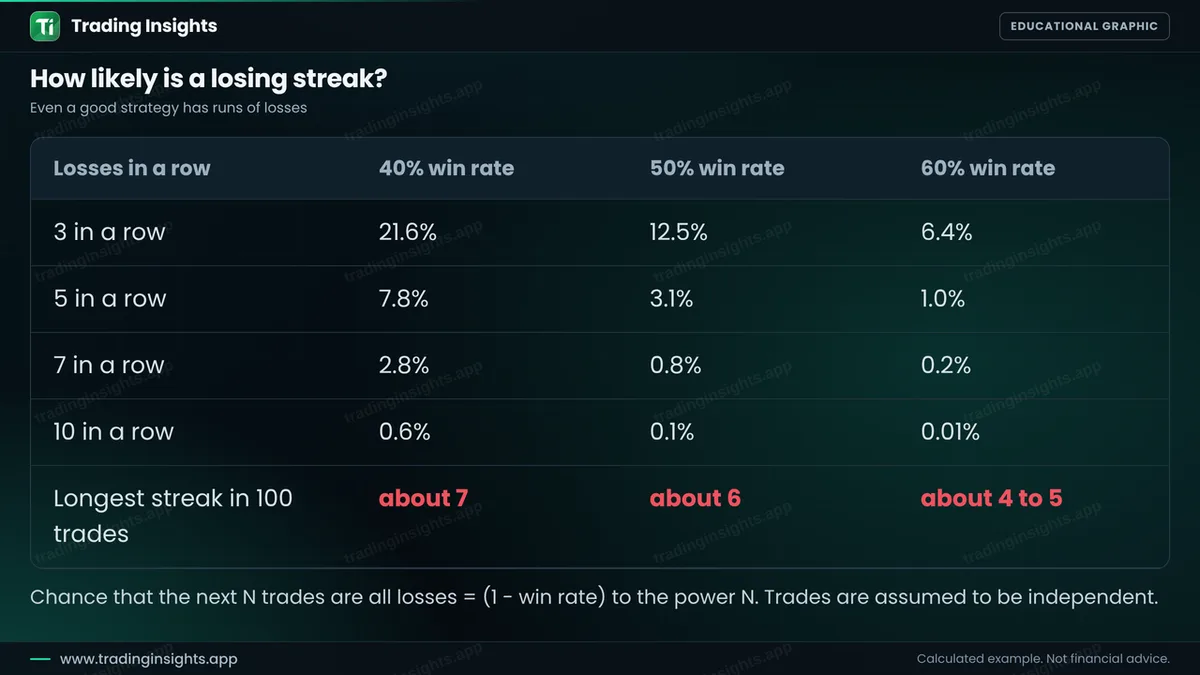
Over a long series, these chances add up. In 100 trades, the longest losing streak is about seven for a 40% win rate, about six for 50%, and about four to five for 60%. The numbers are approximate, but the message is clear: a streak of five losses is not rare. If your plan cannot handle it, the plan is too fragile.
What a streak does to your account
The damage depends on your risk per trade. After N losses at a risk of r per trade, the balance is (1 - r) to the power N of the start. So the drop is easy to calculate.
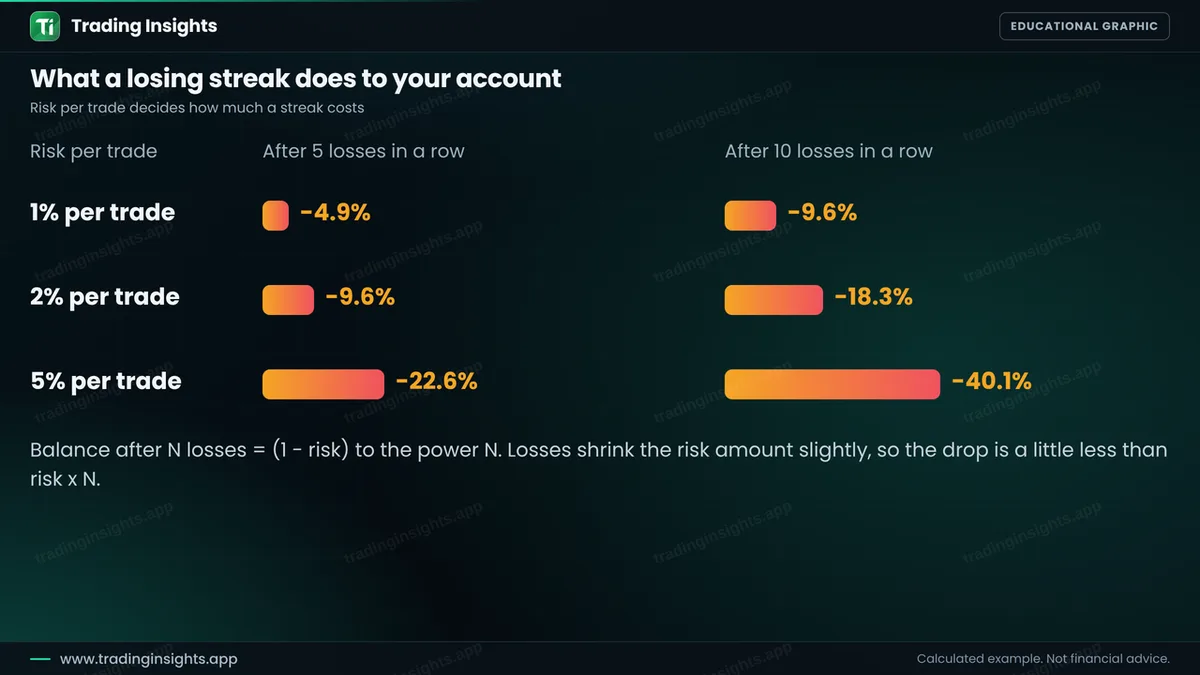
At 1% risk, five losses cost 4.9% and ten cost 9.6%. That hurts, but you can recover. At 5% risk, five losses cost 22.6% and ten cost 40.1%. To recover 40%, you need a gain of 67%. See drawdown and risk of ruin. This is why most traders risk 1% or less per trade.
Why a streak is hard on the mind
- Doubt. You start to think that the strategy has stopped working.
- The urge to change. You tweak the rules after every loss.
- The urge to recover. You raise the size to win it back. See revenge trading.
- Fear. You skip good setups, and then the winner arrives without you.
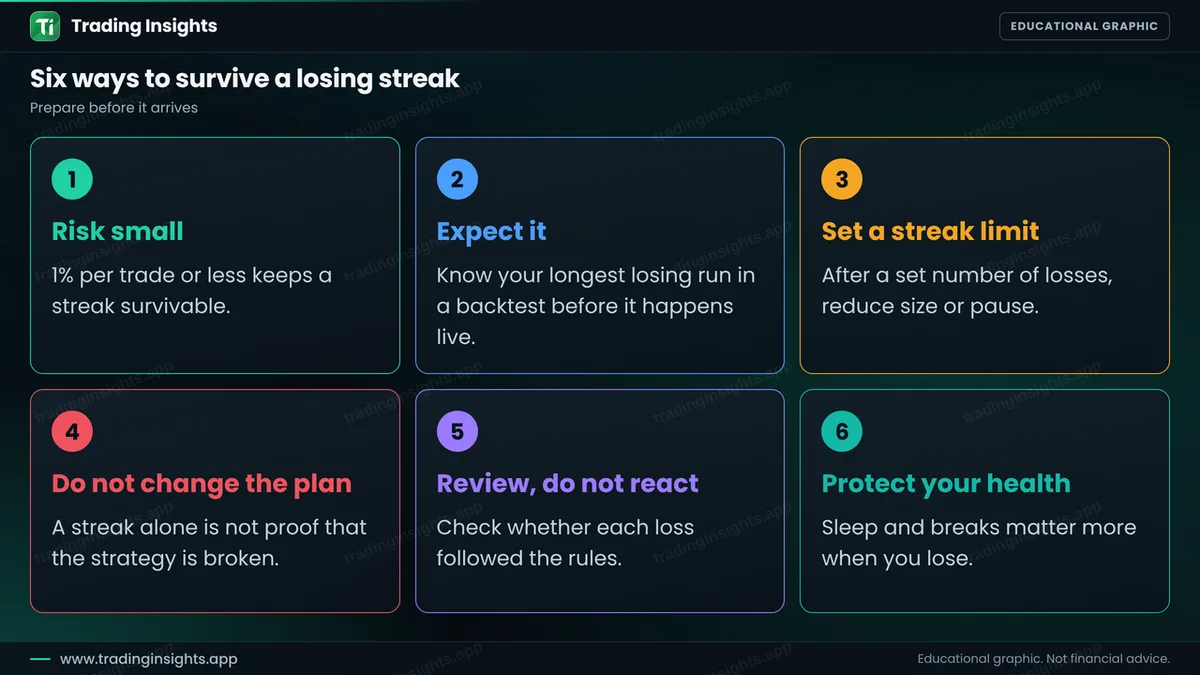
Six ways to survive a losing streak
- Risk small. 1% per trade or less keeps a streak survivable. See position sizing.
- Expect it. Know your longest losing run in a backtest before it happens live. See how to backtest.
- Set a streak limit. After a set number of losses, reduce size or pause.
- Do not change the plan. A streak alone is not proof that the strategy is broken.
- Review, do not react. Check whether each loss followed the rules.
- Protect your health. Sleep and breaks matter more when you lose.
When a streak is a warning
Not every streak is just bad luck. Check these: were the losses within the plan, or were they trades outside the rules? Has the market changed, for example from trending to ranging? Is the streak much longer than anything in your backtest? If the answers point to a problem, step back to a demo account and review. If the losses followed the plan and the streak is within the normal range, the right move is often to keep following the rules. Your trading plan and journal will help you tell the difference.
Common mistakes
- Doubling the size after losses.
- Dropping a strategy after five losses.
- Switching strategies every week.
- Taking trades outside the plan to end the streak.
- Not knowing the strategy's normal losing run.
Frequently asked questions
How many losses in a row is normal?
It depends on the win rate. At a 40% win rate, a run of five or more losses is likely within 100 trades, and a run of about seven is typical.
Does a losing streak mean my strategy is broken?
Not by itself. Compare the streak with your backtest and check that the trades followed the rules.
Should I trade smaller during a losing streak?
Some traders reduce size or pause after a set number of losses, but it should be a rule decided in advance, not an emotional reaction.
How much should I risk to survive a streak?
Many traders risk 1% or less per trade. At 1%, ten losses in a row cost about 9.6% of the account.
Trading involves risk. This is education, not financial advice. The charts are illustrative and not real market data. Trading carries risk, and no method guarantees results.


