
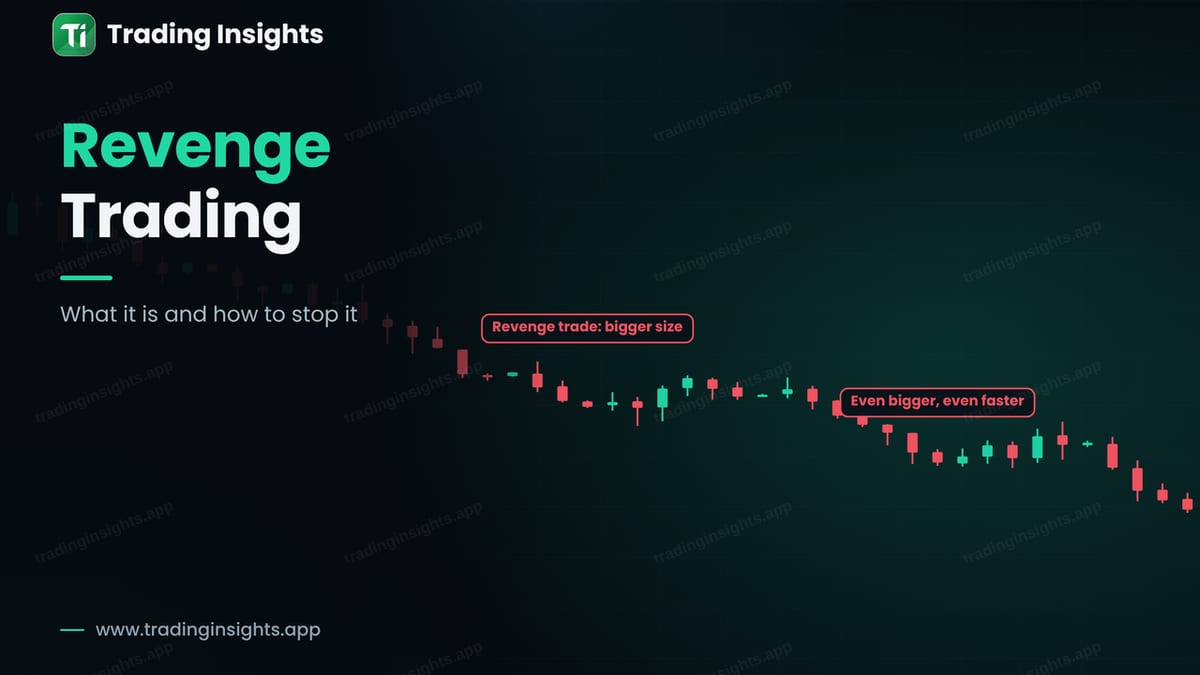
Revenge trading means opening a trade to win back a loss, not because a setup appeared. It usually comes right after a stop-out. You feel that the market took your money, and you want it back quickly. The trade that follows is often larger, faster and less planned than the first one. This is one of the most common ways that traders damage an account.
The revenge trading loop
Revenge trading works as a loop, and it helps to see the steps. First comes a loss. It can be a normal stop-out, which is a part of trading. Then comes anger, and the feeling that you need to recover. Then comes a rushed trade with no setup, a bigger size and a tight or missing stop. That trade often loses too, and the loss is bigger because the risk was higher. Then the loop starts again, and each round makes the next one more likely.
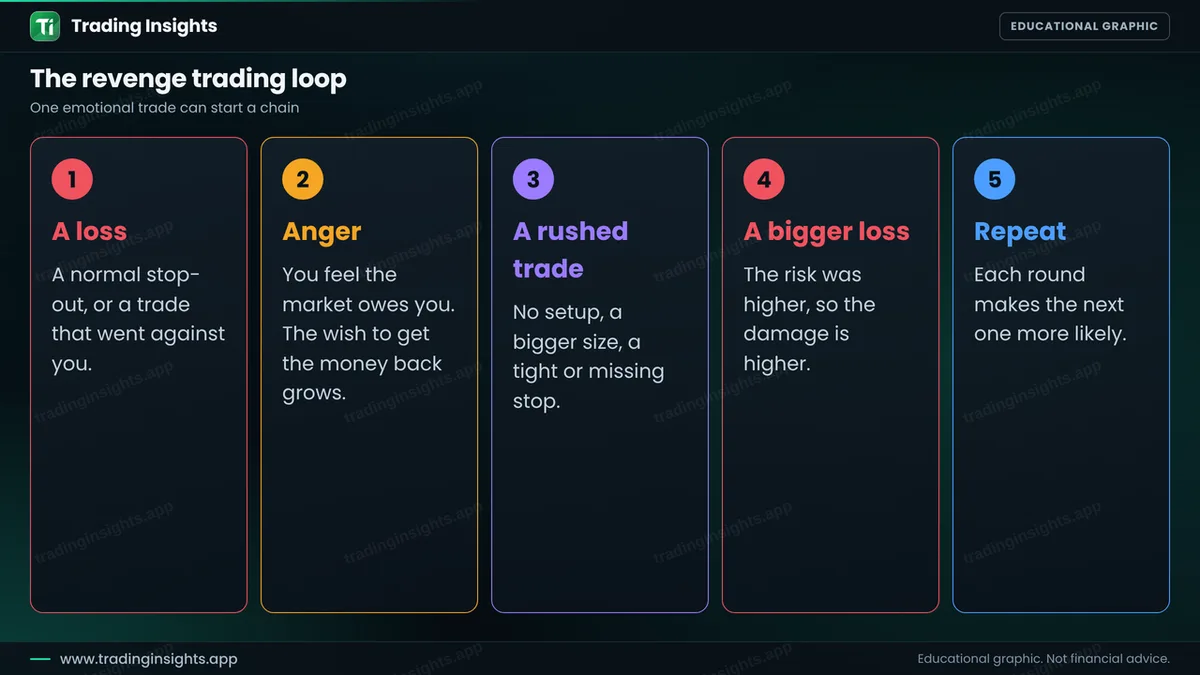
The key point is that the first loss is not the problem. A normal loss within your plan is fine. The damage comes from the trades that follow, which are taken for emotional reasons, not because the strategy asked for them.
Signs that you are in the loop
- You open a trade within minutes of a loss.
- You increase your lot size after a loss.
- You enter without a setup from your plan.
- You move or remove the stop loss.
- You feel angry, tense or in a hurry.
If two or more of these are true, stop and step away. The decision to trade is being made by the emotion, not by you.
Why chasing losses makes things worse
There is also a maths problem. A loss needs a larger gain to get back to even, and the gap grows quickly. If you lose 20%, you need a 25% gain, because the gain is calculated on a smaller balance. The formula is: gain needed = loss / (1 - loss).
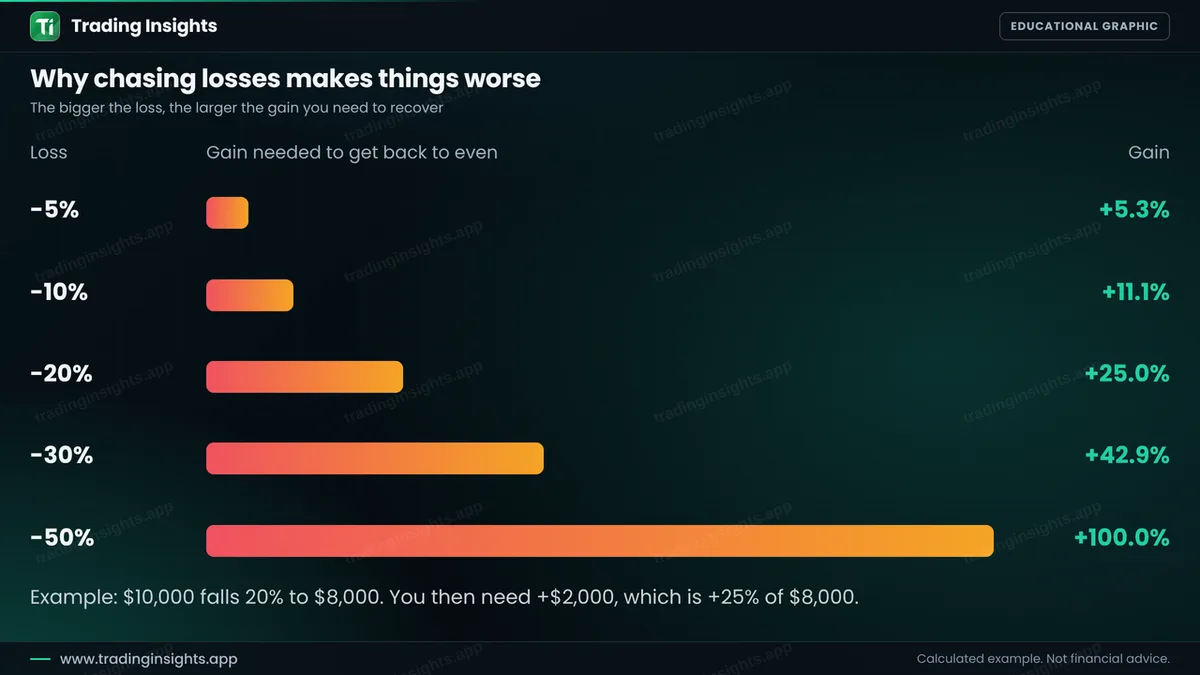
A 10% loss needs about 11.1%. A 30% loss needs 42.9%. A 50% loss needs 100%, which means doubling the account. This is why small losses are manageable and large ones are not. Revenge trading makes losses larger, so it moves you toward the part of the table where recovery is hard. For more, see position sizing.
Six rules that break the loop
- Stop after two losses. Close the platform for the rest of the session.
- Set a daily loss limit. For example 2% of the account. When it is hit, you are done for the day.
- Take a 30-minute break. Walk away from the screen before any new trade.
- Keep the size fixed. The risk per trade never goes up after a loss.
- Use a checklist. No written setup, no trade.
- Journal the urge. Write down what you felt and what you wanted to do.
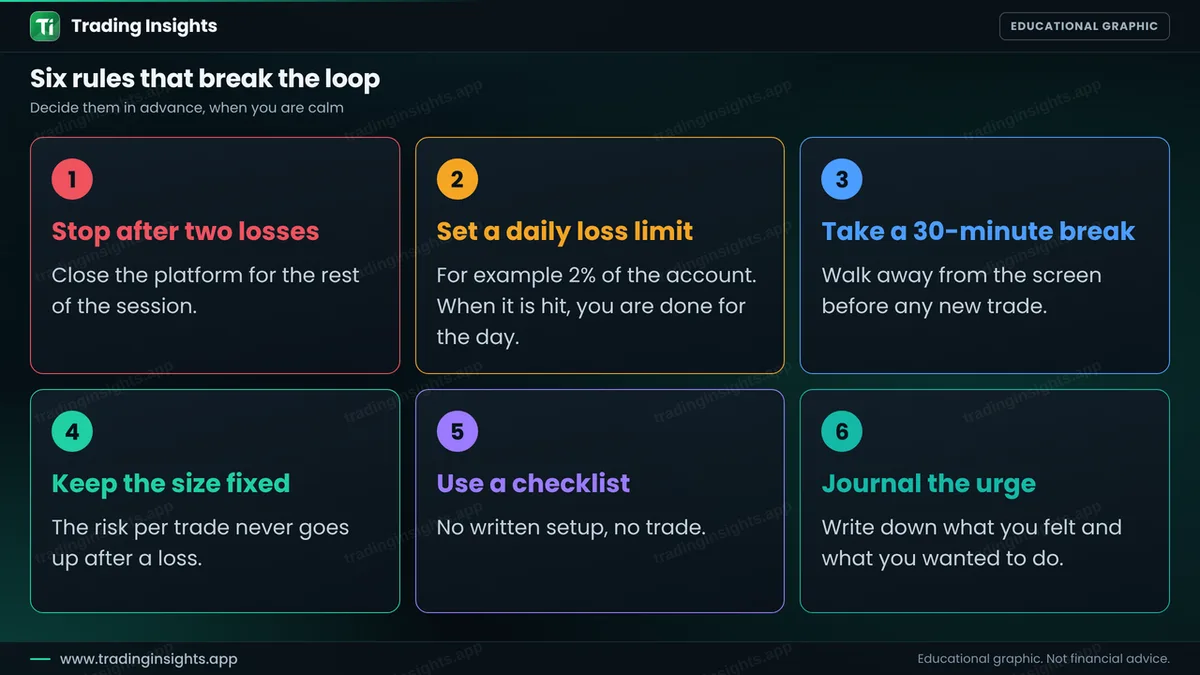
The rules work because they are decided before the emotion arrives. In the moment you will have a good reason to break them, which is why they must be written down. See stop loss and take profit for the stop that protects every trade.
A simple example
You have a $10,000 account and risk 1% ($100) per trade. You take two losing trades in a row, so you are down $200. The rule says to stop. If you ignore it and open a trade with five times the size, you now risk $500 to win back $200. If that trade loses, you are down $700, and a normal day has become a bad one. If you follow the rule, the loss is $200, and tomorrow starts with a clear head.
Common mistakes
- Believing that you can win it back today.
- Raising the size to recover faster.
- Removing the stop loss because it was hit last time.
- Switching to another pair to find a quick trade.
- Skipping the journal because the day was bad.
Frequently asked questions
What is revenge trading?
It is trading to win back a loss, driven by emotion and not by a setup. The trades are often larger and less planned.
Why do traders revenge trade?
Losses feel personal, and the wish to recover is strong. Without fixed rules, that wish often turns into a quick, oversized trade.
How do I stop revenge trading?
Use fixed rules: stop after two losses, set a daily loss limit, take a break and keep the size the same. Write them before you trade.
Is a stop loss enough to prevent it?
A stop loss limits a single trade. A daily loss limit and a stop rule limit the number of trades, and that is what breaks the loop.
Trading involves risk. This is education, not financial advice. The charts are illustrative and not real market data. Trading carries risk, and no method guarantees results.


