Overtrading means taking more trades than your plan allows. It can mean too many trades in a day, trades that do not match your setup, or trades that are too large. Many beginners think that more trades mean more chances to earn. In practice, each extra trade has a cost, and many of them are of poor quality.
Six signs of overtrading
Overtrading is not about a fixed number of trades. A scalper may take many trades within a plan. The problem is volume that does not come from the plan. If several of these signs apply to you, the issue is volume, not the market.
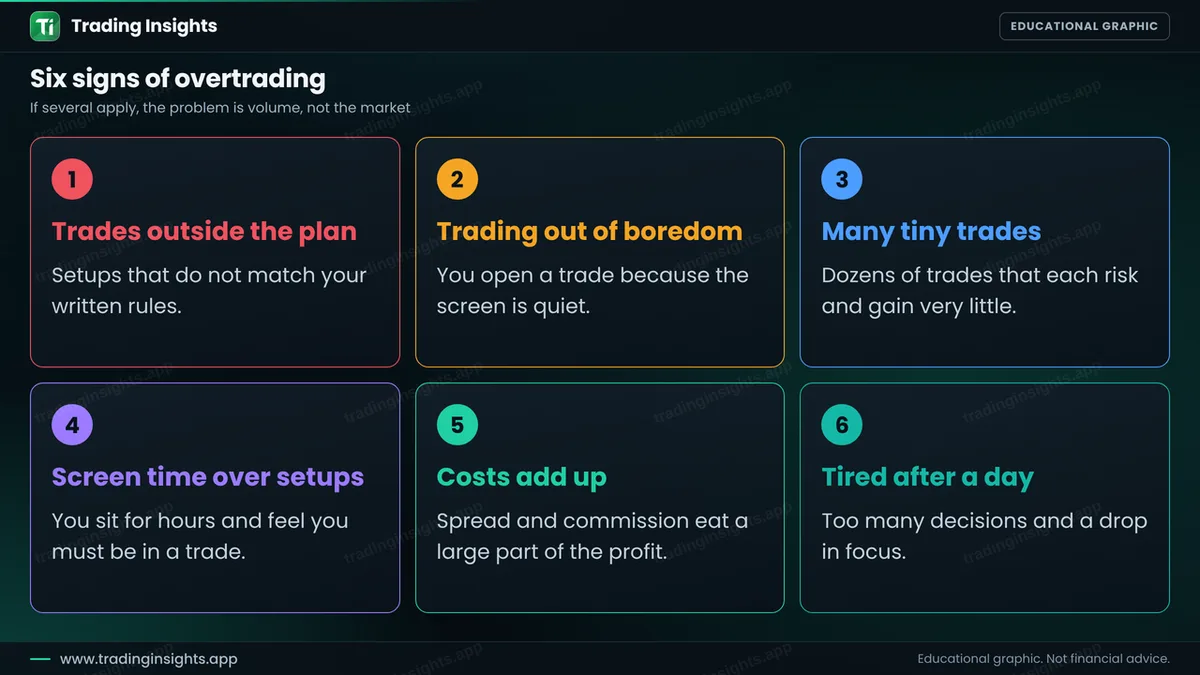
- Trades outside the plan. Setups that do not match your written rules.
- Trading out of boredom. You open a trade because the screen is quiet.
- Many tiny trades. Dozens of trades that each risk and gain very little.
- Screen time over setups. You sit for hours and feel that you must be in a trade.
- Costs add up. Spread and commission eat a large part of the profit.
- Tired after a day. Too many decisions and a drop in focus.
What each extra trade costs
Every trade pays the spread, and some brokers also charge commission. The cost looks small on a single trade, but it grows with volume. Take a $10,000 account that trades 0.50 lot on EUR/USD with a spread of 1.2 pips. Each trade costs 1.2 pips x $10 x 0.50 = $6, before commission.
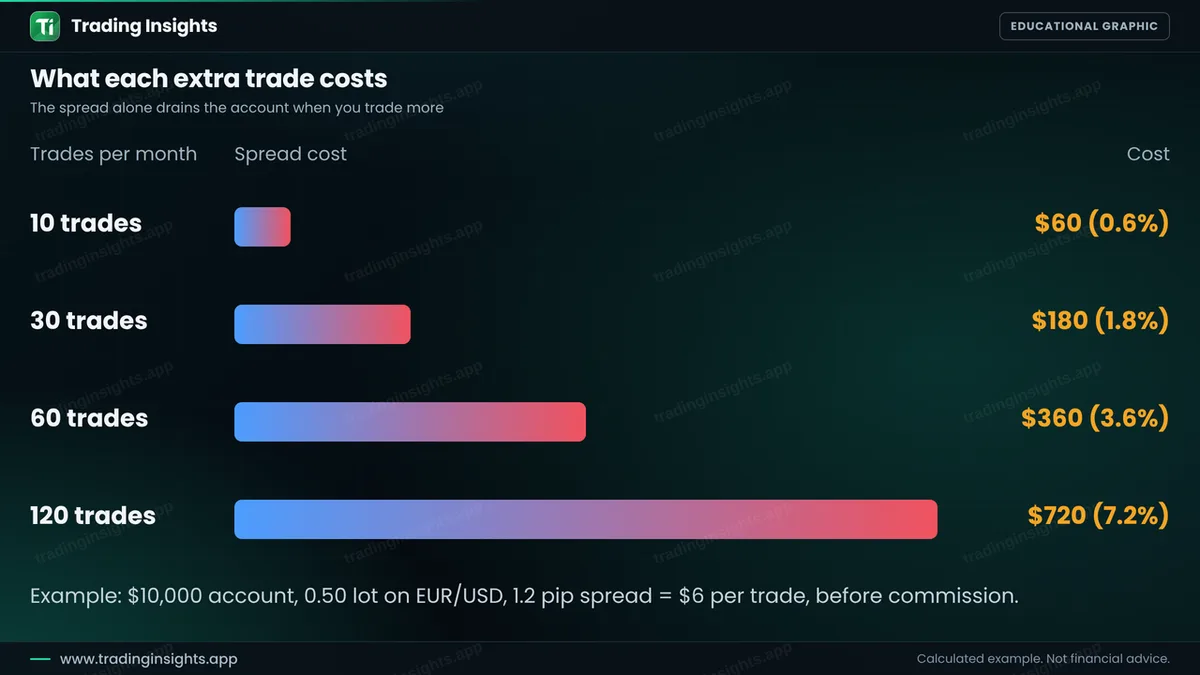
At 10 trades a month, the cost is $60, or 0.6% of the account. At 60 trades it is $360, or 3.6%. At 120 trades it is $720, or 7.2%. Your strategy must earn more than that just to break even. A trader who takes 120 average trades has a much higher bar to clear than one who takes 10 good ones. For more on the cost of trading, see forex trading sessions, where spreads are usually tighter in busy hours.
Why traders overtrade
- Boredom. Waiting feels like doing nothing, so a trade feels like action.
- Fear of missing out. Every move looks like a missed chance.
- Chasing losses. This is related to revenge trading.
- No clear plan. If the rules are vague, almost any setup looks acceptable.
A simple plan to fix it
- Cap the trades. For example two trades a day. When you reach it, stop.
- Set a daily loss limit. For example 2% of the account.
- Trade a fixed window. Only the hours when your setup works best.
- Use an A-setup checklist. If one item is missing, skip the trade.
- Count the costs. Track spread and commission in your journal.
- Review each week. Which trades followed the plan and which did not.
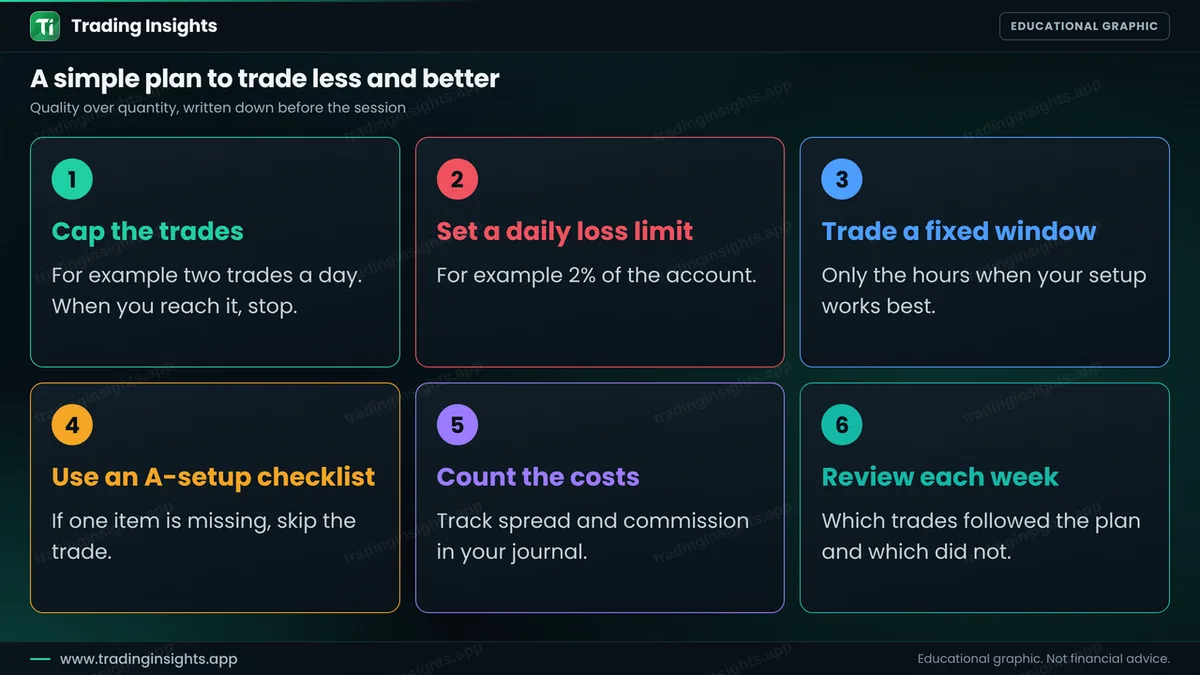
A cap on trades feels strange at first. But it forces you to choose only the best setups. If you only have two trades, you will not waste one on a weak idea. Combine the cap with position sizing so each trade has a fixed risk.
A simple example
Trader A takes 60 trades a month with an average gain of 0.2R before costs, and the spread costs 0.1R per trade. The net is 0.1R per trade, or 6R in total. Trader B takes 15 trades with an average gain of 0.5R and the same cost. The net is 0.4R per trade, or 6R in total, with far less effort and fewer chances to make mistakes. The numbers are illustrative, but they show that fewer, better trades can match the result of many weak ones.
Common mistakes
- Measuring a day by the number of trades.
- Trading every session on every pair.
- Taking a weak setup because nothing better appeared.
- Ignoring spread and commission in the journal.
- Trading when tired, because the day was long.
Frequently asked questions
What is overtrading in forex?
It is taking more trades than your plan allows, or trades that do not meet your rules. Boredom and emotion are common causes.
How many trades a day is too many?
There is no single number. It is too many when the trades are outside your plan, or when costs and tiredness hurt the results. Many beginners start with a cap of two a day.
Does overtrading cost money even if I win?
Yes. Spread and commission are paid on every trade, so a high number of trades raises the profit you need just to break even.
Is scalping the same as overtrading?
No. A scalper takes many trades, but they follow a plan. Overtrading means the trades are not part of the plan.
Trading involves risk. This is education, not financial advice. The charts are illustrative and not real market data. Trading carries risk, and no method guarantees results.


