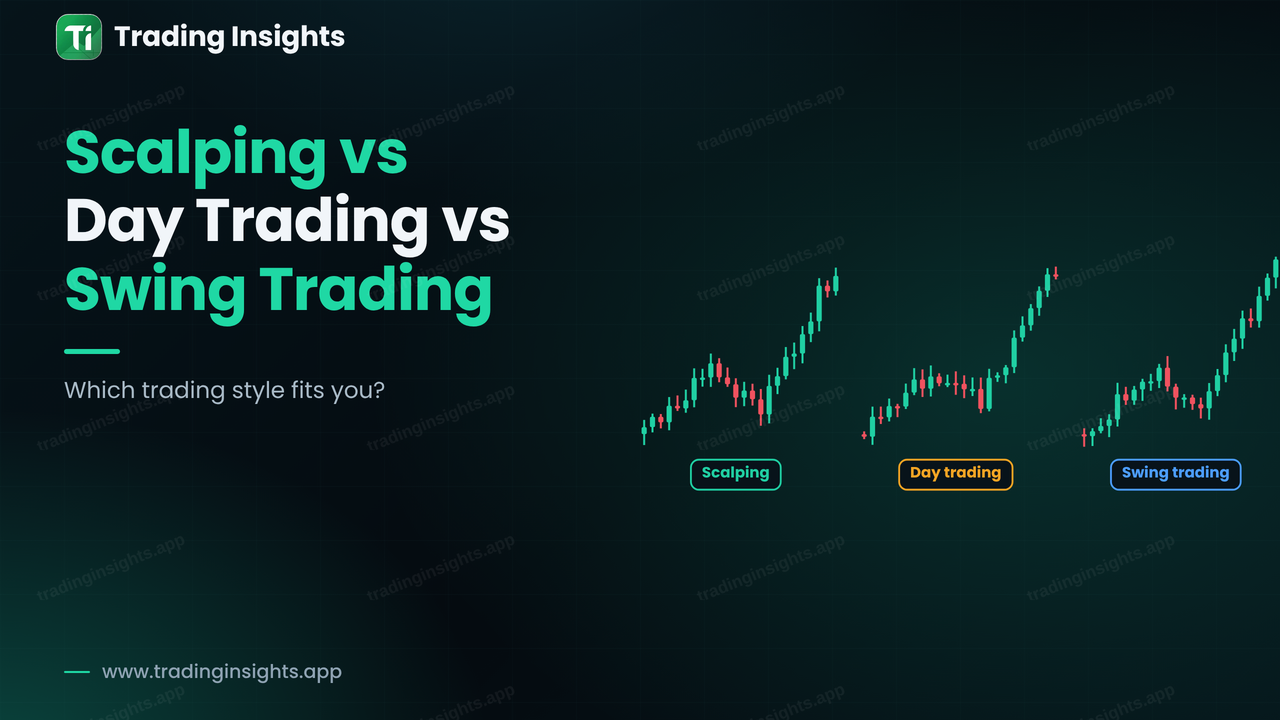
Before you decide which strategy to trade, you must decide how you want to trade. Scalping, day trading and swing trading are the three main trading styles in forex, and they differ in how long a trade lasts, how many trades you take, how much of your day it needs and how strongly costs affect the result. None of them is better than the others, but one will fit your time, your temperament and your account better. This guide compares the three side by side, shows the same trade idea on three time scales, explains why costs matter more the shorter you trade, and gives questions to help you choose.
The three styles side by side
The main differences come down to the timeframe you use and how long you hold a trade. The comparison below shows typical ranges. These are general tendencies, and your own plan can differ.
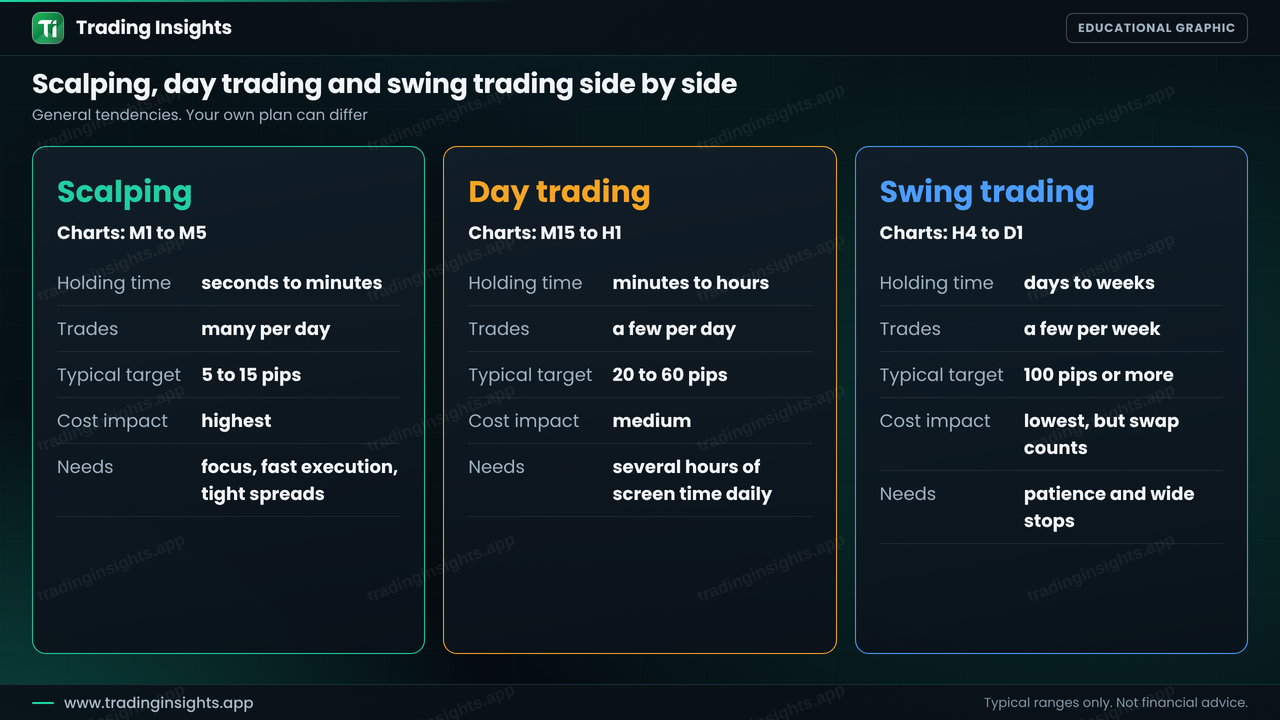
- Scalping aims for very small moves, usually 5 to 15 pips, on charts from M1 to M5. Trades last seconds to minutes, and a scalper may take many trades in a day. It demands focus, fast execution and tight spreads.
- Day trading uses charts from M15 to H1, holds trades for minutes to hours and closes everything before the end of the day. Targets are often 20 to 60 pips, and there is no overnight swap.
- Swing trading uses H4 and D1 charts, holds trades for days to weeks and aims for moves of 100 pips or more. It needs fewer hours at the screen, but it needs patience and wider stops, and the swap is charged each night.
There are also styles in between and beyond, such as position trading on weekly charts. What they share is the rule that the trade you plan on a chart should match the time you can give to it. The timeframes themselves and how to combine them are explained in top-down analysis.
The same idea on three time scales
A common misunderstanding is that the styles use different methods. Often they use the same ideas, such as market structure, support and resistance and entry on a pullback, but applied on a different scale. The charts below show the same 1:2 trade on three scales. The shape is identical, and only the size of the stop changes.
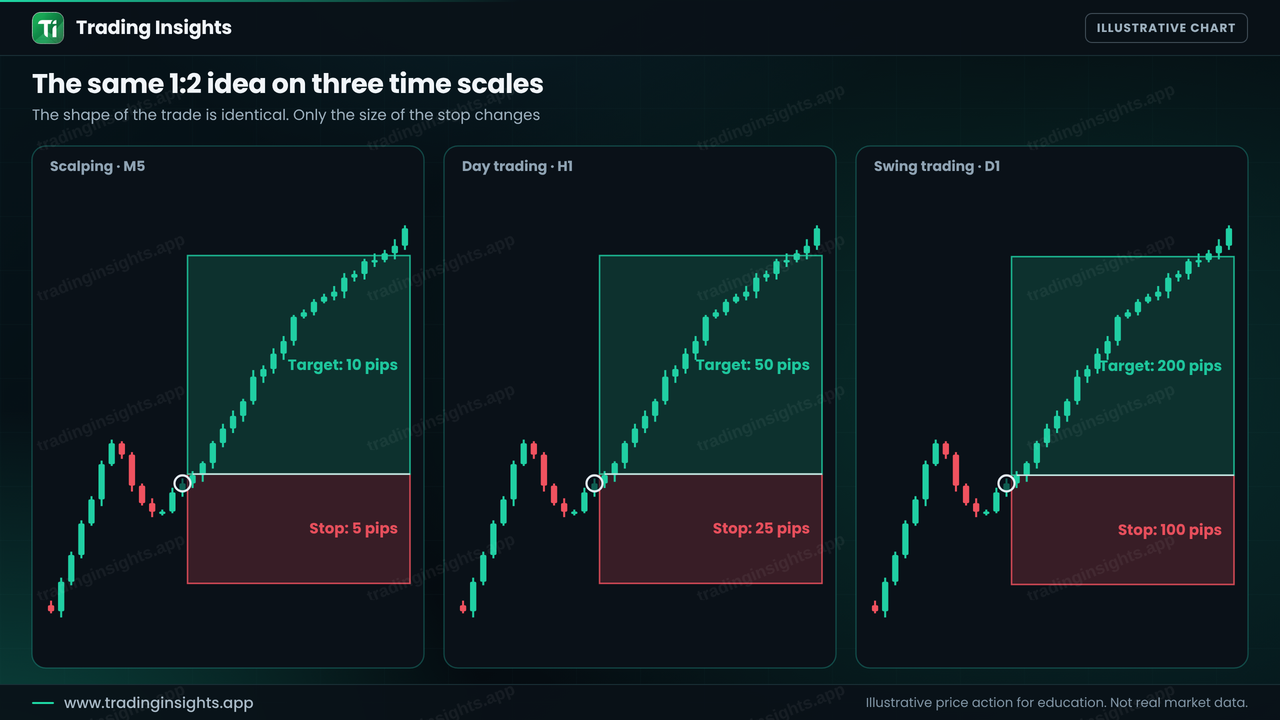
The stop size matters because it decides your position size. With a $10,000 account risking 1% ($100) on EUR/USD, where a pip is worth about $10 per lot:
| Style | Stop | Target | Lot size for $100 risk |
|---|---|---|---|
| Scalping | 5 pips | 10 pips | 2.00 lots |
| Day trading | 25 pips | 50 pips | 0.40 lot |
| Swing trading | 100 pips | 200 pips | 0.10 lot |
The risk in money is the same in all three cases, and the lot size changes with the stop. Scalpers trade the largest size for the same risk, and a small error in the entry or a slippage of a few pips has a big effect on the result. The method is explained in how to calculate position size, and you can check it with the position size calculator.
Why costs matter more the shorter you trade
Every trade pays the spread, and some also pay commission or swap. These costs are roughly the same in pips regardless of your style, which means they take a much bigger share of a small target. Take a 1.5 pip spread:
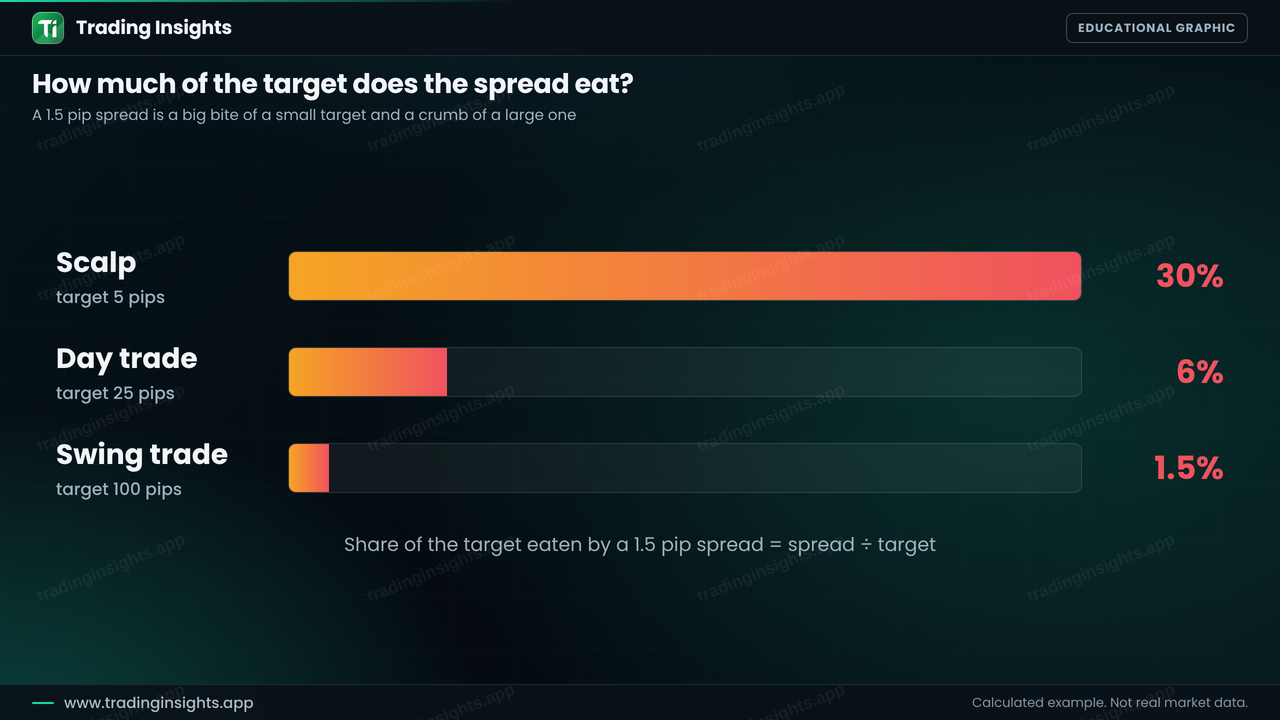
This is the main reason many beginners find scalping harder than it looks: the market must move your way, and the costs must also be small. A scalper needs a broker with very low spreads and fast execution, and should avoid trading when spreads widen, such as during news or at the rollover. A swing trader does not worry much about the spread but should look at the swap charge, which adds up for trades held for weeks. All the cost types are explained in forex trading costs explained. Busy hours also help; see forex trading sessions explained.