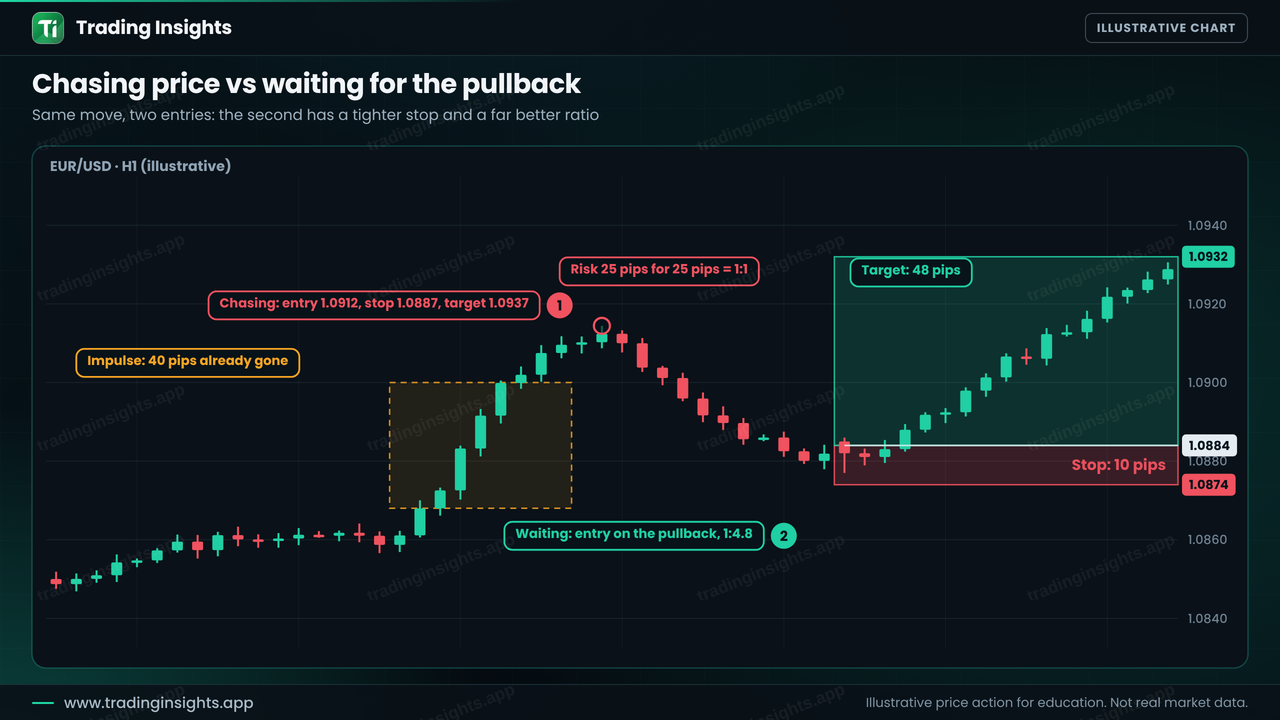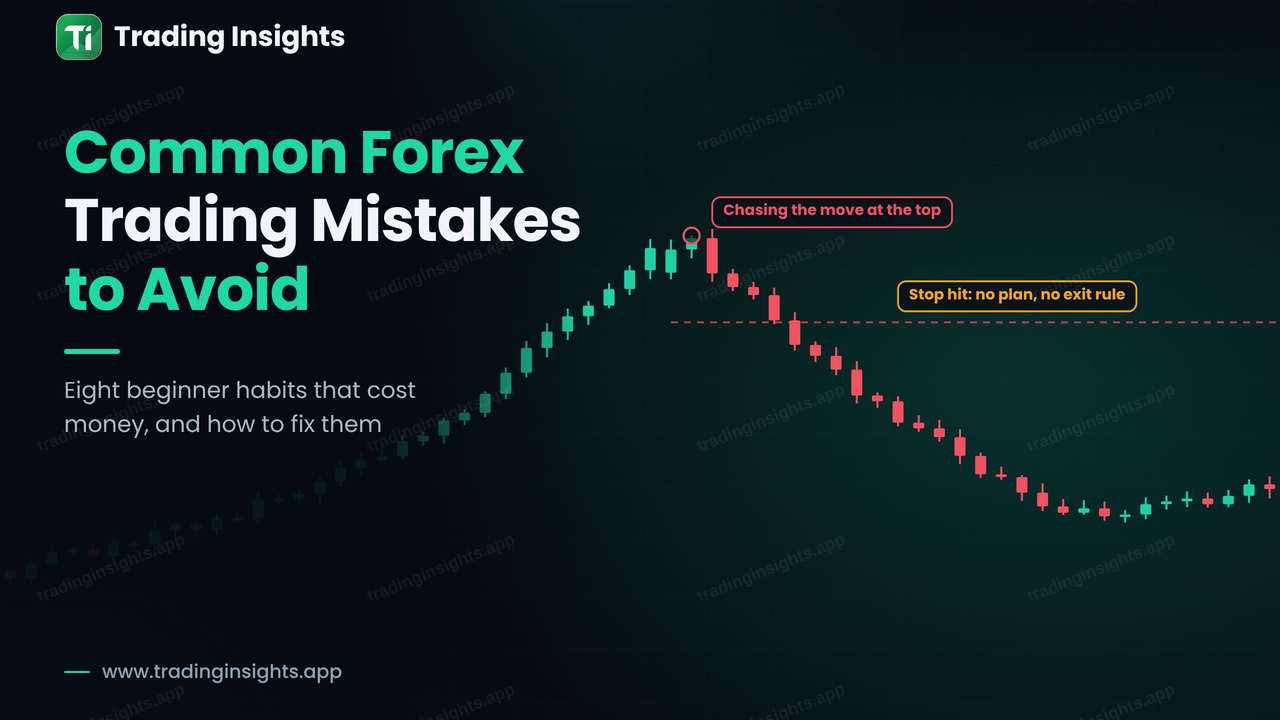
Most beginners do not lose money because they cannot find good setups. They lose because of a handful of repeating habits: trading without a plan, risking too much on one trade, skipping the stop loss, and trading emotionally after a loss. These mistakes are common, they are well documented, and every one of them has a practical fix. This guide lists the eight most frequent forex trading mistakes, shows the maths behind why over-risking is so damaging, and compares chasing a move with waiting for a pullback on a chart. Use it as a checklist to review your own trading.
The eight mistakes at a glance
The grid below summarises the eight mistakes covered in this guide, with the problem and the fix side by side. The sections after it explain why each one matters.
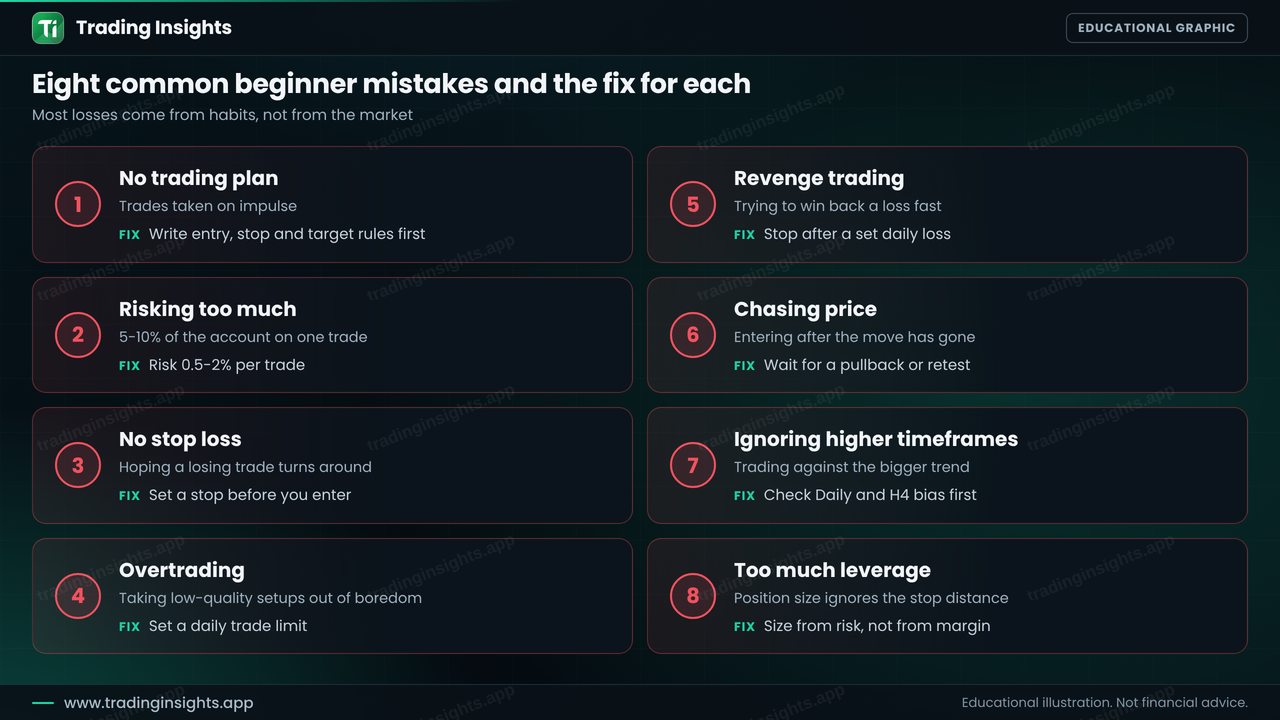
Figure 1: Eight common beginner mistakes and the fix for each.
1. Trading without a plan
Without written rules, every decision is made in the moment, under the influence of the last candle. Entries become impulsive and exits depend on mood. The fix is to write down what you trade, when you trade, how you enter, where the stop goes and how much you risk, before you open the chart. A sample structure is in how to build a trading plan and journal.
2. Risking too much per trade
Risking 5% or 10% of your account on one idea can feel exciting, but a short losing streak is enough to damage it badly. The problem is not just the size of each loss. Losses are also harder to recover than they look, because the gain needed grows faster than the loss.
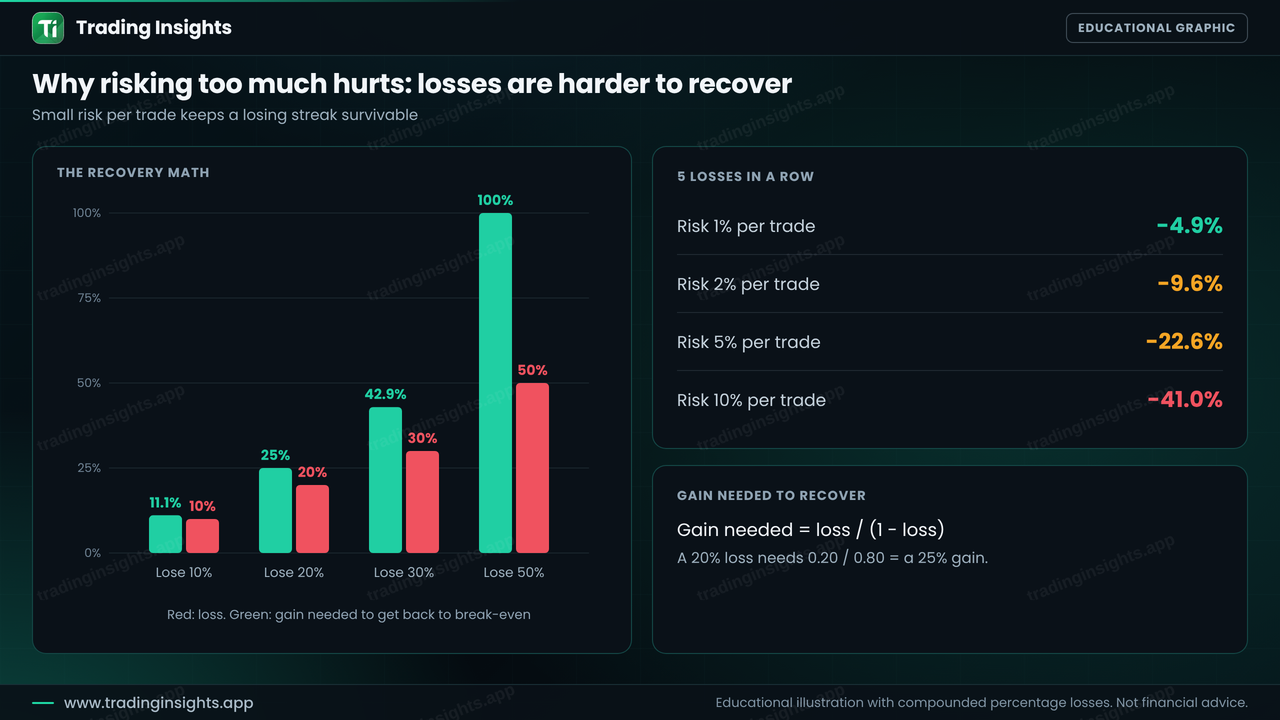
Figure 2: Why risking too much hurts. A bigger loss needs a much bigger gain to recover, and a losing streak at high risk is severe.
The formula is: gain needed = loss / (1 - loss). A 20% loss needs a 25% gain (0.20 / 0.80). A 50% loss needs 100%. And compare five losses in a row at different risk levels:
Risk per trade | Account after 5 losses in a row | Loss |
|---|---|---|
1% | 95.1% of the starting balance | -4.9% |
2% | 90.4% | -9.6% |
5% | 77.4% | -22.6% |
10% | 59.0% | -41.0% |
The fix is to risk a small, fixed percentage per trade, commonly 0.5% to 2%, and size the position from the stop distance. See how to calculate risk-to-reward ratio for the formula.
3. Trading without a stop loss, or moving it
Trading with no stop turns a small mistake into a large one, because losing trades are held in the hope of a recovery. Moving the stop further away once the trade goes against you has the same effect. Decide the stop before you enter, based on where the idea is wrong, and do not widen it. If you need to understand how the order works, see stop loss vs stop limit.
4. Overtrading
More trades do not mean more profit. Many trades taken out of boredom or the fear of missing out are low quality, and each one pays the spread. Set a maximum number of trades per day and take only setups that match your written rules. Fewer, better trades usually beat constant activity.
5. Revenge trading
After a loss, there is a strong urge to win the money back immediately. This leads to larger positions, worse setups and more losses. A simple rule helps: after a set number of losses, or a set daily loss such as 3% of the account, stop trading for the day. Come back to the charts the next session.