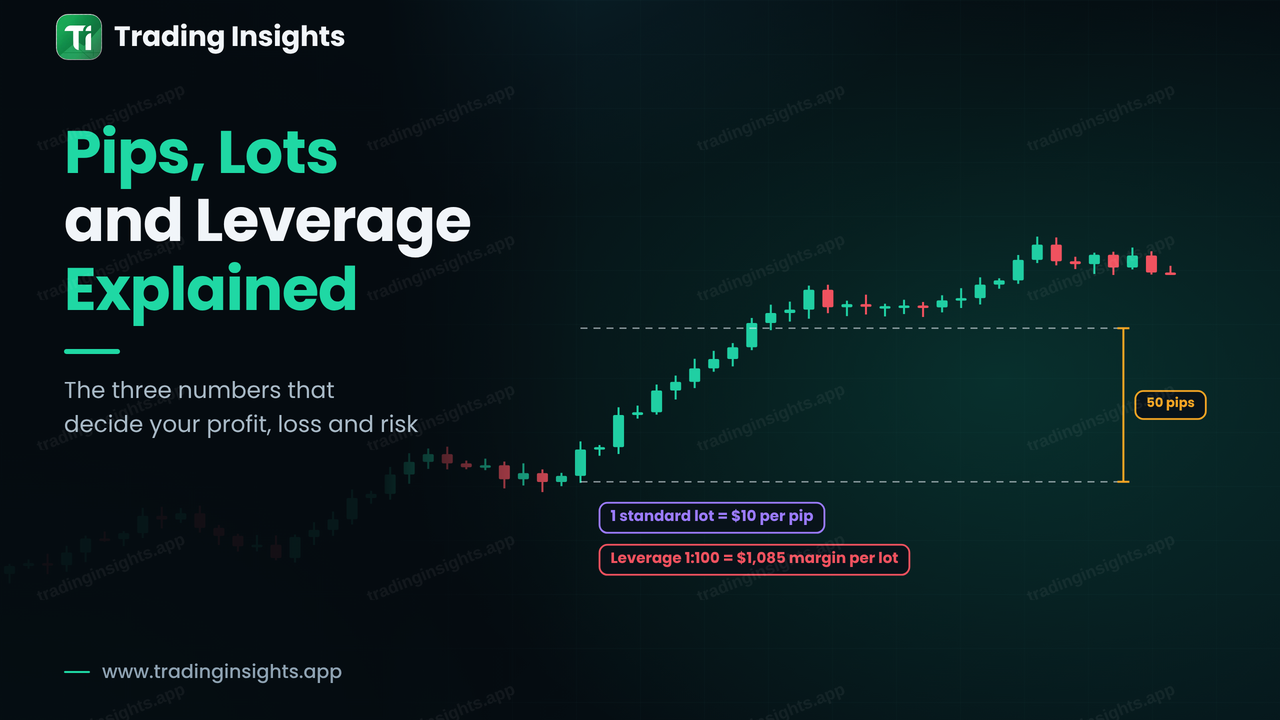
Pips, lots and leverage are the three numbers behind almost every forex trade. A pip is the unit used to measure price movement. A lot is the size of your trade. Leverage lets you open a position larger than your deposit by using borrowed buying power, and the deposit that backs it is called margin. Together they decide how much you can win or lose on a trade, so it is worth learning them properly before you place an order. This guide explains each with worked examples. If you are new to the market, read what forex trading is first.
What is a pip?
A pip, short for percentage in point, is the standard unit for measuring price changes. For most currency pairs, a pip is the fourth decimal place, or 0.0001. If EUR/USD moves from 1.0850 to 1.0851, it has moved one pip. For pairs that include the Japanese yen, a pip is the second decimal place, or 0.01. If USD/JPY moves from 148.25 to 148.26, that is one pip.
Many brokers also show a fifth decimal place, or third for yen pairs. This extra digit is called a pipette and is one-tenth of a pip. The price 1.08503 therefore has 3 pipettes beyond the pip.
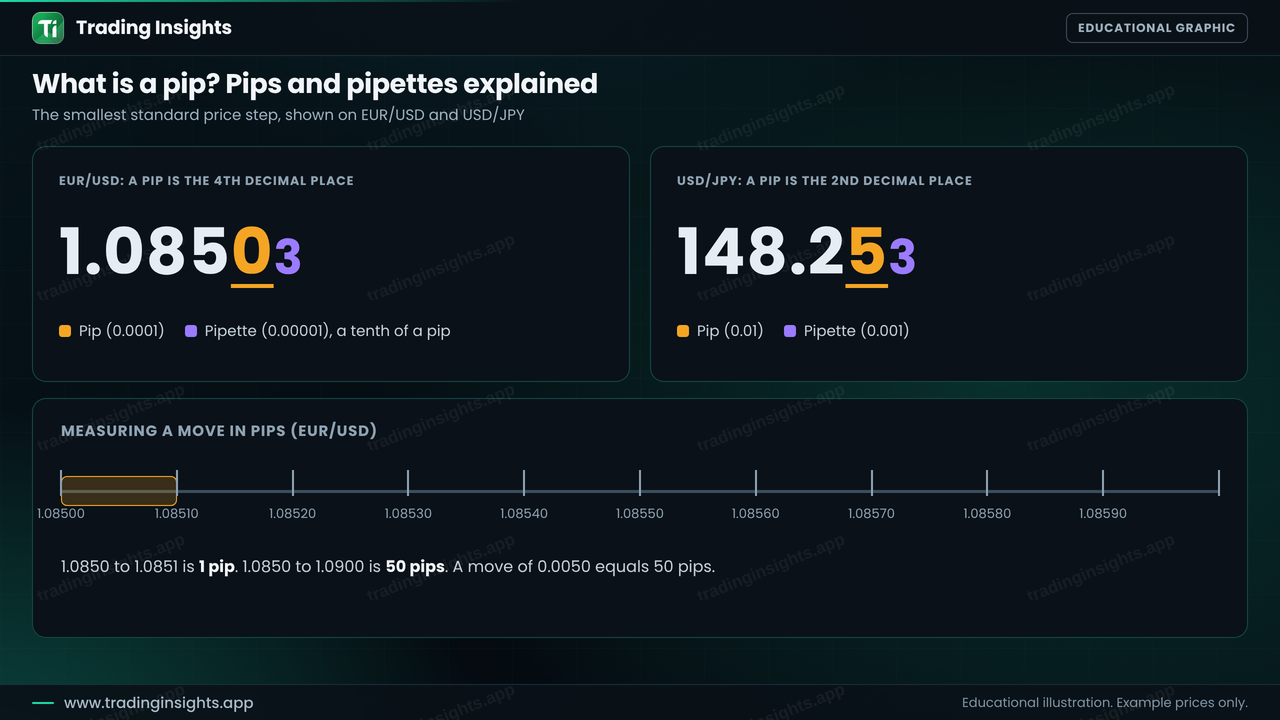
Figure 1: The pip and the pipette on EUR/USD and USD/JPY, and how to measure a move in pips.
To measure a move in pips, subtract the prices and count the pips. From 1.0850 to 1.0851 is 1 pip. From 1.0850 to 1.0900 is 50 pips. A move of 0.0050 equals 50 pips.
What is a lot?
A lot is a standard trade size in forex. It tells the broker how many units of the base currency you want to buy or sell. There are three common sizes:
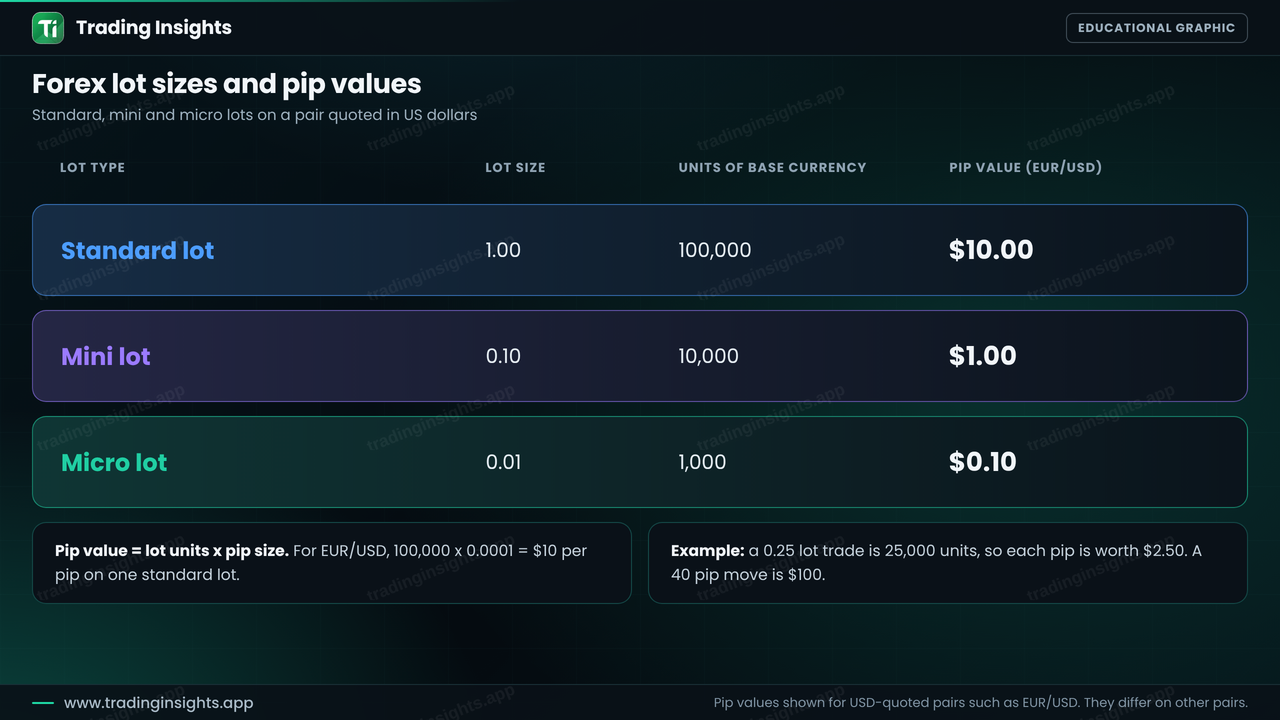
Figure 2: Lot sizes and the value of one pip on EUR/USD for a USD account.
Lot type | Lot size | Units of base currency | Pip value (EUR/USD) |
|---|---|---|---|
Standard | 1.00 | 100,000 | $10.00 |
Mini | 0.10 | 10,000 | $1.00 |
Micro | 0.01 | 1,000 | $0.10 |
You can also trade in between, such as 0.25 lots. That is 25,000 units, so each pip is worth $2.50. A move of 40 pips would then change your profit or loss by $100.
How to work out pip value
The pip value is the amount of money a one-pip move is worth for your position size. For pairs where the US dollar is the quote currency, such as EUR/USD, the calculation is simple:
Pip value = units x pip size. For one standard lot of EUR/USD, that is 100,000 x 0.0001 = $10 per pip.
For other pairs the pip value is expressed in the quote currency and converted to your account currency. A trading platform's calculator does this for you, but the logic is worth knowing. The values in this article are for USD-quoted pairs with a USD account.
What is leverage?
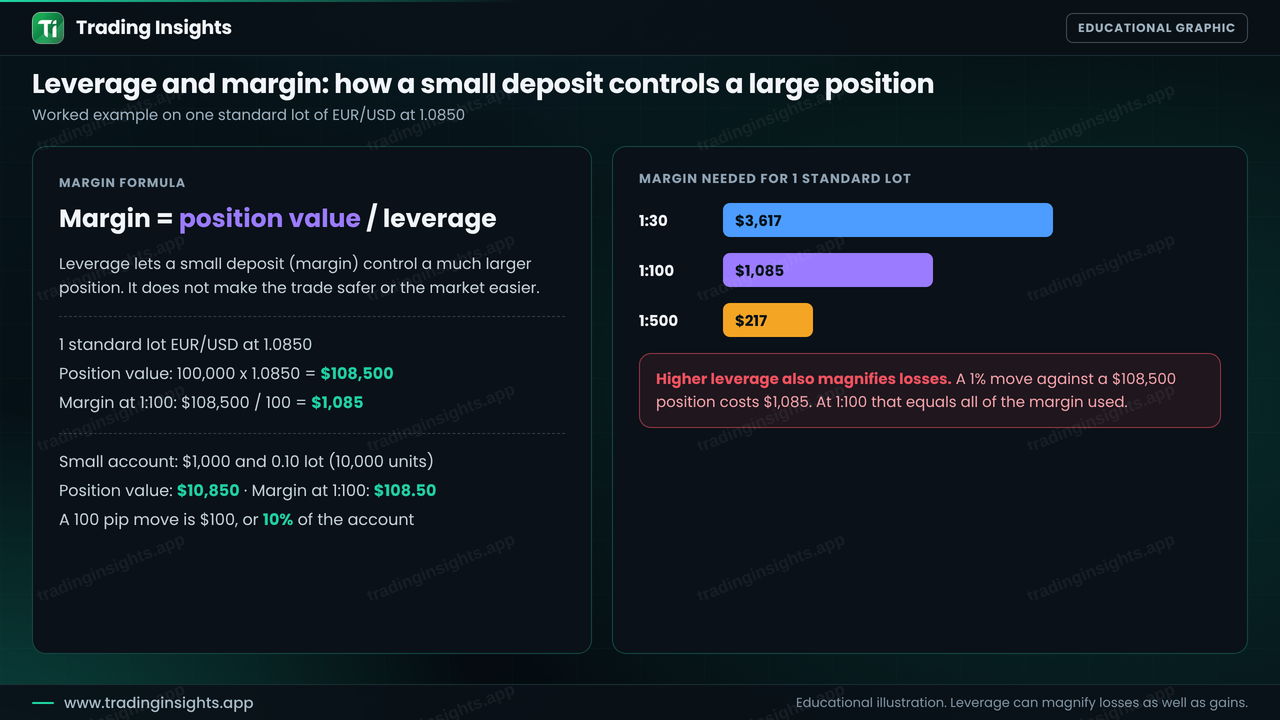
Leverage lets you open a larger position than your account balance would otherwise allow. It is shown as a ratio such as 1:30 or 1:100. With 1:100 leverage, you can control $100 of currency for every $1 of your own money. The deposit your broker holds to keep the position open is called the margin.
The formula is: margin = position value divided by leverage.
A worked leverage and margin example
Suppose you want to buy one standard lot of EUR/USD at 1.0850. The position value is 100,000 x 1.0850 = $108,500. The margin needed depends on the leverage: