The forex market is open 24 hours a day from Monday to Friday because financial centres around the world open and close in turn. These windows are called trading sessions: Sydney, Tokyo, London and New York. Each has its own character, and the busiest times are when two sessions overlap. Knowing when the market is active helps you choose the right pairs, expect the right kind of movement and avoid quiet hours where setups tend to fail. This guide gives the hours, the typical behaviour of each session and an illustrative day on a chart.
The four sessions on a 24-hour clock
The times below are approximate, shown in UTC during northern hemisphere summer time. They shift by one hour when daylight saving changes, and the shift happens on different dates in different countries, so check your broker's server time.
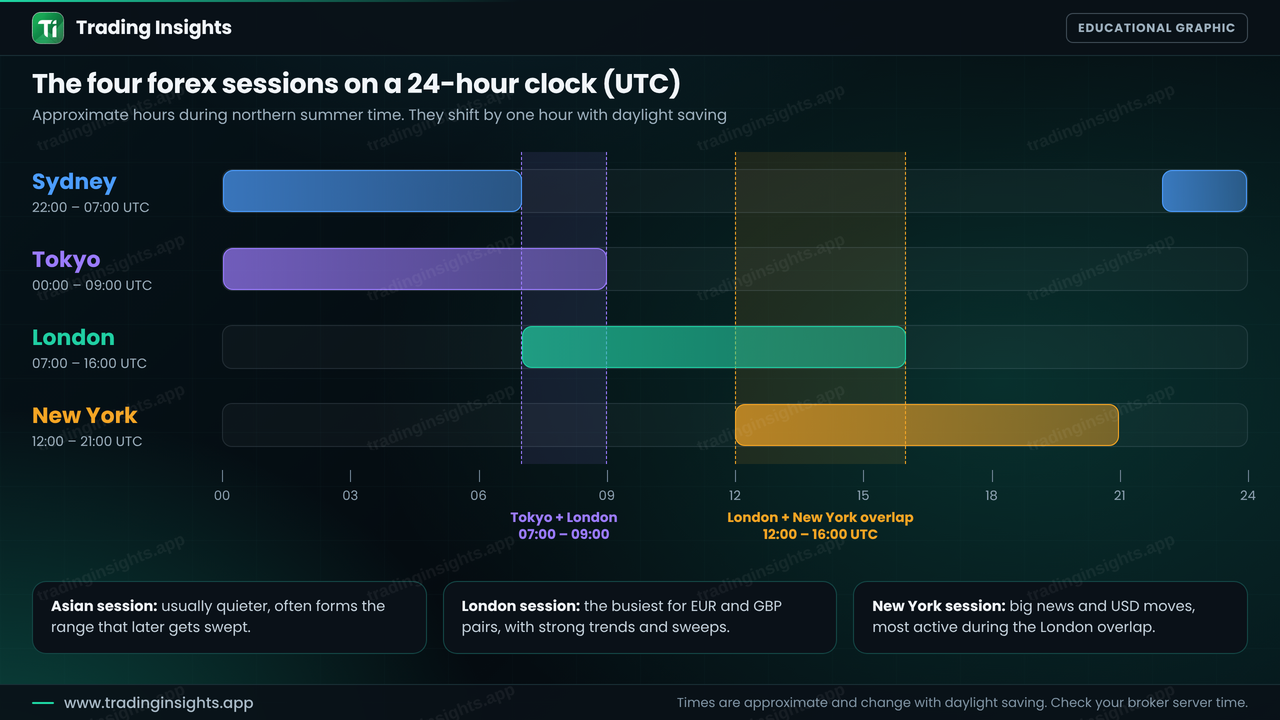
Figure 1: The four forex sessions in UTC, with the two main overlaps.
Session | Approximate hours (UTC) | Main currencies |
|---|---|---|
Sydney | 22:00 - 07:00 | AUD, NZD |
Tokyo (Asian) | 00:00 - 09:00 | JPY, AUD, NZD |
London | 07:00 - 16:00 | EUR, GBP, CHF |
New York | 12:00 - 21:00 | USD, CAD |
Sessions overlap, so there is no moment when the market is closed during the week. The two overlaps that matter most are Tokyo and London (07:00 - 09:00) and London and New York (12:00 - 16:00).
The Asian session: usually the quiet one
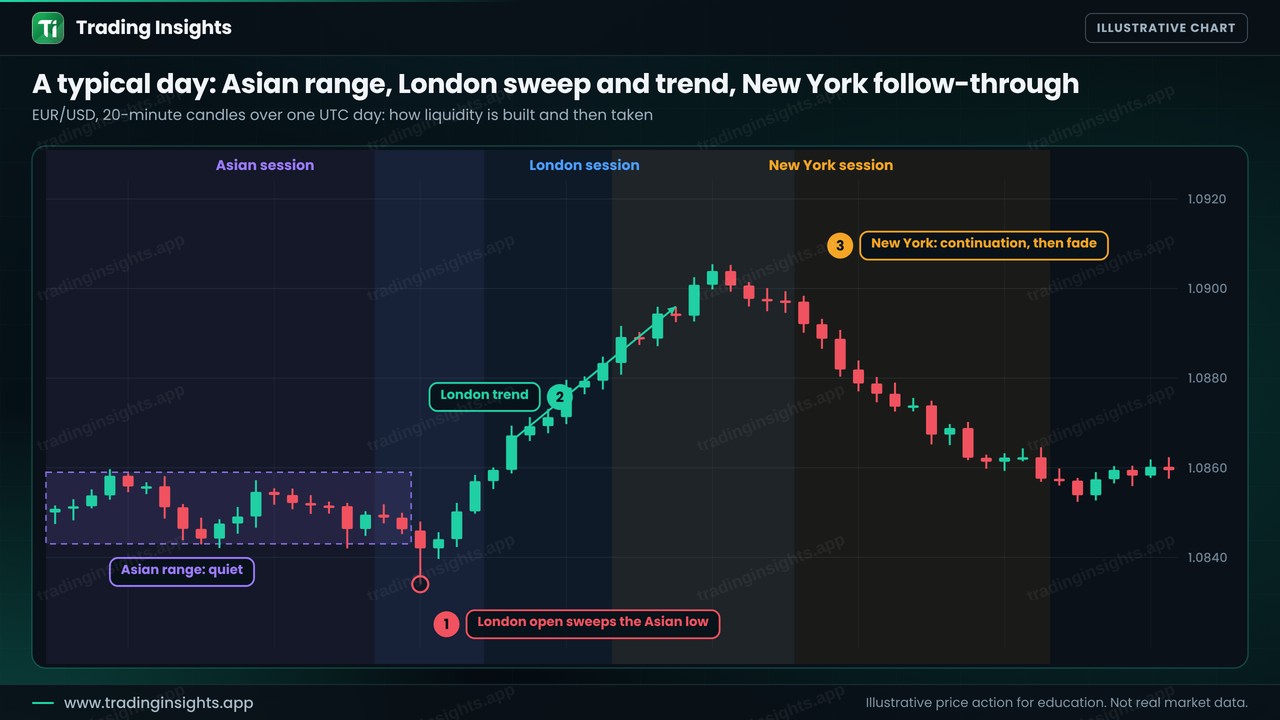
The Asian session, driven by Tokyo and Sydney, is usually the least volatile for the major pairs such as EUR/USD and GBP/USD. Price often moves sideways in a narrow range. Pairs that include JPY, AUD and NZD tend to be more active, because their home markets are open. For price action traders, this range is useful: its high and low often become the liquidity that price later targets. This idea is explained in liquidity sweep and market structure shift and what a liquidity pool is.
The London session: the busiest
London is the largest forex centre, so the London session usually brings the biggest volume and the strongest trends for pairs such as EUR/USD, GBP/USD and EUR/GBP. A common pattern is that price takes out the high or low of the Asian range soon after the London open, then reverses or accelerates. Spreads on major pairs are usually tight during this time. If you can trade only one window, London is the one most day traders choose.
The New York session: news and the dollar
The New York session brings important US economic data, which often moves the dollar sharply. Volume is highest in the first hours, when London is still open. Later in the session, volume fades, and price often drifts or reverses part of the earlier move. USD pairs and CAD pairs are most active here.
Why overlaps matter
When two sessions are open, more participants are trading, so liquidity is high and spreads are usually tighter. The London and New York overlap, from about 12:00 to 16:00 UTC, is the most active part of the day for major pairs. The Tokyo and London overlap is shorter and mainly affects pairs such as EUR/JPY and GBP/JPY.
A typical day on a chart
The chart below shows one illustrative day for EUR/USD in UTC. It is not real data, but it displays a common sequence.