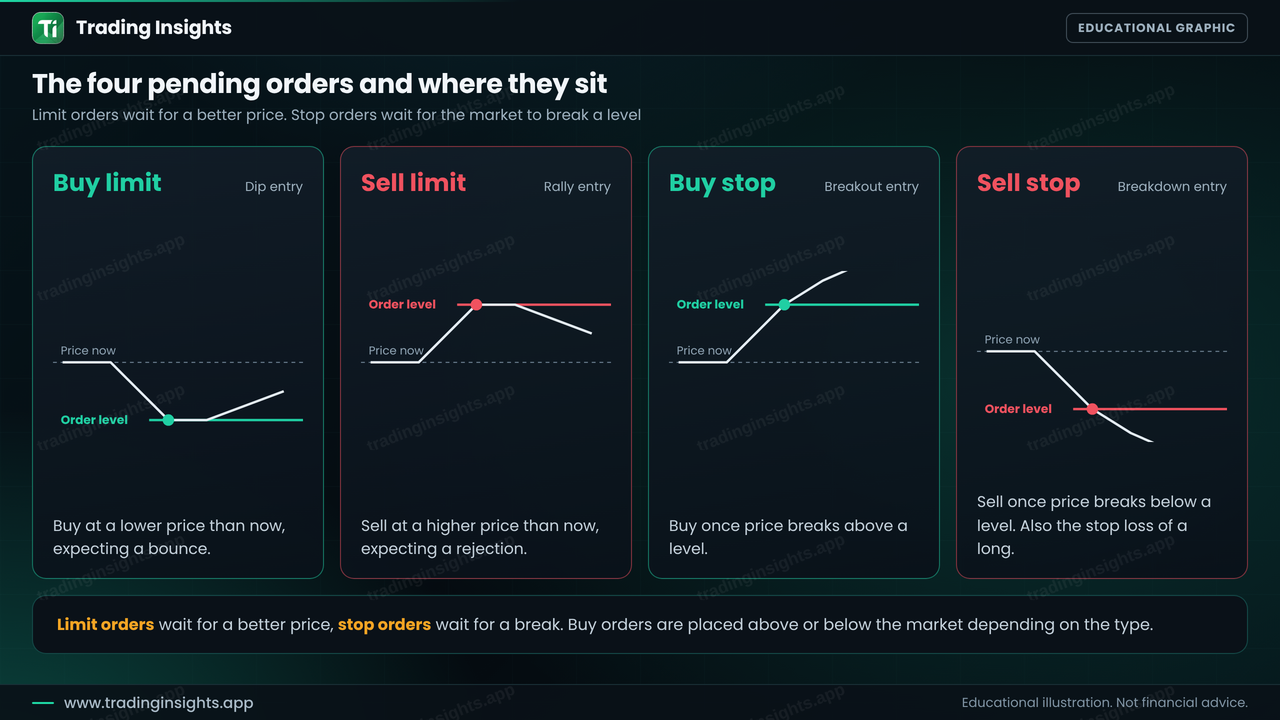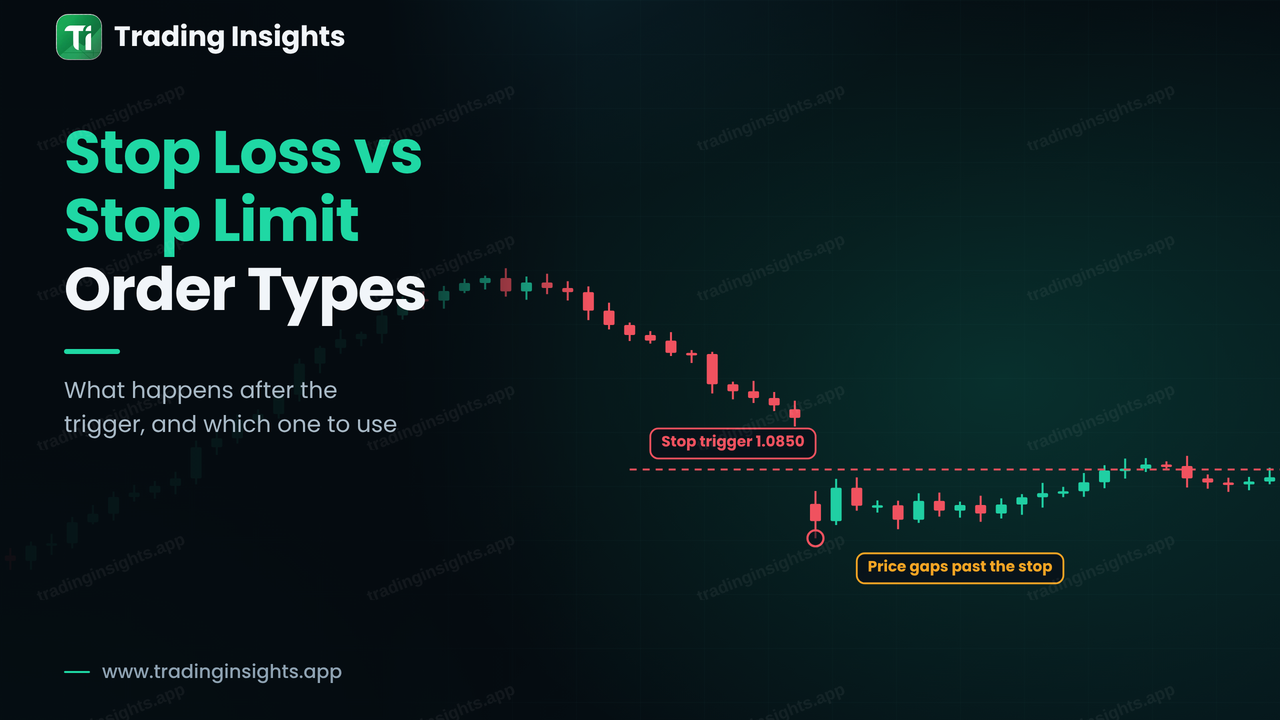
A stop loss and a stop-limit order both start with a trigger price, but they behave differently after it is hit. A stop order, which is what most people mean by a stop loss, turns into a market order and closes the trade at the next available price. A stop-limit order turns into a limit order, so it will only fill at your limit price or better. The first guarantees the exit but not the price. The second guarantees the price but not the exit. Choosing the wrong one at the wrong time is a common and expensive mistake. This guide explains the difference with a worked example and then covers the four pending order types.
The basics: market, limit and stop orders
Before comparing the two, it helps to know the building blocks.
Market order: buy or sell immediately at the best available price.
Limit order: buy or sell only at a specified price or better. It may never fill.
Stop order: an order that becomes a market order once price reaches a trigger level.
Stop-limit order: an order that becomes a limit order once price reaches the trigger level.
In forex, a stop loss is a protective stop order attached to an open position. If you are long, it is a sell stop below the market. If you are short, it is a buy stop above the market.
Stop vs stop-limit: side by side
The comparison below puts the two orders next to each other, using a sell stop at 1.0850 and a stop-limit with a stop at 1.0850 and a limit at 1.0845 as examples.
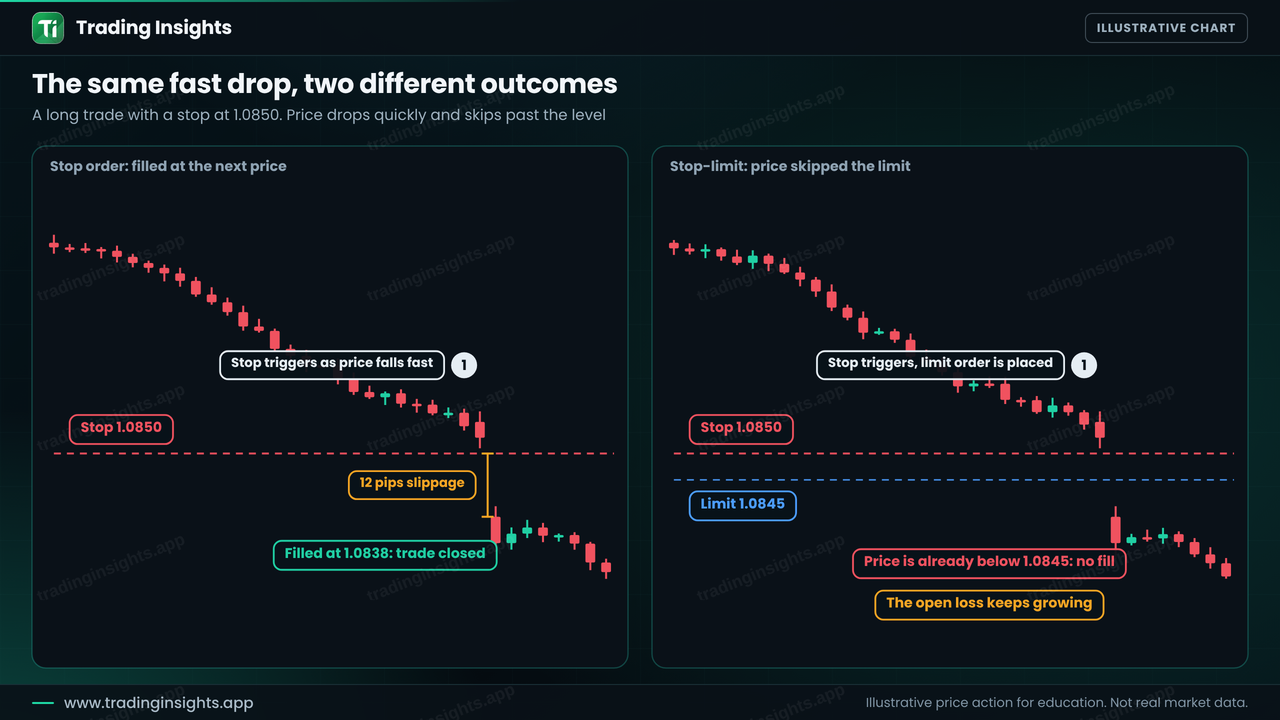
Figure 1: A stop order guarantees the exit but not the price. A stop-limit guarantees the price but not the exit.
Stop order (stop loss) | Stop-limit order | |
|---|---|---|
At the trigger | Becomes a market order | Becomes a limit order |
Exit guaranteed? | Yes, fills at the next available price | No, it may never fill |
Price guaranteed? | No, slippage is possible | Yes, never worse than the limit |
Main risk | A worse fill in fast markets | The trade stays open and the loss can grow |
Typical use | Protective stop on an open trade | Entries where the price matters more than the fill |
What happens in a fast market: a worked example
The difference matters most when price moves quickly, such as after a news release or a weekend gap. Imagine you are long EUR/USD and your protective stop is at 1.0850. Price drops fast and skips from 1.0853 straight down to 1.0838.
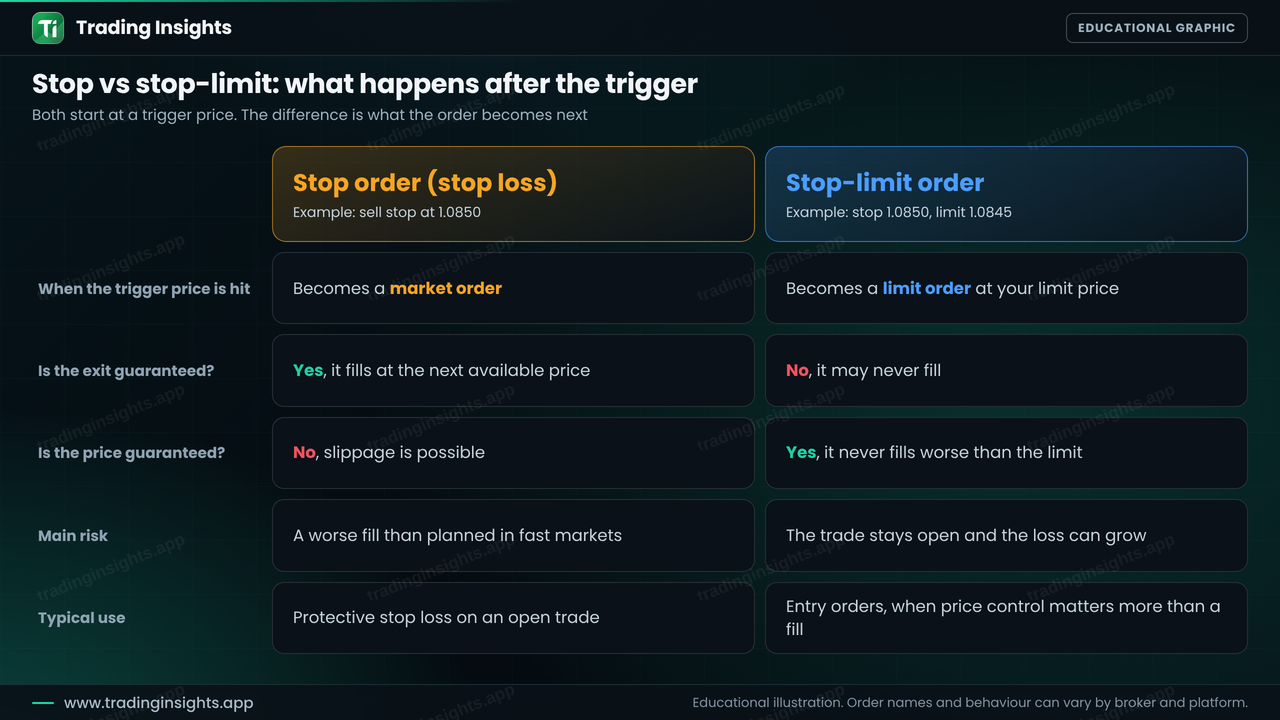
Figure 2: The same fast drop, two outcomes. The stop order fills with slippage. The stop-limit is not filled and the loss keeps growing.
Stop order at 1.0850: the trigger is hit, a market order is sent and it fills at the next available price, 1.0838. That is 12 pips worse than planned. This is called slippage, and it is the cost of a guaranteed exit.
Stop-limit with stop 1.0850 and limit 1.0845: the trigger is hit and a limit order to sell at 1.0845 or better is placed. But price is already below 1.0845, so nobody is buying at that level. The order does not fill, and you remain in a trade that is moving against you.
With a standard lot of EUR/USD, 12 pips of slippage costs $120. But if the stop-limit leaves you in the trade while price falls another 40 pips, the extra loss is $400. For a protective stop, the guaranteed exit is usually the more important feature, and that is why most traders use a plain stop for protection.
When a stop-limit makes sense
Stop-limit orders are better suited to entries than to protection. If you want to buy a breakout, but do not want to pay more than a certain price, a buy stop-limit lets you set both the trigger and the maximum price. The cost is that you can miss the trade if price jumps past your limit. Some platforms offer them for forex, while others offer only plain stops, and the exact name and behaviour can vary by broker and platform, so read your broker's order documentation.