Position size is how many lots you trade, and it is the most important number in your risk management. A trader with a good strategy can still blow up an account by trading too large, and a trader with an average strategy can survive for years by trading the right size. The idea is simple: you decide how much money you are willing to lose on a trade, you place your stop where the idea is wrong, and then the stop distance decides the size. This guide shows the formula in four steps, a full example for EUR/USD, a USD/JPY example where the pip value is different, and a table you can use as a quick reference.
Why position size matters more than the entry
Two traders can take the same entry with the same stop. If one risks 1% of the account and the other risks 10%, a losing streak of five trades leaves the first with about 95% of the account and the second with about 59%. The method is the same, and the survival is very different. Fixing the risk per trade is what keeps a normal losing streak from becoming a disaster. It also keeps you from reaching a margin call or stop out.
The position size formula in four steps
The method is the same for every pair and every account size. Work through the four steps below in order, and you will never have to guess your lot size again.
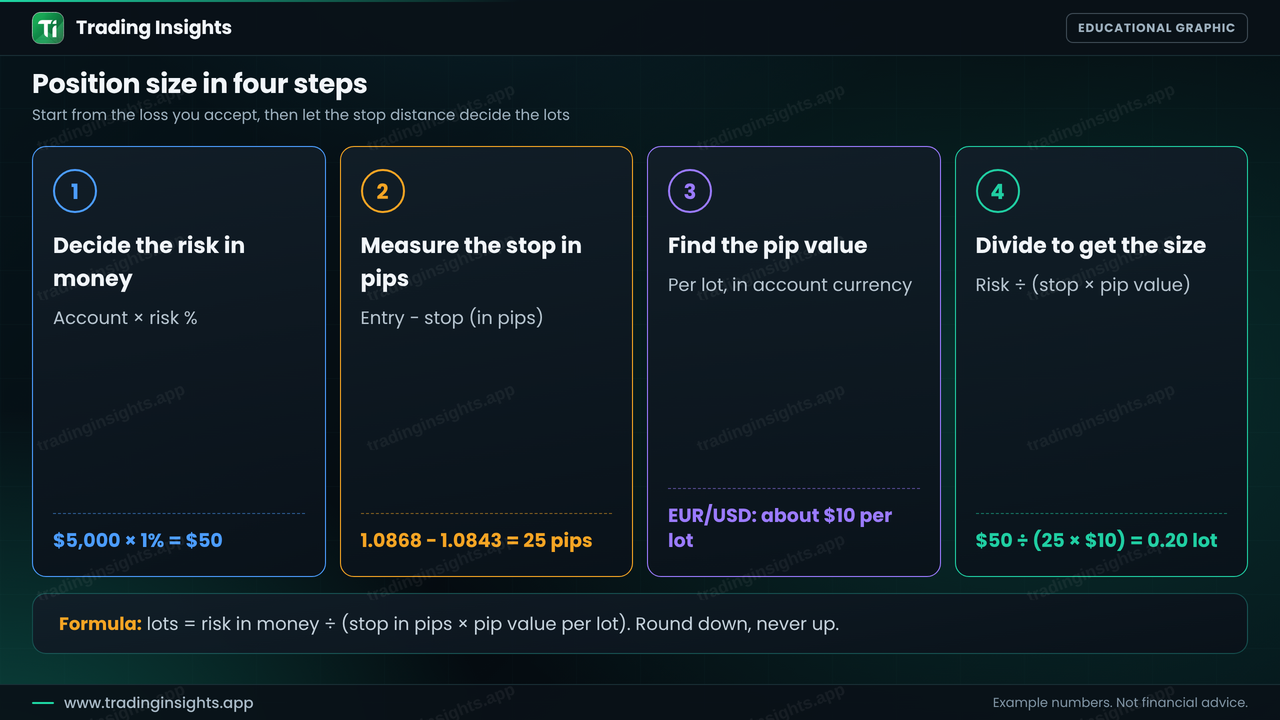
- Decide the risk in money. Account balance x risk percentage. A common choice is 1% or less. On a $5,000 account, 1% is $50.
- Measure the stop in pips. The distance from the entry to the stop loss, taken from the chart. In this example, an entry at 1.0868 and a stop at 1.0843 is 25 pips.
- Find the pip value per lot. For EUR/USD on a USD account, one pip on 1 standard lot is about $10.
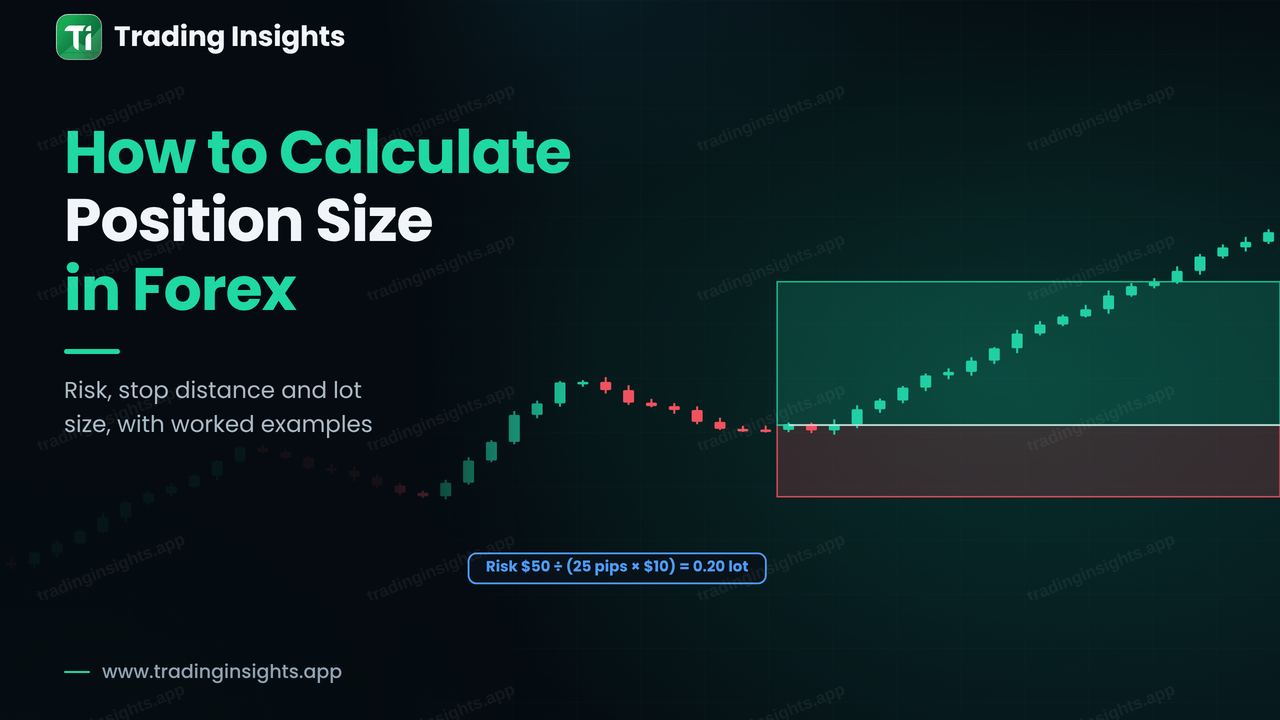
- Divide. Lots = risk in money / (stop in pips x pip value per lot) = $50 / (25 x $10) = 0.20 lot.
Always round down, never up, so that the real risk is never above your limit. A lot is 100,000 units, so 0.20 lot is 20,000 units, and the smallest common size, 0.01 lot, is a micro lot (1,000 units).
Why the stop distance changes the size
The key point is that the amount you risk stays the same, while the lot size changes with the stop. A tight stop allows a larger position, and a wide stop requires a smaller one. The chart below shows the same $50 risk on EUR/USD with five different stop distances.
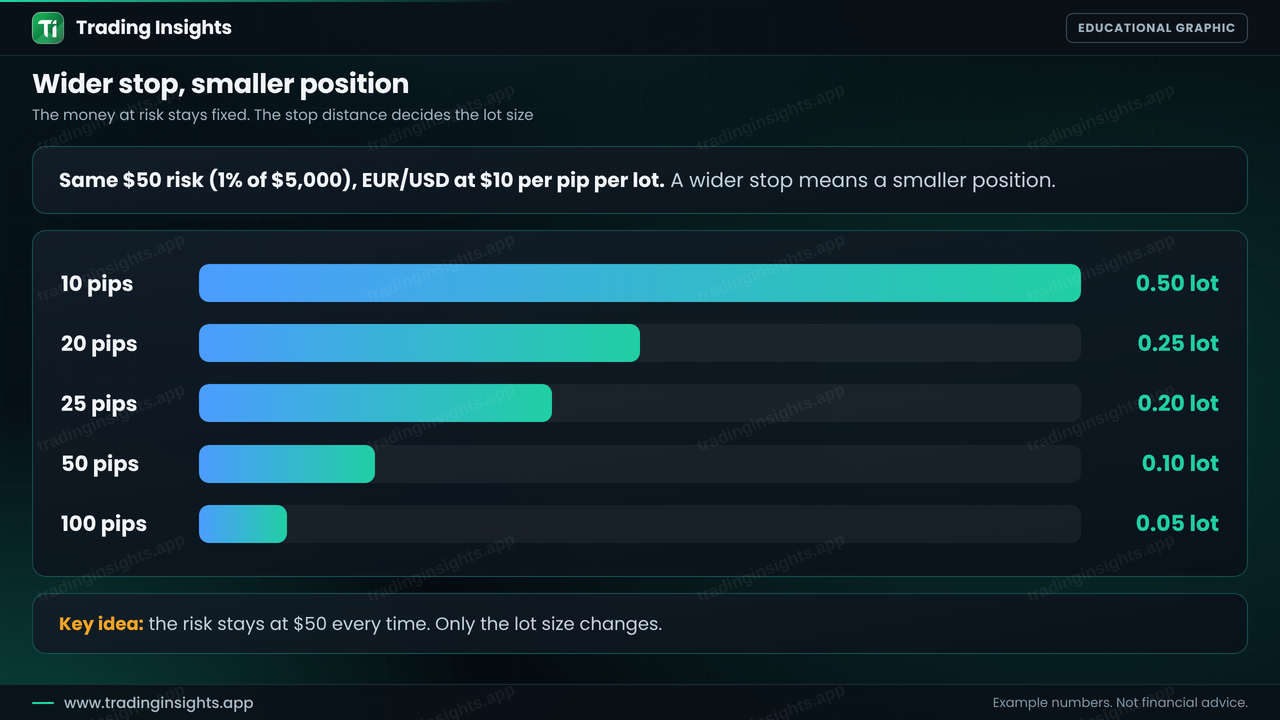
This is the reverse of how many beginners think. They pick a lot size first, and then place the stop wherever it fits the risk they already took. The stop should come from the chart, such as beyond a swing, an order block or a fair value gap, and the size should adapt to it. For help with placing the stop, read how to find entry, stop loss and take profit.
A full example on EUR/USD
Here is the complete plan for an illustrative EUR/USD trade on H1, with a $5,000 account and 1% risk.
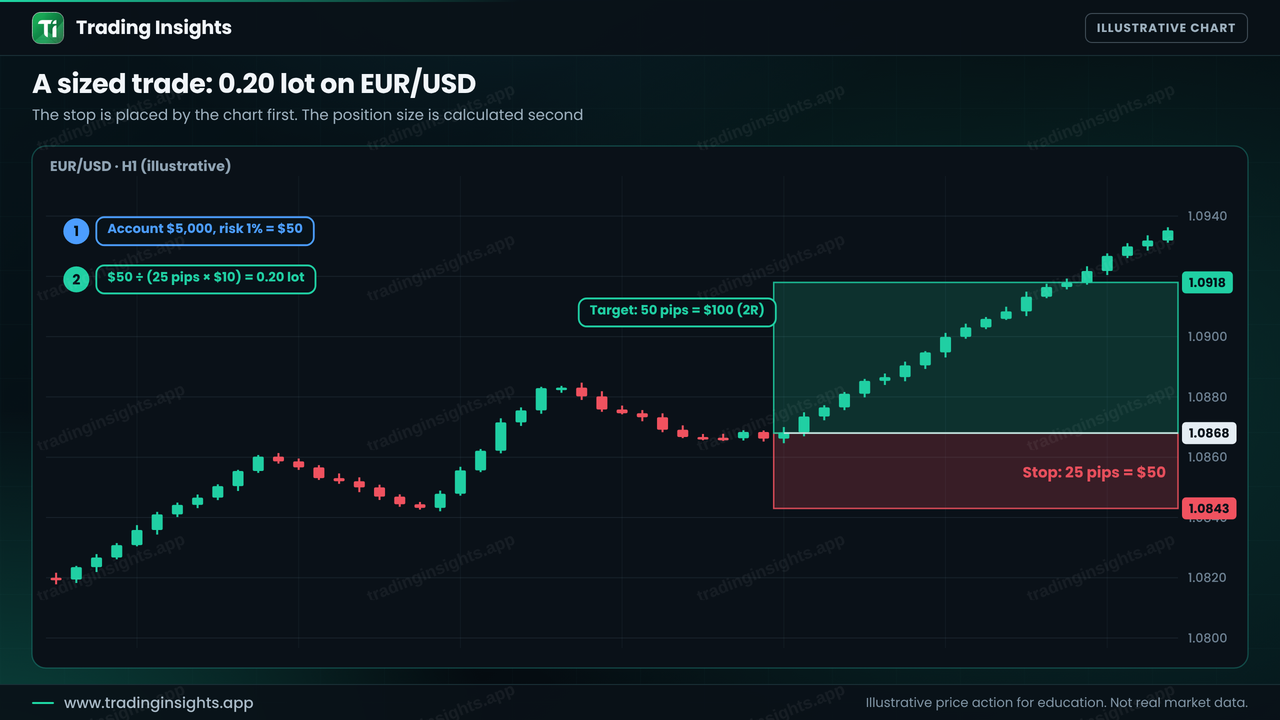
- Risk: $5,000 x 1% = $50.
- Entry: 1.0868. Stop: 1.0843 (25 pips). Target: 1.0918 (50 pips).
- Size: $50 / (25 x $10) = 0.20 lot.
- If the stop is hit: you lose $50, or 1% of the account.
- If the target is hit: you make $100, a ratio of 1:2.