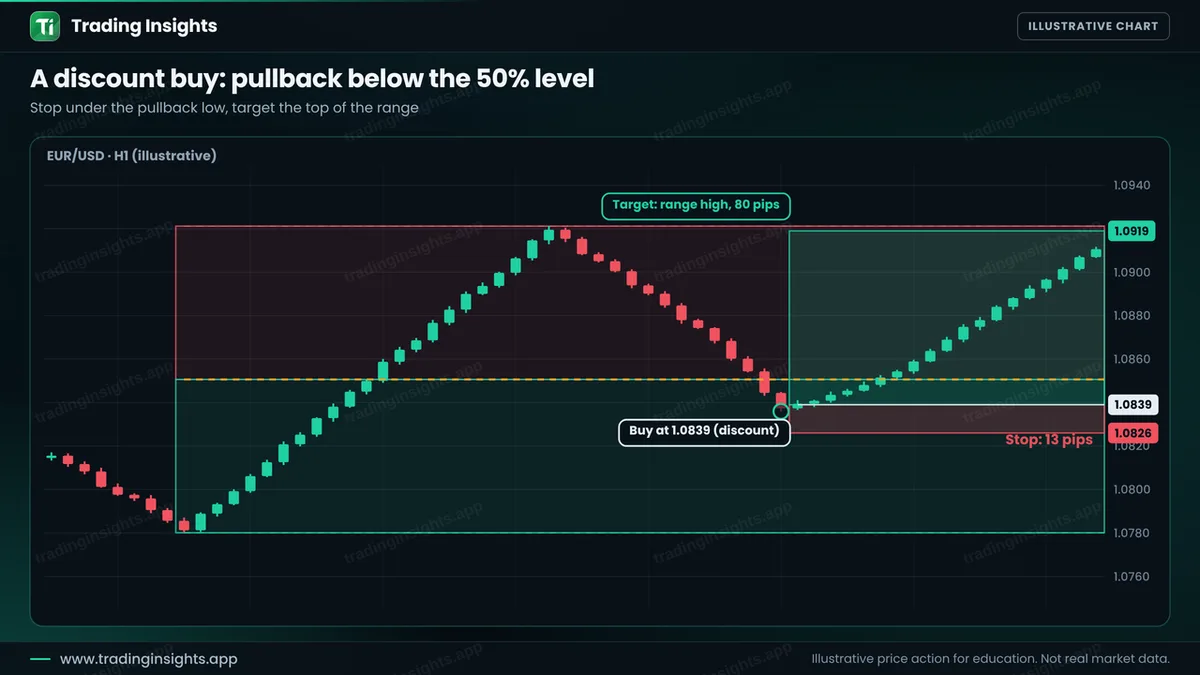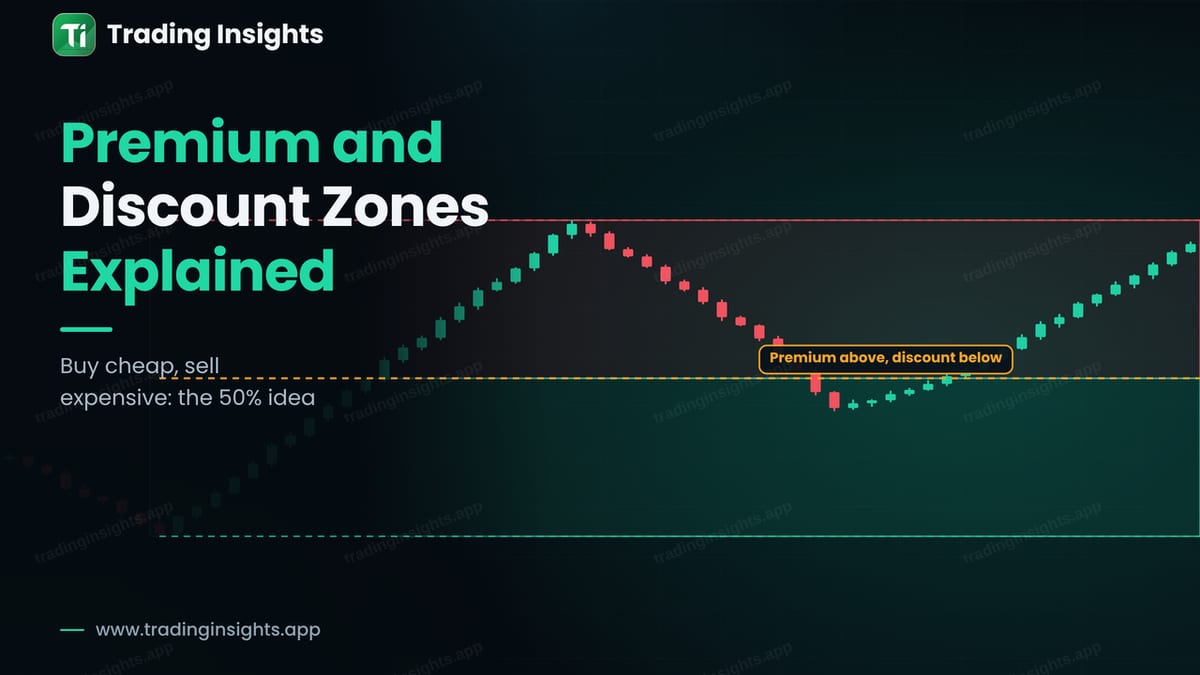
Premium and discount zones are a simple way to judge where price is inside a range. You take a clear swing low and swing high, find the midpoint, and call the upper half the premium zone and the lower half the discount zone. The idea is the same as in any market: buying cheap and selling expensive gives a better risk-to-reward ratio than buying at the top of a move. This guide shows how to mark the zones, how to combine them with the trend, how to plan a discount buy with a stop and a target, and where the idea has limits.
What premium and discount mean
Take the lowest and the highest point of a clearly defined range, and draw a line halfway between them. This line is called the equilibrium, or the 50% level. Price above it is in the premium zone, which means it is relatively expensive within that range. Price below it is in the discount zone, which means it is relatively cheap.
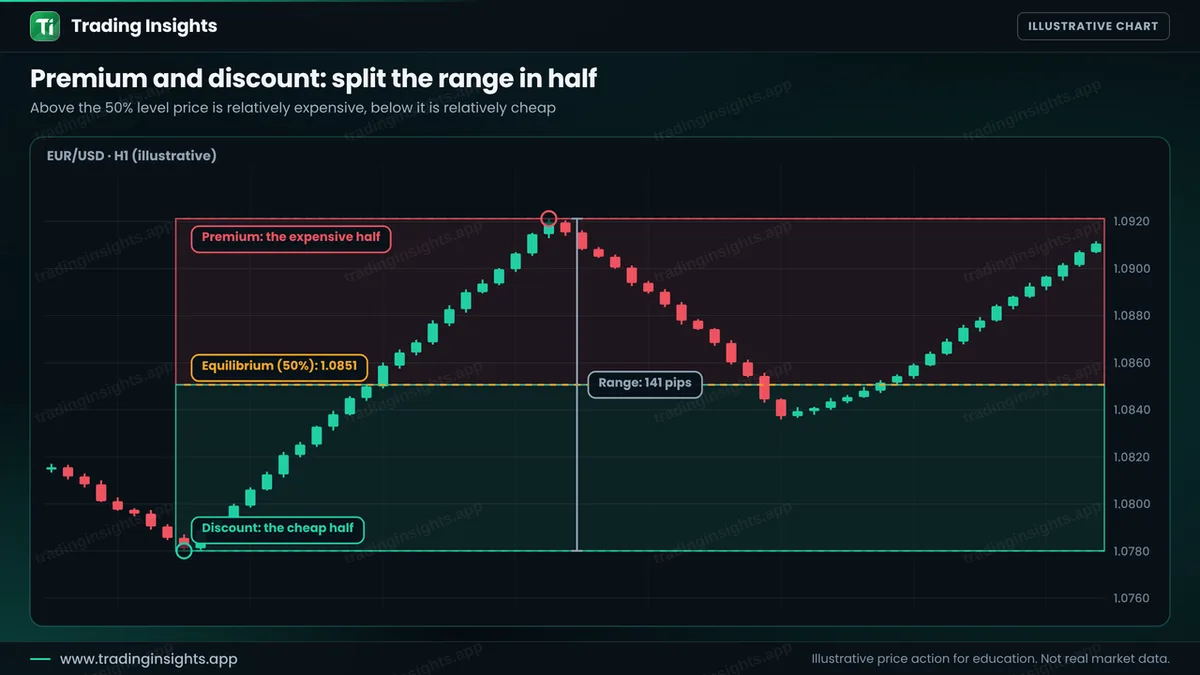
The tool is the same as a Fibonacci retracement drawn at only one level, the 50% line. It does not say that price must react there. It tells you where a trade would start from a good location or a poor one. A buy in the discount half has more room to the upside and a stop that is close to the low of the range. A buy in the premium half has less room and a stop that is far away.
How to mark the zones
- Choose a meaningful range. Use the last major swing low and swing high on your timeframe, not a few candles. See swing highs and lows for how to find them.
- Draw the 50% line. Most platforms have a Fibonacci or a range tool. Many traders only use the 50% level.
- Shade the halves. The area above the line is premium and the area below is discount.
- Update when the range changes. If price makes a new high or low and breaks the range, redraw the zones from the new swings.
The range should come from the structure of the market, as described in what market structure is. A range drawn between two random candles gives a random equilibrium.
Using the zones with the trend
The zones are most useful as a filter in a trend. In an uptrend, you look for buys when price pulls back into the discount half, and you avoid chasing buys in the premium half. In a downtrend, you look for sells when price rallies into the premium half.
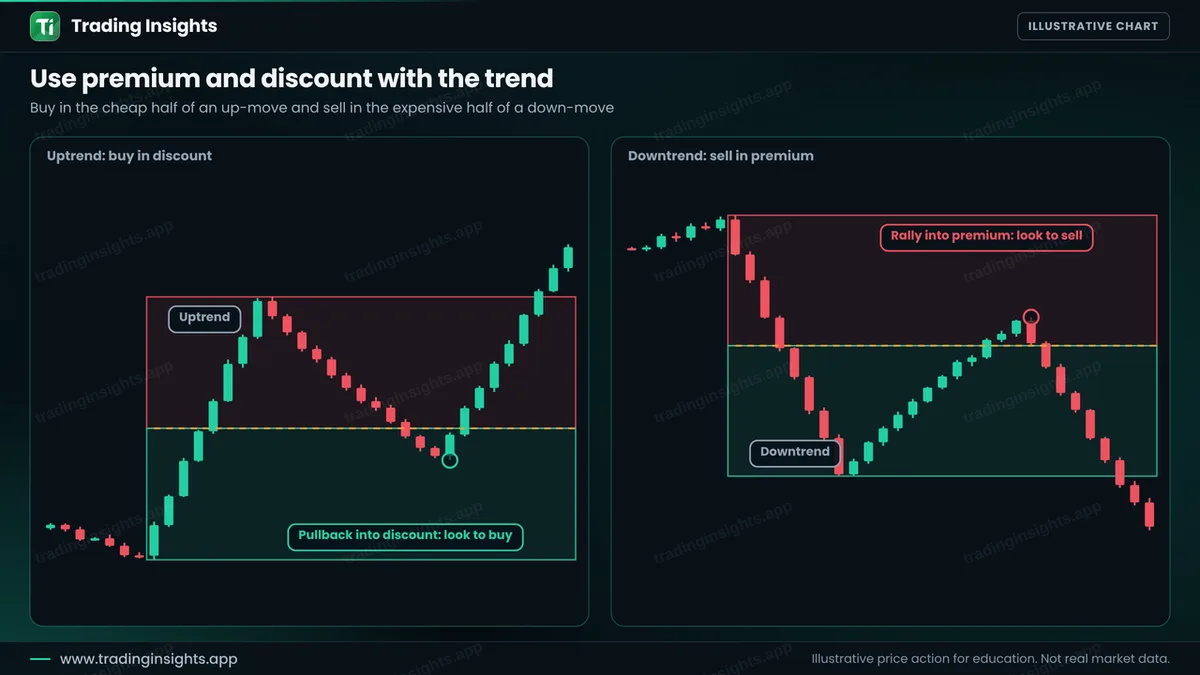
Notice the role of the trend. A pullback into the discount zone in a downtrend is not a buy signal, because it can be just a pause before the next leg down. First decide the direction, as in top-down analysis and in bullish vs bearish market structure, and then use the zones for timing.