Markets do not trend all the time. For long periods price moves sideways between a ceiling and a floor, and trend strategies stop working. Range trading is built for that condition: you sell near the top of the range, buy near the bottom, and take profit before the other side. It is a simple strategy that suits beginners because the levels are easy to see, but it has one big risk: a range always ends, and a trade taken just before the break can lose quickly. This guide shows how to identify a range, how to trade its edges, how to place the stop and target with real numbers, and how to know when to stand aside.
What a trading range looks like
A range has a clear resistance, where price turns down several times, and a clear support, where it turns up several times. The area in between is the range. You need at least two touches on each side before you call it a range, and three is better.
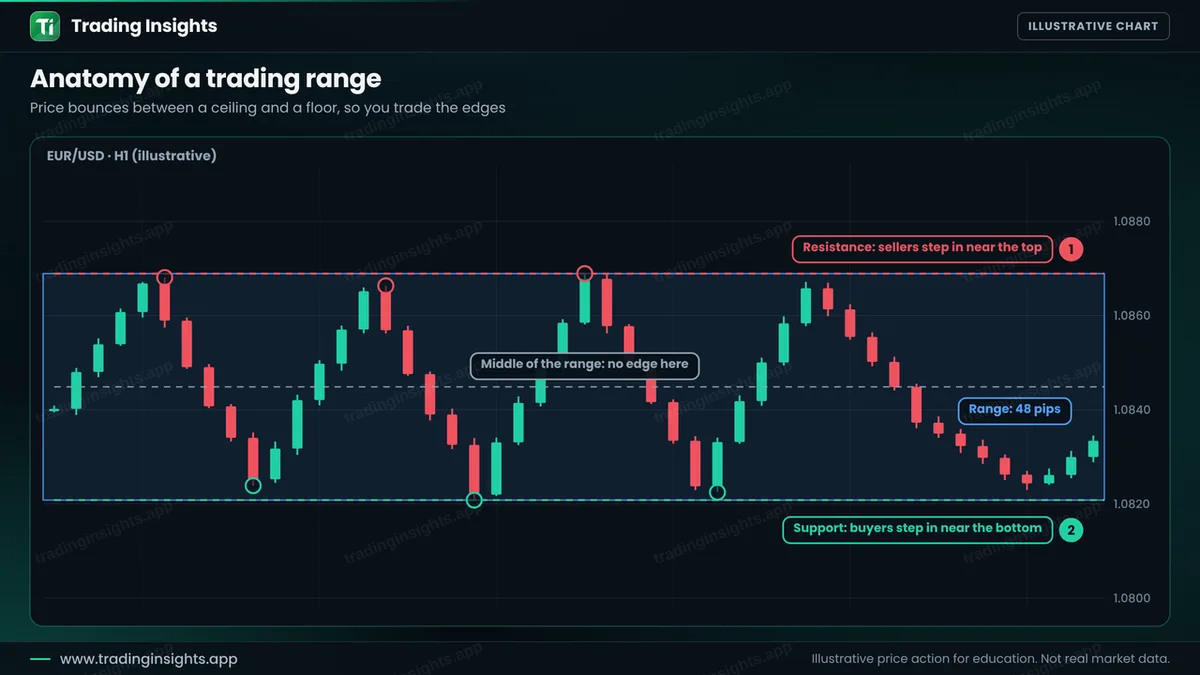
The levels are zones and not exact lines, so wicks will sometimes poke beyond them. For how to draw these levels, see support and resistance vs supply and demand zones. The middle of the range is a no-trade area: the stop would be far away and the target close, which gives a poor ratio.
The rules, step by step
- Confirm the range. At least two or three touches of both the top and the bottom, with no clear trend. The higher timeframe should also be sideways or at least not strongly trending. See top-down analysis.
- Wait for price to reach an edge. Do not trade in the middle.
- Wait for a reaction. A rejection candle at the edge, such as a wick that fails to close beyond the level. See candlestick patterns for beginners.
- Enter in the direction away from the edge. Sell near the top or buy near the bottom.
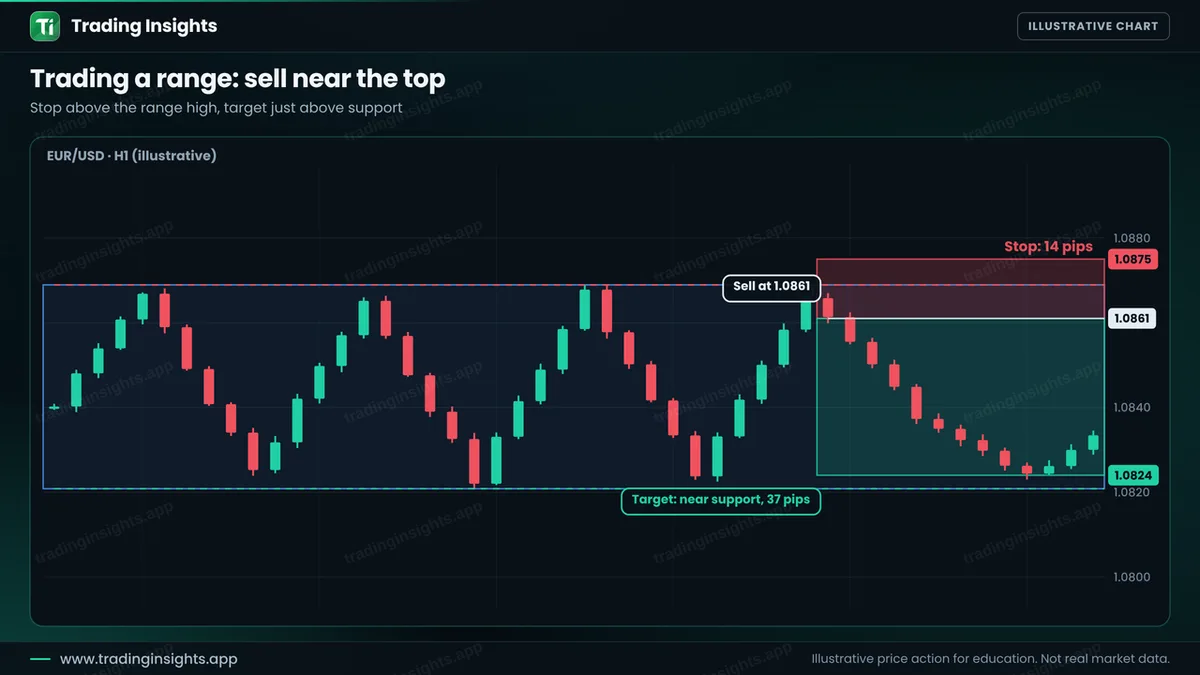
- Place the stop beyond the range. A few pips above the high for a sell, or below the low for a buy. If price gets there, the range may be breaking.
- Set the target. Near the opposite side of the range, a little before the level, because price often turns before it touches. Some traders take part of the profit at the middle.
- Size the trade. From the stop distance and a fixed risk percentage.
When the range breaks
The danger of the strategy is the breakout. A range does not announce its end. Price closes beyond a level, and the trades that were taken against it lose. The safest approach is to decide in advance what a close outside the range means for you.
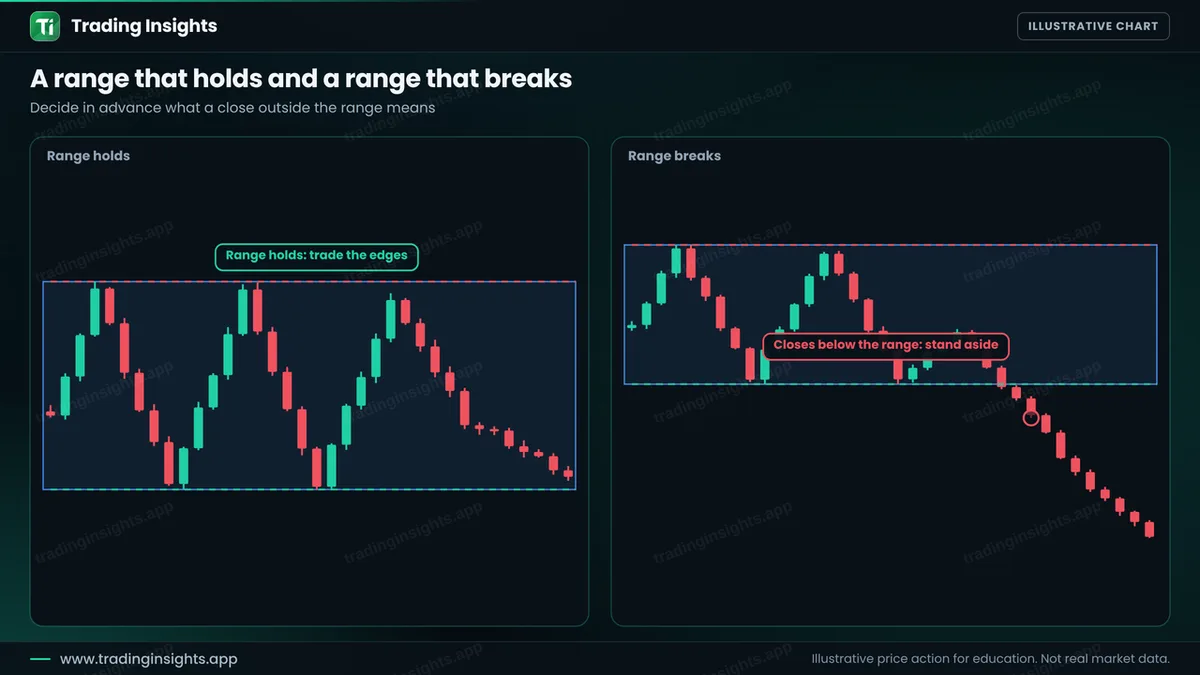
A simple rule is that after a candle closes beyond the range, you stop trading against the break and wait. If price comes back to retest the broken level, the situation changes, and you may be dealing with a break and retest setup. Be careful with the first spike, since it may also be a liquidity sweep that returns inside. A stop loss placed beyond the range limits the damage in each case.