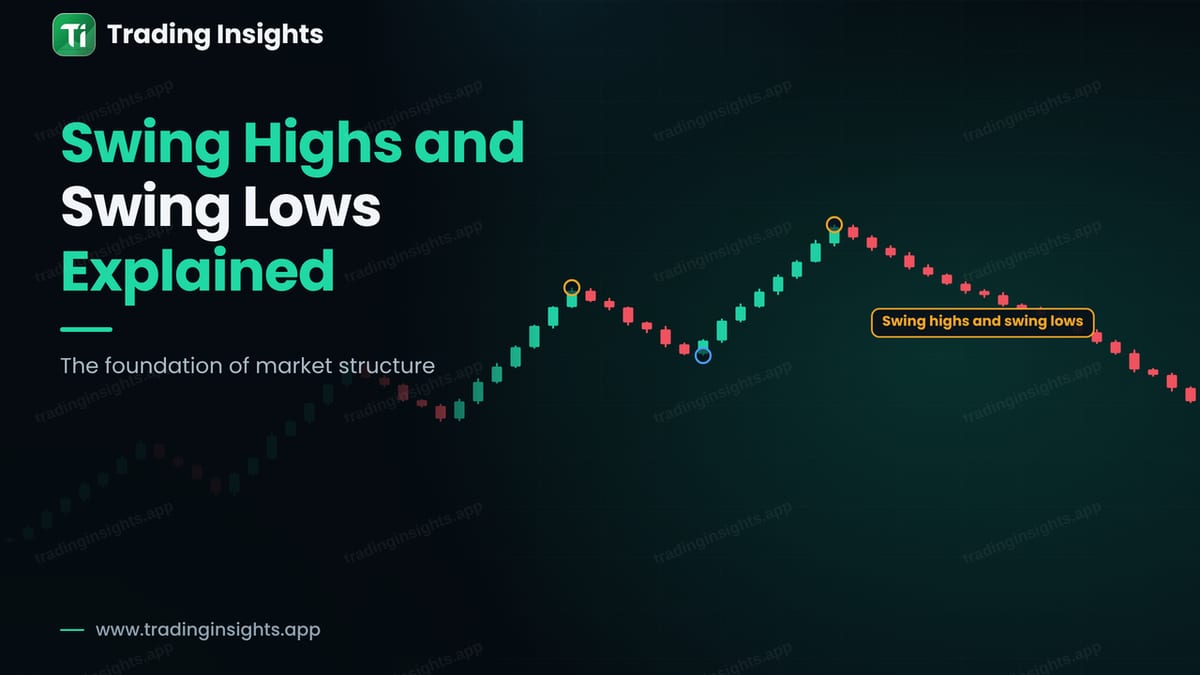
Almost every price-action idea starts with swing points. A swing high is a peak that is lower on both sides, and a swing low is a trough that is higher on both sides. Connect them and you can read the trend, find where to put a stop loss and decide where a trade idea is wrong. This guide explains how to mark swings, why two traders can mark different swings on the same chart, how swings label an uptrend and a downtrend, and four rules for keeping your marking consistent.
What swing highs and swing lows are
A swing high is a candle high with lower highs on both sides. A swing low is a candle low with higher lows on both sides. The simplest version uses one candle on each side, and a stricter version uses two or three. Because a swing needs candles after it to be confirmed, you always recognise it with a delay.
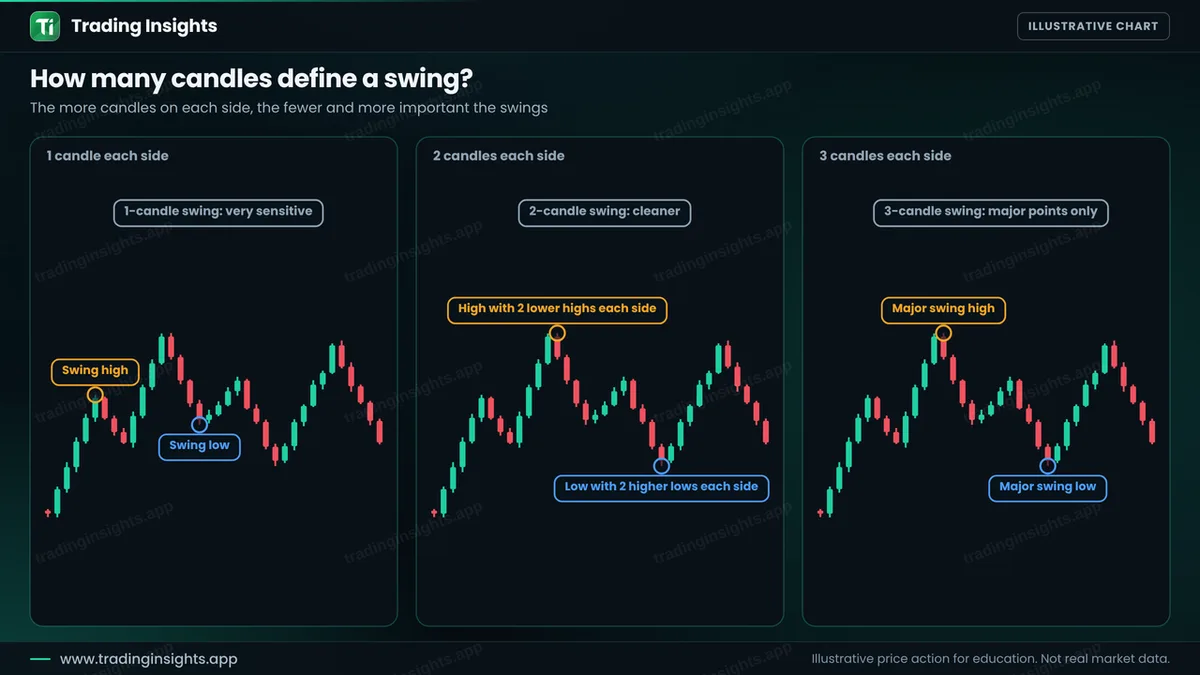
The figure shows why you must choose a sensitivity and stick to it. Small swings are useful for entries on a lower timeframe, and major swings are useful for the big picture. Most traders mark swings on two timeframes, as in top-down analysis.
How swings label the trend
The order of swings defines the trend. In an uptrend, each swing high is higher than the last (higher highs, HH) and each swing low is higher than the last (higher lows, HL). In a downtrend, you see lower highs (LH) and lower lows (LL). When a swing low in an uptrend is broken, the sequence is in question, which is the first sign of a change of character.
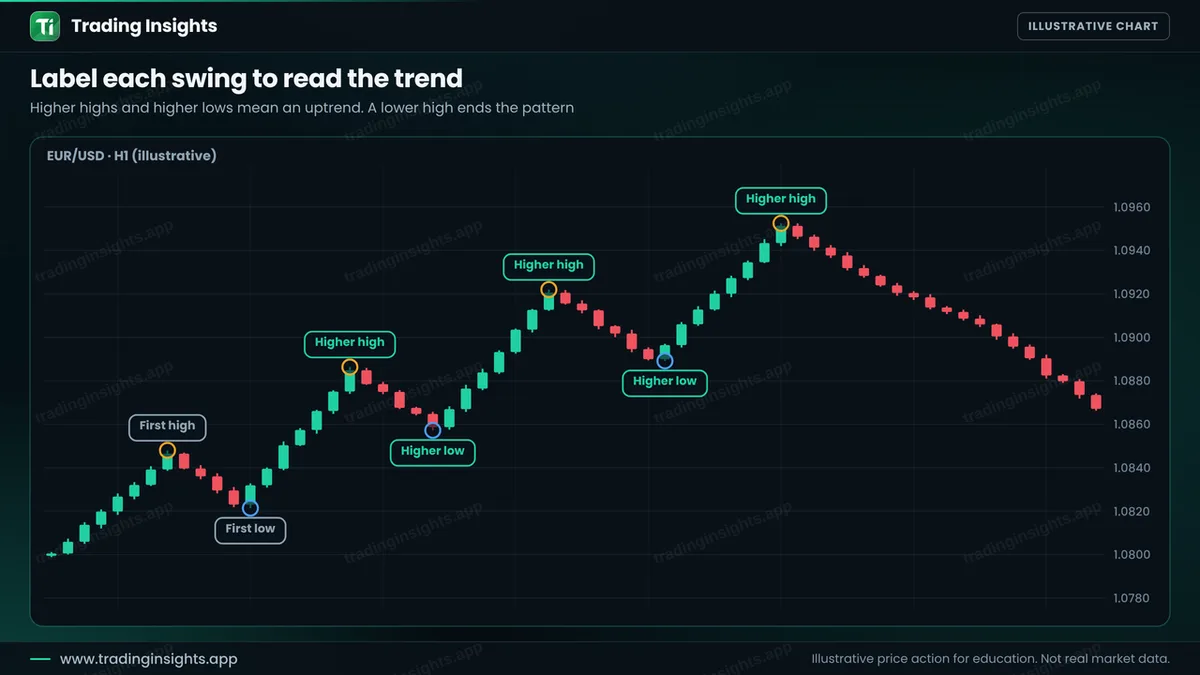
This is the base for market structure and for bullish vs bearish structure. It is also the base for break of structure and change of character: both are defined as breaks of a swing point.
Four rules for marking swings
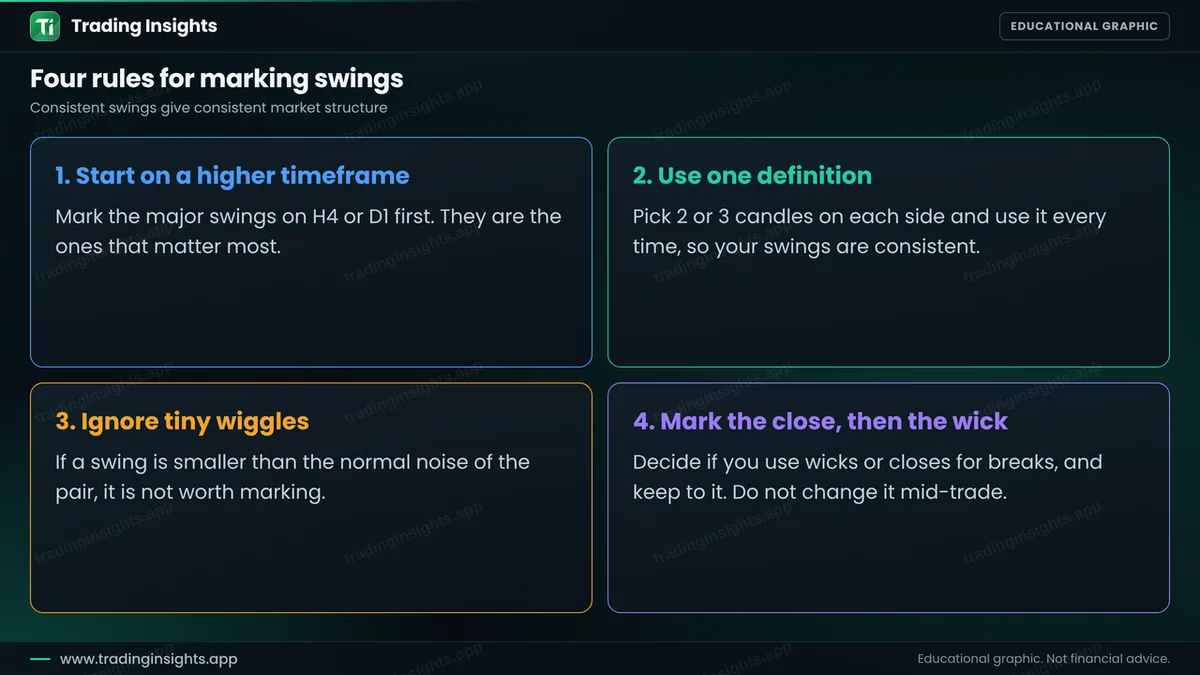
- Start on a higher timeframe. Mark the major swings on H4 or D1 first. They are the ones that matter most.
- Use one definition. Pick two or three candles on each side and use it every time, so your swings are consistent.
- Ignore tiny wiggles. If a swing is smaller than the normal noise of the pair, it is not worth marking.
- Decide between the close and the wick. Choose whether you judge breaks by wicks or by closes, and keep to it. Do not change it in the middle of a trade.