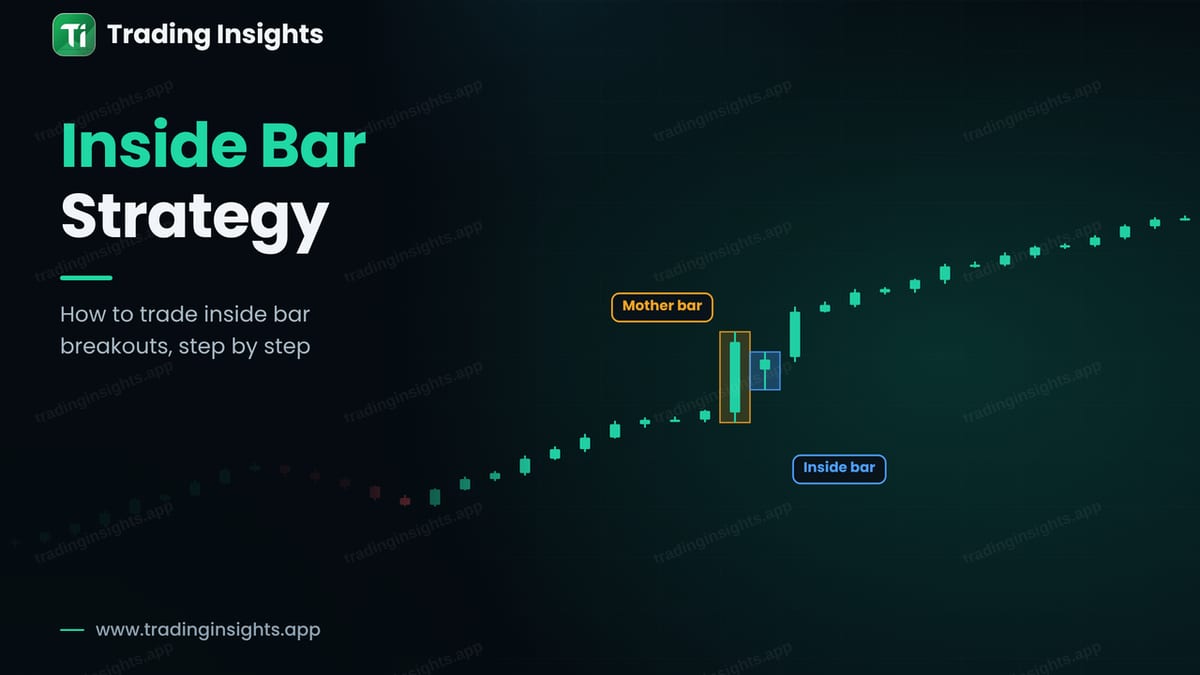
An inside bar is one of the simplest candlestick patterns, and it gives a clear framework for a trade. It is a small candle whose high and low both stay within the range of the candle before it. That larger candle is called the mother bar. The inside bar shows a pause, with neither buyers nor sellers able to push price beyond the mother bar, and the next move often comes when one side finally breaks out. This guide explains how to identify the pattern, why the trend matters, how to place the entry and the stop, and how to size a trade. It is a simple strategy, but it has losing trades and many false breaks, so it needs testing.
What an inside bar looks like
You need two candles. The first is the mother bar, usually larger than the recent average. The second is the inside bar: its high is lower than the mother bar high, and its low is higher than the mother bar low. The body and the color do not matter as much as the position of the high and the low.
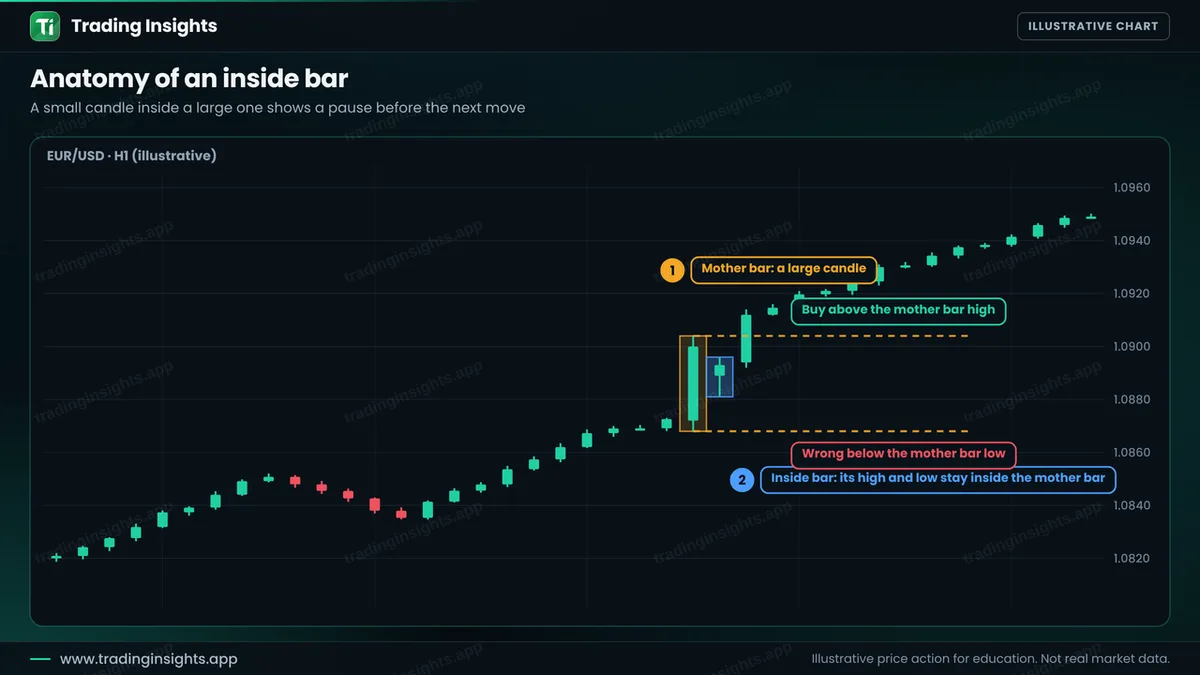
The logic is compression. A big candle shows a strong move, and the small candle that follows shows hesitation. Volatility has dropped for a moment, and a break of the mother bar range often brings it back. This is a common way to see it, not a rule of the market, so what you need is a plan for when it fails. If you are new to candles, read candlestick patterns for beginners first.
The rules, step by step
- Find the trend. Look at the higher timeframe or at the swing structure. Inside bars are more reliable when they appear in the direction of the trend, such as after a pullback in an uptrend. See swing highs and lows.
- Spot the pattern. A mother bar and an inside bar that stays fully inside it. A mother bar that is only slightly bigger than the others gives a weak signal.
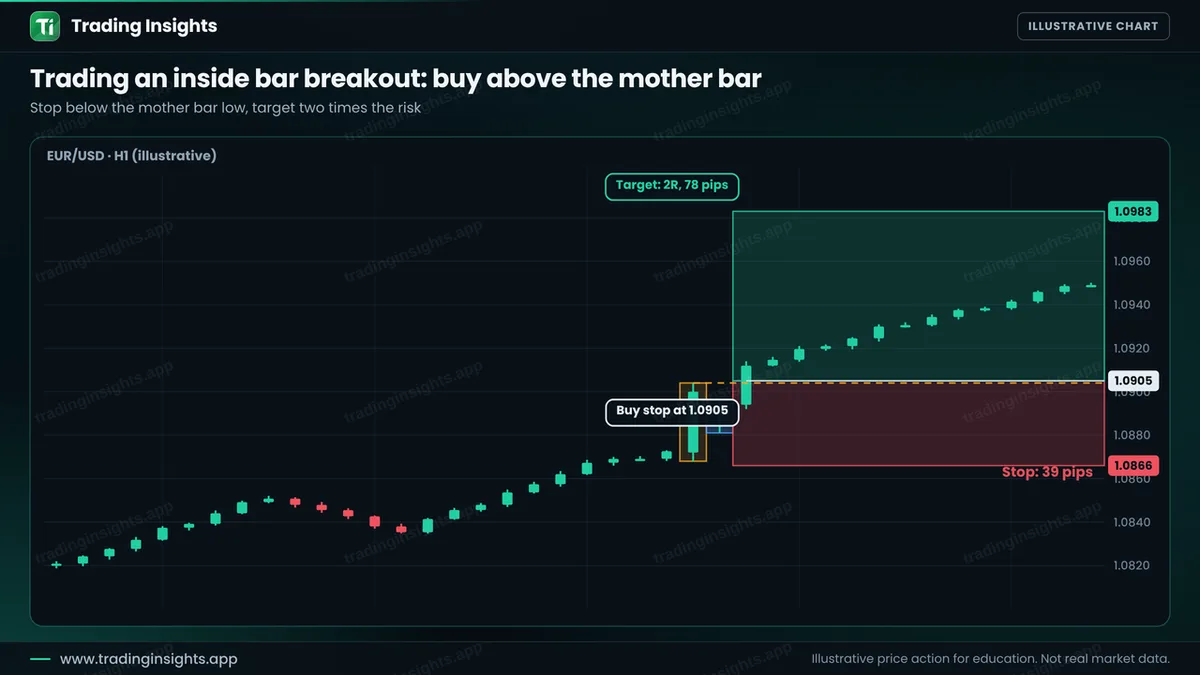
- Place the entry. For a buy, a buy stop order a pip or two above the mother bar high. For a sell, a sell stop a pip or two below the mother bar low.
- Place the stop loss. Beyond the other side of the mother bar, with a small buffer. For a buy, that is below the mother bar low.
- Set the target. A multiple of the risk, such as 2R, or the next level. See stop loss and take profit.
- Cancel if it does not trigger. If price breaks the other side first, or several candles pass with no break, remove the pending order.
Trend or range: when to skip it
The pattern appears all the time, including in sideways markets, and there it gives many false breaks. Price spikes beyond the mother bar, triggers the entry and then returns inside the range.
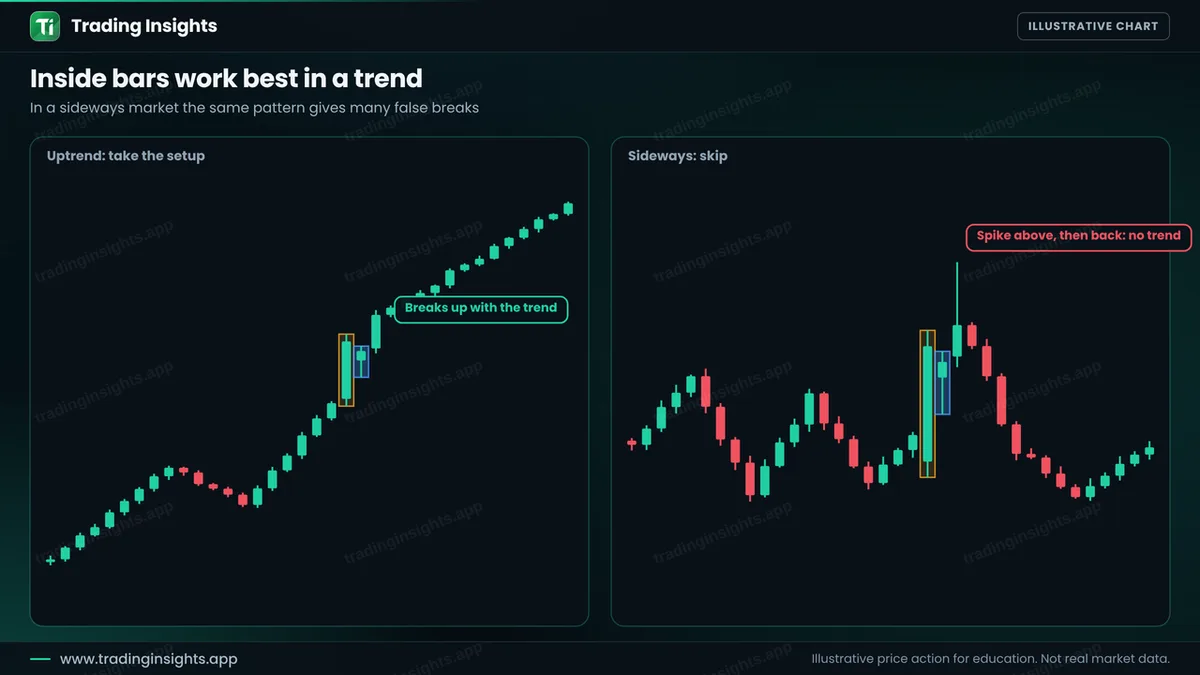
A simple filter is to ask whether the swings are making higher highs and higher lows, or lower highs and lower lows. If the market is choppy, with no clear direction, stay out. Also be careful at the edge of a range, where a break may be a liquidity sweep and not a real move. A location filter helps too: for buys, prefer inside bars that form in the discount half of a swing. See premium and discount zones.