
Yes, you can trade forex part time with a full-time job, but only if the method matches the time you have. A strategy that needs constant screen watching will not survive a work week, so part-time traders usually move to higher timeframes, pending orders with stops and a fixed routine. The goal is fewer decisions, made in advance, not squeezing a day-trading style into the evening.
The challenges of part-time forex trading
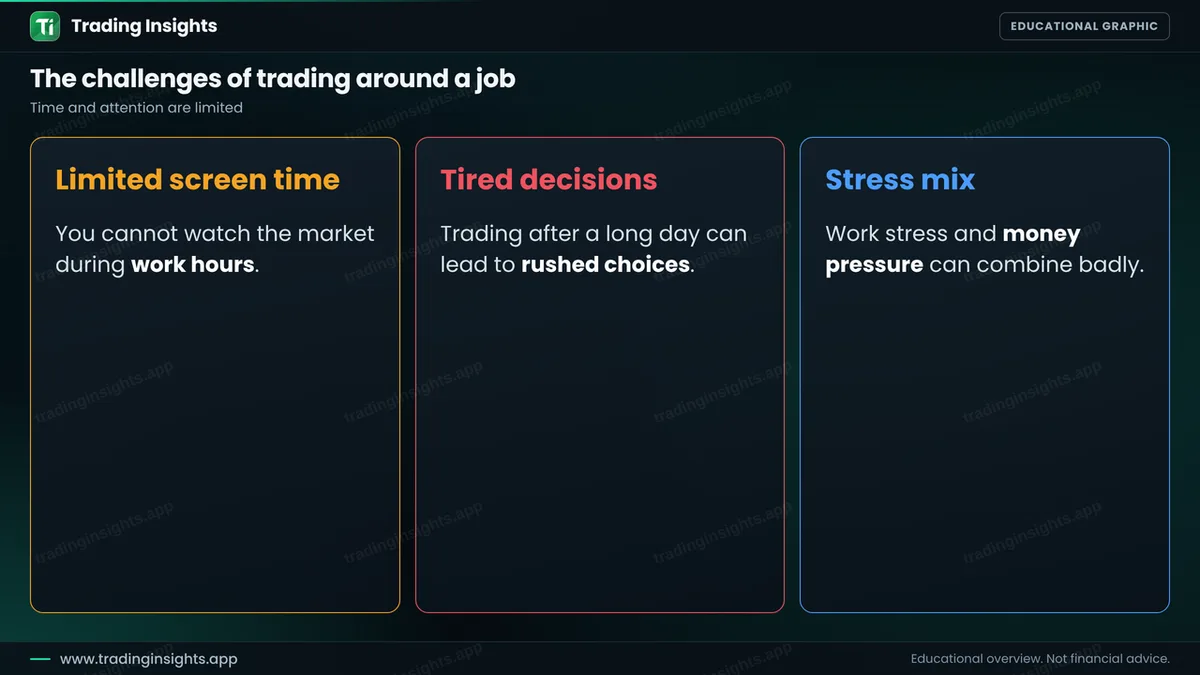
- Limited screen time. You cannot watch the market during work, so you may miss exits and entries.
- Tired decisions. Trading after a long day can lead to rushed choices, which is a recipe for overtrading and FOMO.
- Stress that mixes. Work stress and money pressure can build on each other, especially if the account is needed for something.
Change the method, not only the hours
The solution is not to squeeze a day-trading style into the evening. It is to use a style with fewer decisions that can be made in advance. This usually means higher timeframes, such as H4 and D1.
On these charts, a candle takes hours to form, signals are fewer, and you do not need to watch every move. See top-down analysis for how to use them.
A sample forex routine for a full-time worker
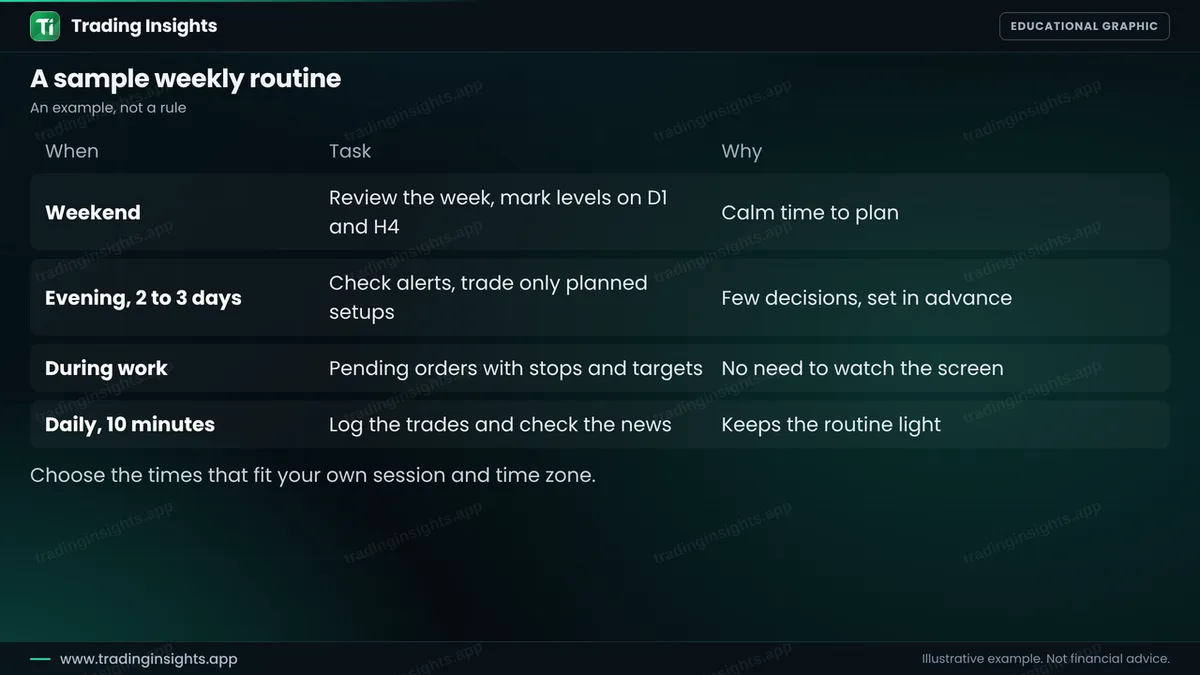
On the weekend, review the week, mark levels on the daily and four-hour charts, and note the news for the week. On two or three evenings, check your alerts and take only the setups that are in your plan. During work hours, rely on pending orders with a stop and a target, not on watching the screen. Every day, spend ten minutes logging trades and checking the news.
See the daily forex trading routine for a fuller version.
Rules that help part-time traders
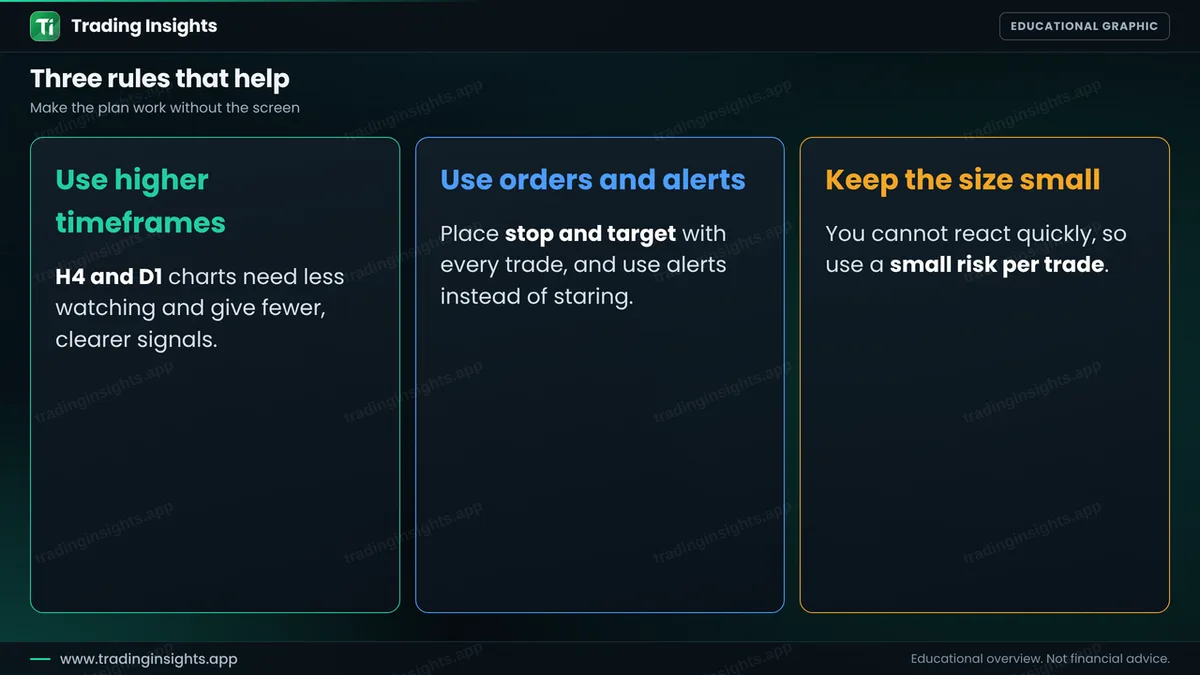
- Use higher timeframes. H4 and D1 setups need less watching, and the larger stops go with a smaller size. See how to calculate position size.
- Use orders and alerts. Place the stop and the target with every trade, so the trade is protected while you are away. Use pending orders for entries, see forex order types, and alerts for levels.
- Keep the size small. You cannot react quickly, so use a small risk per trade, and set a daily loss limit.
- Know the news times. Do not hold large positions through a release that you cannot watch. See trading forex news.
- Count the swap. Trades held for days pay or earn swap. See forex swap and rollover.
Illustrative example: an H4 pending order set before work
This is an illustrative example, not a real trade. On Sunday evening, GBP/USD is in an uptrend on the daily chart and price is heading down to a support level at 1.2700. The trader places a buy limit at 1.2700 with a stop at 1.2640 (60 pips) and a target at 1.2820 (120 pips), a 1 to 2 ratio. Then the trader goes to work.
With a $10,000 account risking 0.5% ($50), the position size is $50 / (60 pips x $10 per pip per lot) = about 0.08 lot. A win pays about $100, and a loss costs about $50. If price never reaches 1.2700, the order is cancelled or expires, and nothing is lost.
The trader did not need to watch the screen once. The plan, the stop and the target were all set in advance.
Strategies that fit a busy schedule
- Pullback entries in a trend on H4 or D1. See the EMA pullback strategy.
- Break and retest on higher timeframes. See break and retest.
- Range trading with orders at support and resistance. See range trading.
Keeping the balance
- Do not trade at work, even when you can, if it hurts your job. Your salary is your safety net.
- Do not trade money that you need for bills.
- Rest. Take days off from the charts.
- Start with a demo account to test the routine. See demo account vs live account.
Common mistakes
- Using a scalping style with no time to watch it. Fast trades need fast decisions. Move to H4 or D1.
- Entering a trade without a stop before a meeting. A sudden move can do real damage while you are away. Place the stop with the order.
- Checking the phone all day and making impulsive changes. Moving stops and targets on a whim breaks the plan. Set alerts, then leave the chart alone.
- Risking too much to make up for the lack of time. Bigger size does not replace screen time. Keep the risk small and fixed.
Frequently asked questions
Can I trade forex part time?
Yes. Many people trade part time using higher timeframes, pending orders with stops and a set routine that fits around their hours.
Which timeframe is best for a person with a job?
H4 and D1 are common choices, because they need less watching and give fewer, clearer signals.
Should I use stop losses if I am away from the screen?
Always. Place the stop and the target with the trade, so that it is protected when you are not watching.
How much time do I need each day?
Often about ten to thirty minutes on most days, plus a longer review on the weekend, depending on the strategy.
Your next step
Write your own weekly schedule on one page: when you review the charts, which evenings you may trade, and the one setup you will use. Test it on a demo account for a few weeks before you risk real money, and size trades with the position size calculator.
This is education, not financial advice. Trading carries risk, and no routine removes it. The charts are illustrative and not real market data.


