
Forex swap, also called rollover, is a small fee or credit applied when you keep a trade open past the daily cutoff, often 5 pm New York time. It comes from the interest rate difference between the two currencies, plus a broker charge. It is small on a single night, but it can add up when you hold a position for weeks, so it is worth knowing before you compare brokers or plan a longer trade.
What is rollover in forex?
Every forex trade is, in theory, a settlement of two currencies after a short period. To avoid actual delivery, brokers roll open positions forward from one day to the next. This happens at a fixed time each day, often 5 pm New York time.
If your position is open at that moment, it is rolled over, and a swap amount is added to or taken from your account. If you close before that time, there is no swap.
Why forex swap exists
Each currency has its own interest rate, set by its central bank. When you buy one currency and sell another, you hold one and borrow the other. The swap reflects the difference between the two rates, plus a charge from the broker. See interest rates and forex for how rates affect currencies.
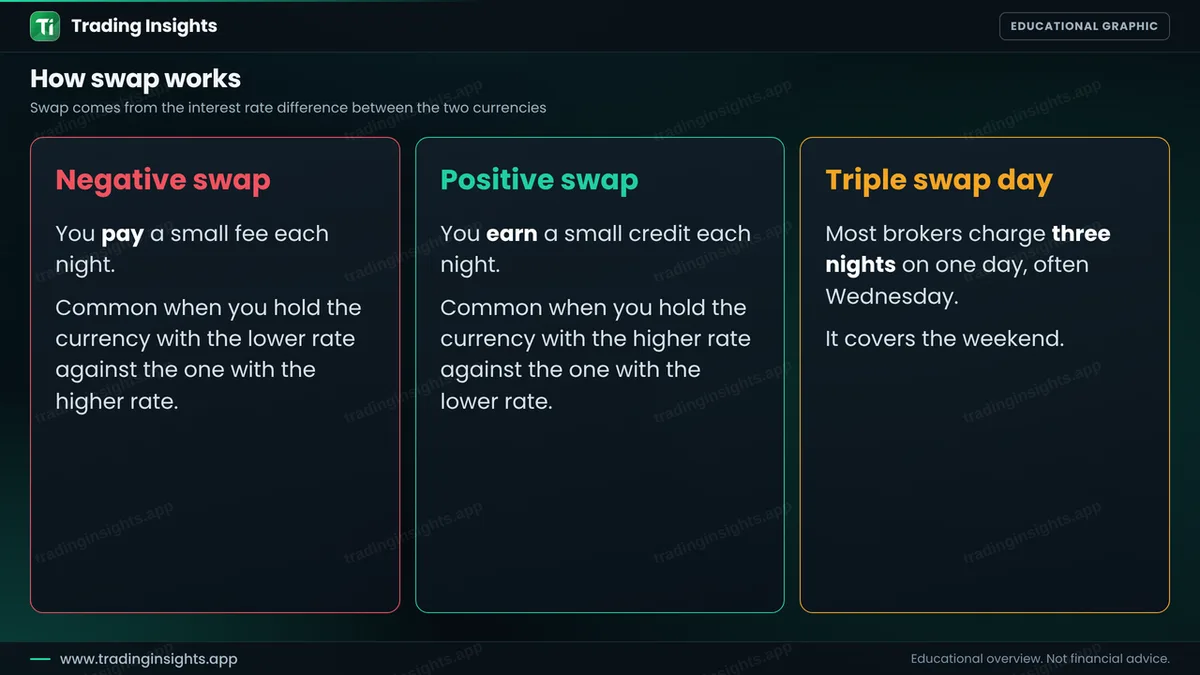
If you hold the currency with the higher rate, you may earn a positive swap. If you hold the one with the lower rate, you usually pay a negative swap. Because brokers add their own charge, both sides can sometimes be negative. Rates change often, so the swap can change from day to day.
What is triple swap?
Spot forex is normally settled two business days later. Because of the weekend, the position rolled on Wednesday is settled after the weekend, so most brokers charge three days of swap on Wednesday.
Some brokers use a different day for some instruments, so check your own broker. If you hold a position through the triple-swap rollover, the charge is three times larger for that night.
Illustrative example: what swap costs on a trade
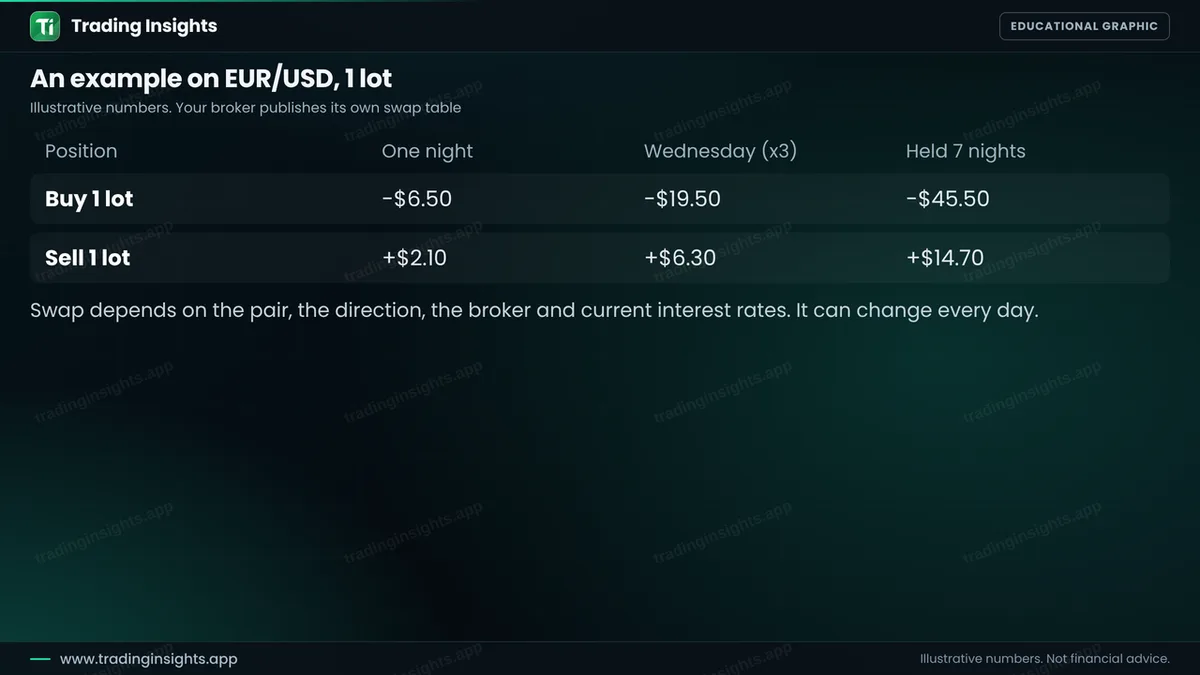
This is an illustrative example with made-up swap values. Real values depend on the broker and the day. Suppose a broker charges -$6.50 per night on a long position of 1 lot in EUR/USD, and credits +$2.10 for a short position.
Seven nights at the base rate would cost 7 x $6.50 = $45.50 on a long, or earn 7 x $2.10 = $14.70 on a short, as in the figure below. If one of those nights is the Wednesday triple, it counts as three nights, so the long costs 9 x $6.50 = $58.50 and the short earns 9 x $2.10 = $18.90.
Now scale it to a real trade. With a $10,000 account risking 1% ($100) and a 40 pip stop, the position size is $100 / (40 pips x $10 per pip per lot) = 0.25 lot. A win at 80 pips pays about $200, and a loss costs about $100.
Swap on 0.25 lot is a quarter of the 1 lot figure, about $1.63 a night. Over ten nights that is roughly $16, or about 8% of the $200 target. Not huge, but part of the plan. See forex trading costs for the other costs.
How to check swap before you trade
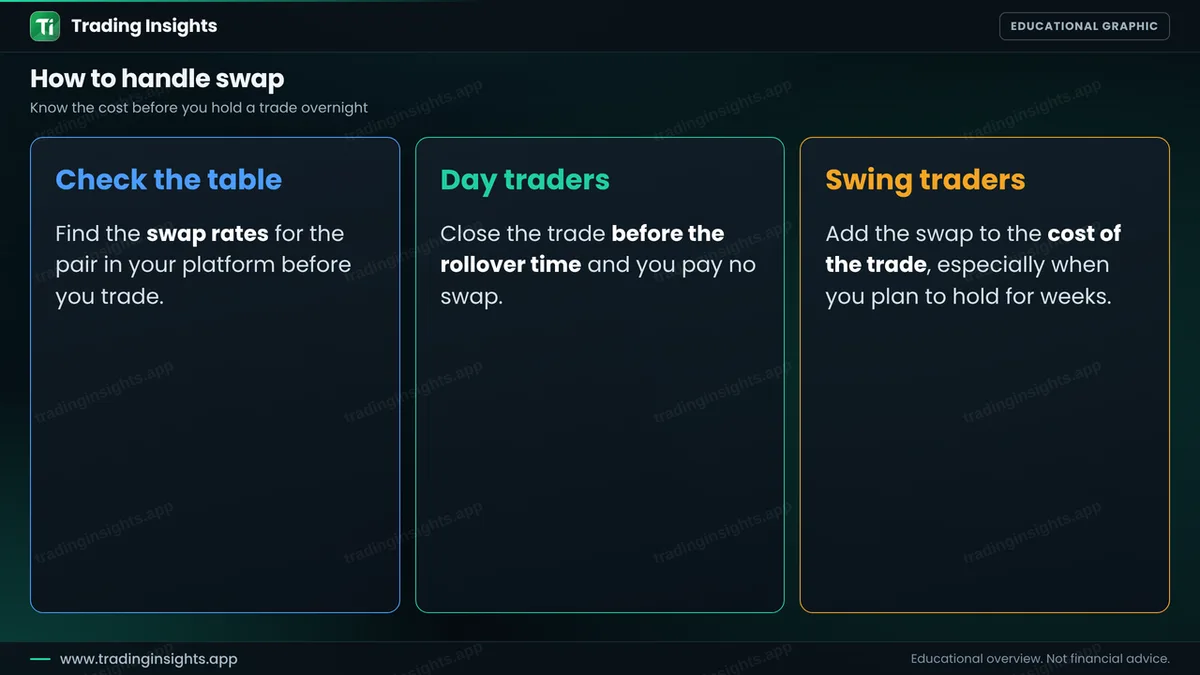
- Check the swap table. Your platform shows the swap for each pair, long and short, in the specification of the instrument.
- Day traders can avoid it. If you close the trade before the rollover time, you pay no swap.
- Swing and position traders should include it. A trade held for weeks with a negative swap has a higher cost. Add it to your calculation of the reward and risk. See risk to reward ratio.
- Watch the triple-swap day. Know which day your broker uses.
- Consider leverage. A larger position pays a larger swap. See leverage in forex.
Does a positive swap make a trade good?
No. A credit of a few dollars a night is small next to a stop of 30 or 40 pips, which can be $300 or $400 on 1 lot. A trade that goes against you can lose far more than the swap earns.
Treat a positive swap as a small bonus for a trade that already makes sense on the chart. Never hold a weak trade just to collect it.
Swap-free accounts
Some brokers offer swap-free, or Islamic, accounts for traders who cannot receive or pay interest for religious reasons. These accounts usually replace swap with another fee, such as a fixed administration charge for holding positions. Read the conditions carefully, because the total cost may be similar.
Common mistakes
- Ignoring swap on trades planned to last weeks. The cost builds up night after night. Add it to your cost estimate before you enter.
- Forgetting the triple-swap day. A trade held through it pays three nights at once. Check which day your broker uses.
- Assuming a positive swap makes a bad trade good. The credit is small next to price risk. Judge the trade by the chart first.
- Comparing brokers only by spread. Swap can matter more for longer holds. Compare the swap tables too, and remember they change with interest rates.
Frequently asked questions
What is a swap in forex?
It is a small fee or credit applied when you keep a position open past the daily rollover time. It is based on the interest rate difference between the two currencies.
When is swap charged?
At the rollover time, usually around 5 pm New York time. Positions closed before that time do not pay swap.
What is triple swap?
Most brokers charge three days of swap on one day of the week, often Wednesday, to cover the weekend.
Can swap be positive?
Yes. Depending on the pair, the direction and the broker, a swap can be a credit, but many positions pay a negative swap.
Your next step
Open the specification of the pair you trade most and write down its long and short swap and its triple-swap day. Then multiply by the number of nights you usually hold. You can also check your sizing with the position size calculator.
This is education, not financial advice. Trading carries risk, and swap values change with interest rates and differ by broker. The charts are illustrative and not real market data.


