
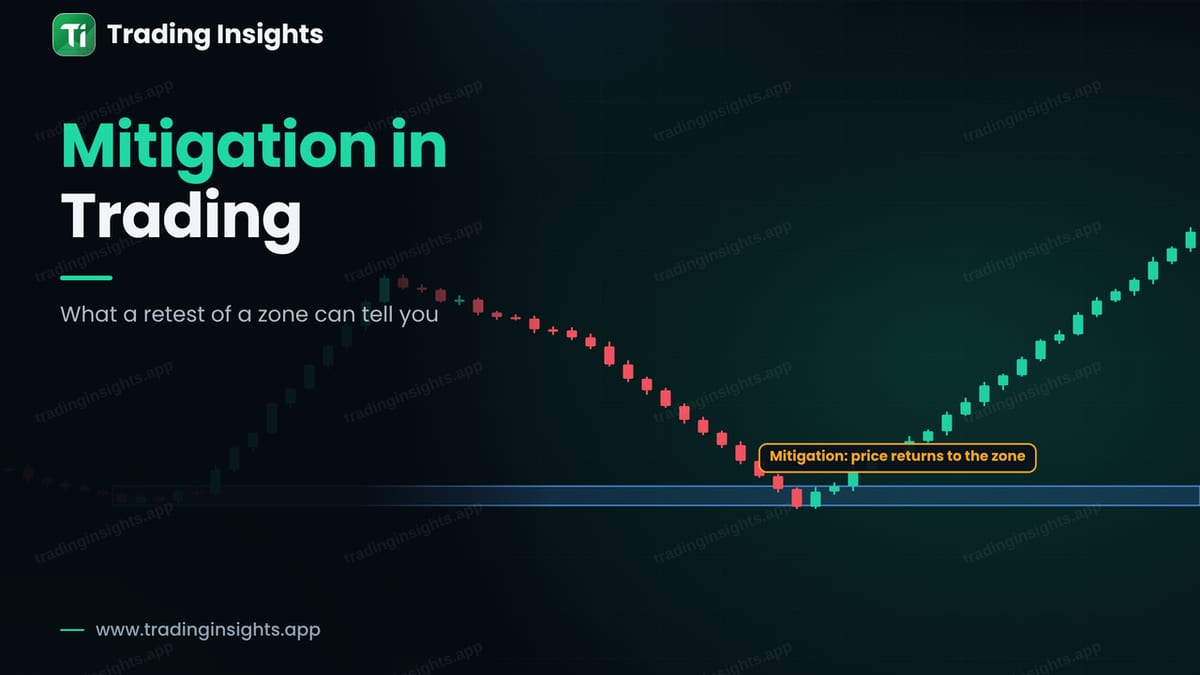
In price-action language, mitigation means that price comes back to a zone where a strong move began. The zone might be an order block, a fair value gap or a supply or demand area. When price returns to it, traders say the zone is being mitigated, and they watch what happens next. The key point of this guide is that a mitigation is a question and not an answer: price may react and continue, it may react weakly, or it may close through the zone and show that it has failed. You will learn how to mark the zone, what the three outcomes look like, and how to plan a trade without assuming the zone has to hold.
What mitigation looks like
The pattern has three parts. First there is an origin, the zone where price started an impulsive move, such as the last down candle before a strong rally. Then there is the impulse itself, a strong, one-sided move away from the zone. Finally, price returns to the zone, and that return is the mitigation.
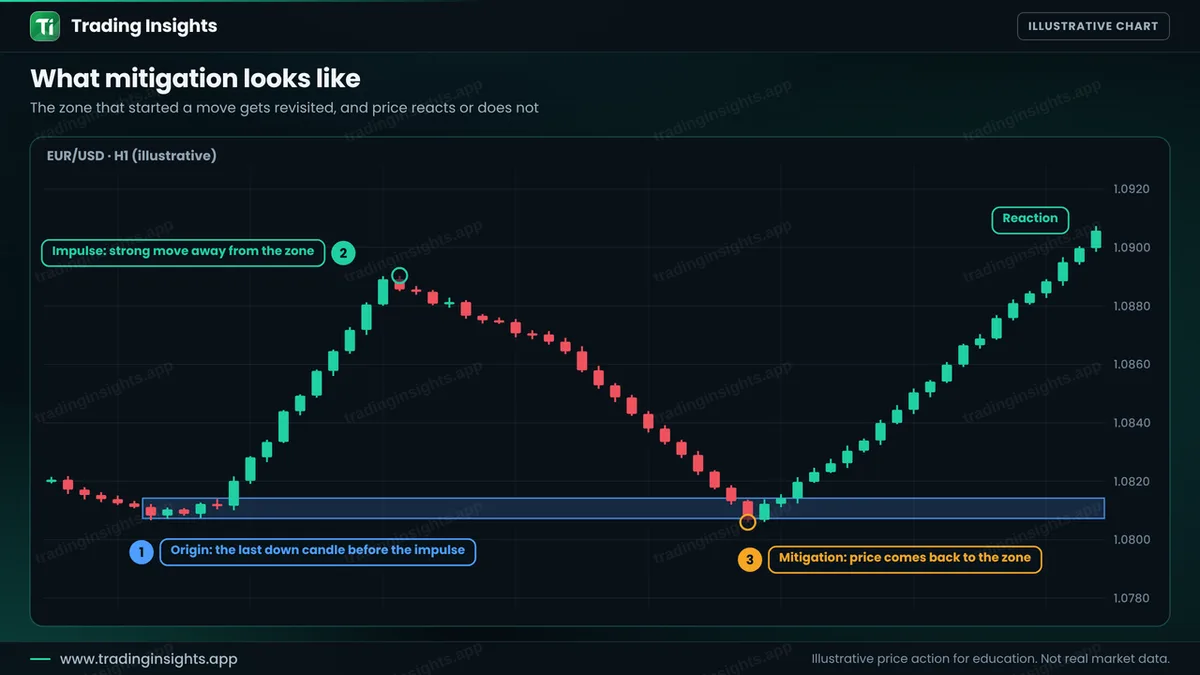
The word comes from the idea that the zone still holds unfilled orders. The impulse left some of them behind, and when price comes back, those orders may be triggered. This is a theory, not a fact, and it should be treated as such. What you can observe is how price behaves at the zone, and that is what you trade. For how a strong move leaves such zones, see what a displacement candle is and what an order block is.
Three things can happen at a zone
A retest does not guarantee a bounce. Here are the three common outcomes.
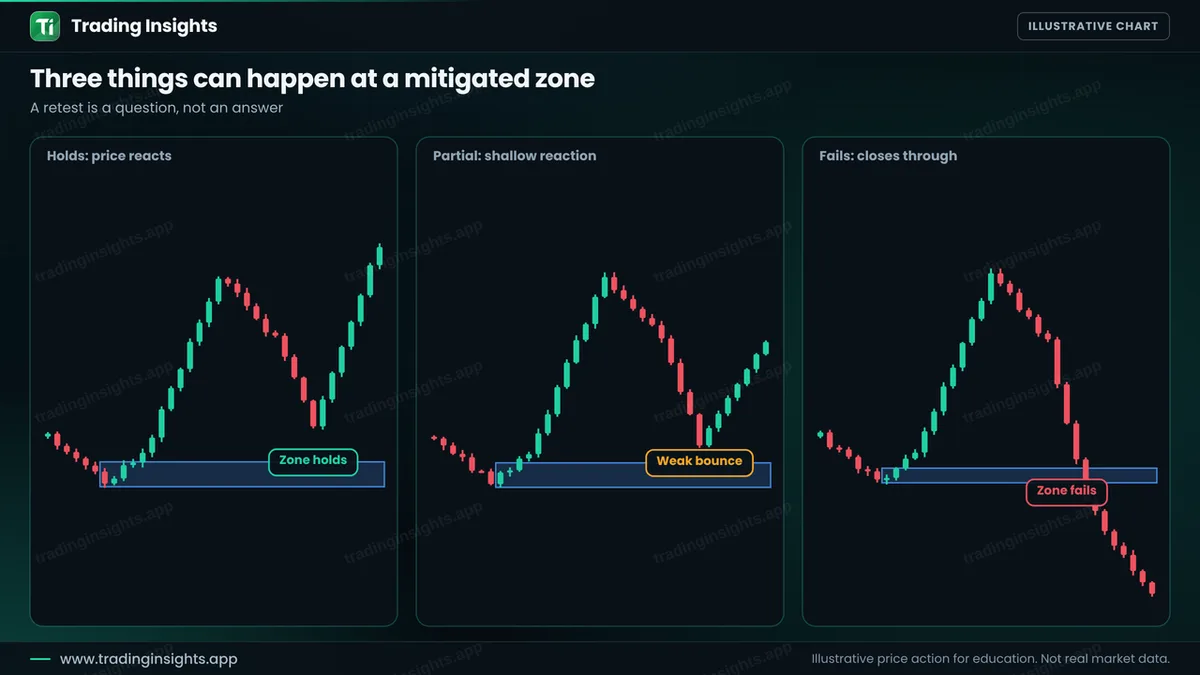
- It holds. Price touches or enters the zone and moves away with strength. This is the outcome traders hope for.
- A weak reaction. Price bounces a little but cannot make progress. It is a warning that buyers are not in control, and the zone may break on the next visit.
- It fails. A candle closes through the zone. The zone is no longer valid for the original direction, and it can turn into a breaker block that works the other way.
Many traders also talk about partial and full mitigation. In a partial mitigation, price only enters the edge of the zone, and in a full mitigation, it travels to the far side. A zone that has been fully mitigated or visited many times is usually weaker. A fresh zone, visited for the first time, is generally viewed as stronger, but even that is a tendency and not a rule.
Trading a mitigation: worked example
Here is an illustrative plan on EUR/USD, H1. A strong rally starts from a small zone. Price later pulls back, and the first candle that returns to the zone is followed by a bullish reaction. You wait for the reaction rather than buying the first touch, place the stop below the zone and target the high of the impulse.
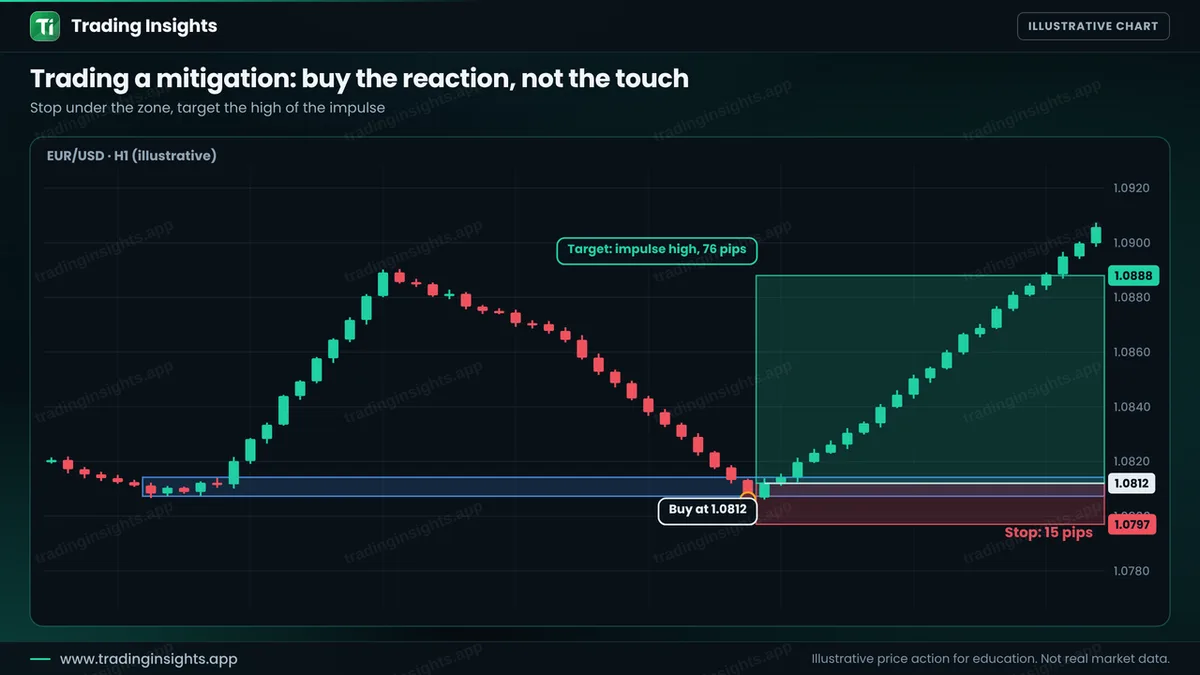
- Entry: 1.0812, after a candle shows a reaction in the zone.
- Stop loss: 1.0797, below the zone (15 pips).
- Take profit: 1.0888, the impulse high (76 pips), a ratio of about 1:5.


