A margin call is a warning from your broker that your account no longer has enough equity to support your open trades. A stop out is what happens if the loss keeps growing: the broker starts closing your positions automatically. Both are caused by the same thing, which is trading a position that is too large for the account. This guide explains how margin works, how the margin level is calculated, how far price can move before you are stopped out on a realistic example, and how to avoid both with simple position sizing.
Margin in simple words
When you trade with leverage, you do not pay the full value of the position. Instead, the broker sets aside a part of your balance as a deposit, called the margin, to cover possible losses. The formula is: margin = position value / leverage. The higher the leverage, the smaller the margin per trade, which lets you open bigger positions, and that is where the danger lies. See what pips, lots and leverage are for the basics.
- Used margin: the money held for your open trades.
- Equity: your balance plus or minus the floating profit or loss on open trades.
- Free margin: equity minus used margin. It is what is left to absorb losses or open new trades.
- Margin level: equity / used margin x 100, shown as a percentage.
Margin level, margin call and stop out
The margin level is the number your broker watches. When it falls too low, two things can happen, and the exact percentages depend on the broker (and in some regions, on the regulator).
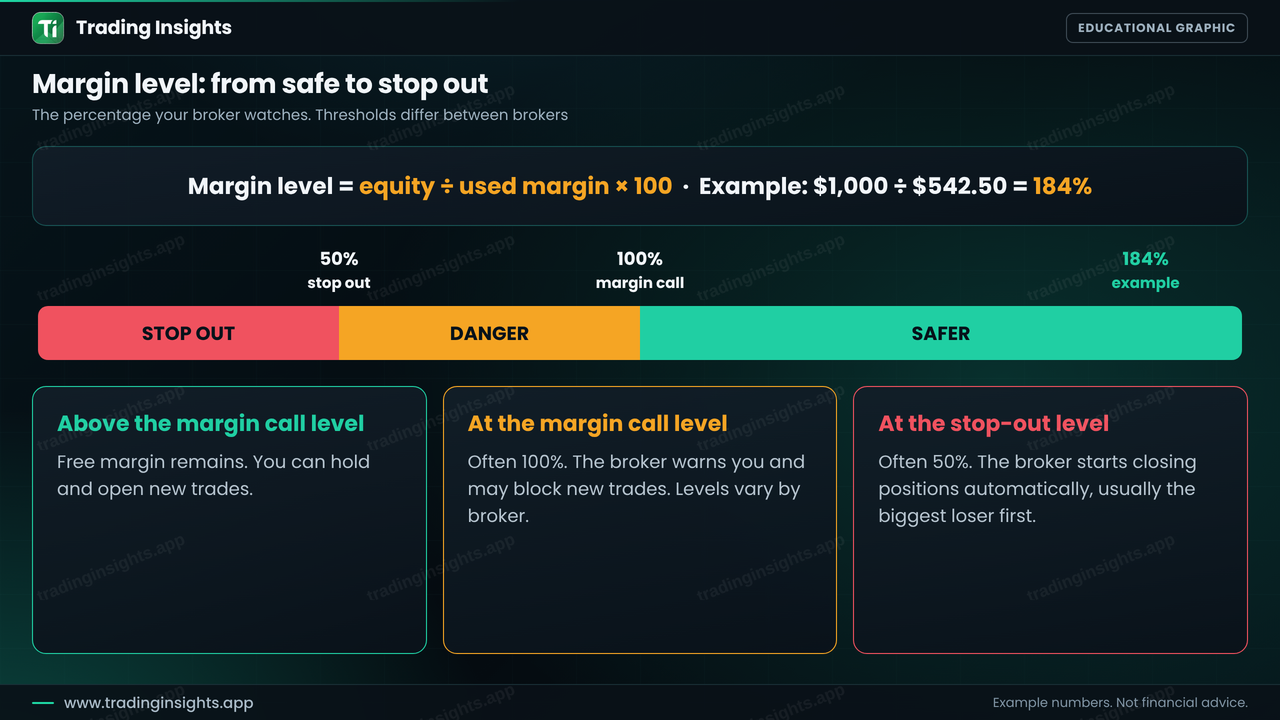
- Margin call: often at a margin level of about 100%. Your equity has fallen to the amount of margin in use. The broker warns you, and may block new trades. You can add funds or close positions to recover.
- Stop out: often at about 50% or lower. The broker starts closing positions automatically, usually the one with the biggest loss first, until the margin level recovers.
Check your broker's terms for the real levels. Some brokers use a margin call level well above 100%, and some close positions at 20% or 30%. A stop out is not a punishment. It protects the broker (and, in theory, you) from a negative balance, but it also locks in your loss at the worst moment.
A worked example: how far can price move?
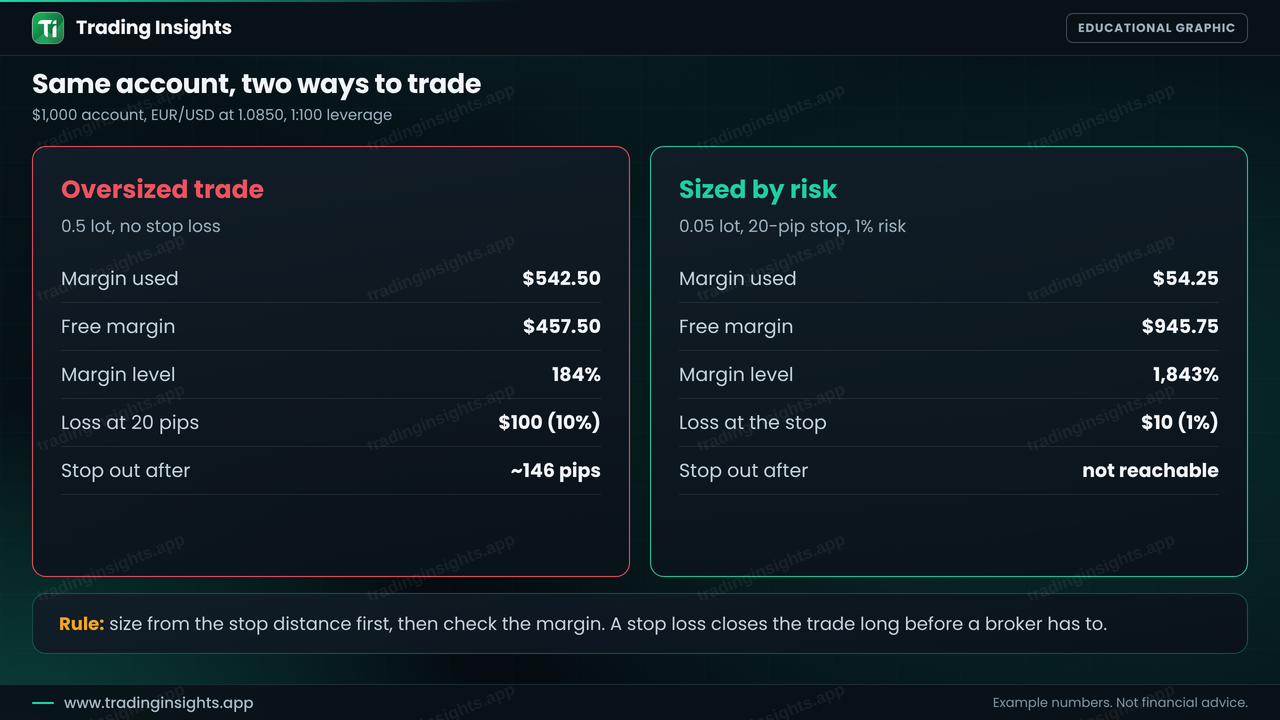
Take a $1,000 account with 1:100 leverage. You buy 0.5 lot of EUR/USD at 1.0850 with no stop loss, which is a 50,000 EUR position worth $54,250.
- Margin used: $54,250 / 100 = $542.50.
- Free margin: $1,000 - $542.50 = $457.50.
- Margin level: $1,000 / $542.50 x 100 = about 184%.
Each pip on 0.5 lot is worth about $5. Now see what happens if price falls.
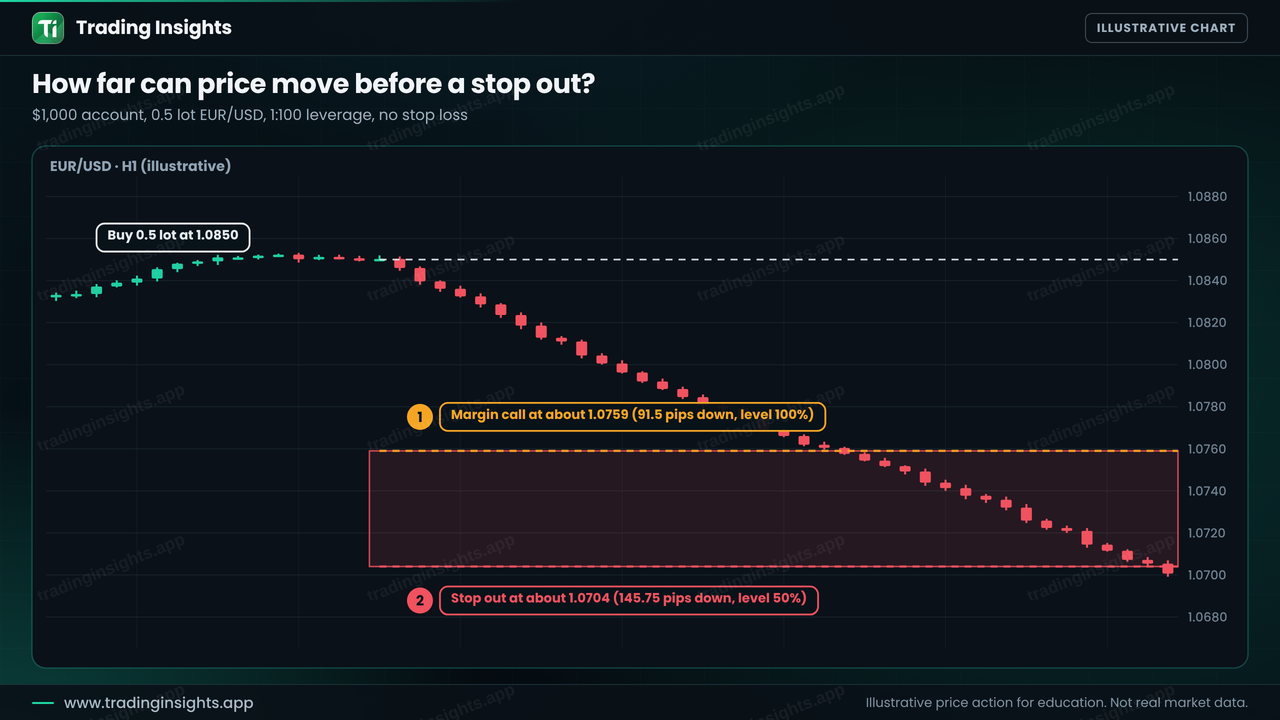
- Margin call (level 100%): equity falls to $542.50, a loss of $457.50. At $5 per pip, that is 91.5 pips, so price at about 1.0759.
- Stop out (level 50%): equity falls to $271.25, a loss of $728.75. At $5 per pip, that is about 145.75 pips, so price at about 1.0704.
A move of 146 pips on EUR/USD is not unusual over a few days, and it can happen in a day around major news. The trade would also lose $100, or 10% of the account, in just 20 pips, long before the stop out. So the real problem starts much earlier than the margin call: the position is simply too big for the account.
How to avoid a margin call
The fix is not to watch the margin level, but to size the trade from the risk, and then check the margin. The steps are simple:
- Decide how much of the account you risk on one trade, typically 1% or less.
- Place the stop where the idea is wrong, based on the chart.
- Calculate the position size from the stop distance, not from the leverage available.