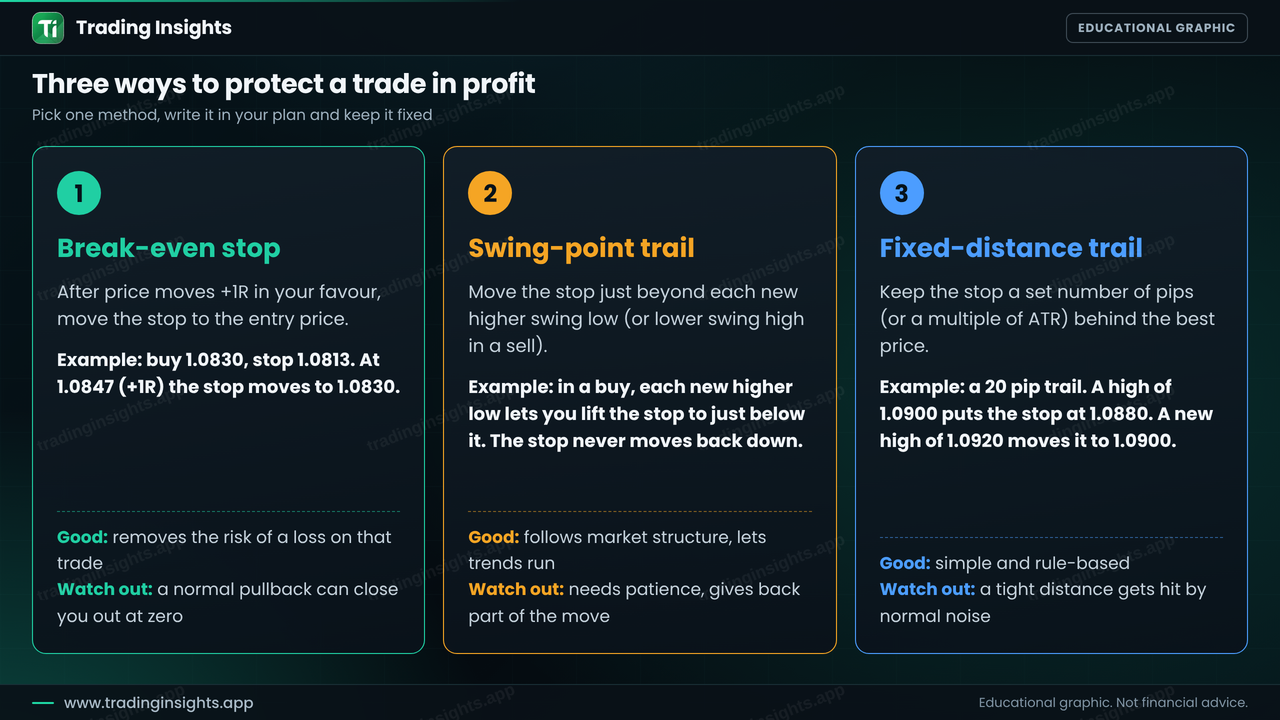
A stop loss protects you before a trade works. A break-even stop and a trailing stop protect you after it starts to work. A break-even stop moves your stop to the entry price once the trade is in profit, so the worst result is a zero loss. A trailing stop follows price as it moves in your favour, so part of the profit is locked in and the trade can still run. Both tools are simple, but both have a cost, and using them badly can turn good trades into small ones. This guide explains how each works, shows a full example step by step, compares three trailing methods and lists the mistakes to avoid.
The idea: from a risk to a locked-in profit
When you enter a trade, the stop sits at a distance that defines your risk. That distance is called 1R, and a trade that moves one stop-distance in your favour is "+1R". The goal of trade management is to protect gains without ending the trade too early. A trailing stop moves the stop only in the direction of the trade, and it never moves it back. If you buy, the stop can only move up. If you sell, it can only move down. You can see how stops fit into a full plan in how to find entry, stop loss and take profit.
The break-even stop
With a break-even stop, you move the stop to your entry price after the trade has moved in your favour by a set amount, often +1R. From then on, if price reverses and hits the stop, you lose nothing except the spread and any commission. Here is the same reversal with and without it. You buy EUR/USD at 1.0850 with a stop at 1.0820, which is 30 pips of risk. Price rises to 1.0880 (+1R) and then falls.
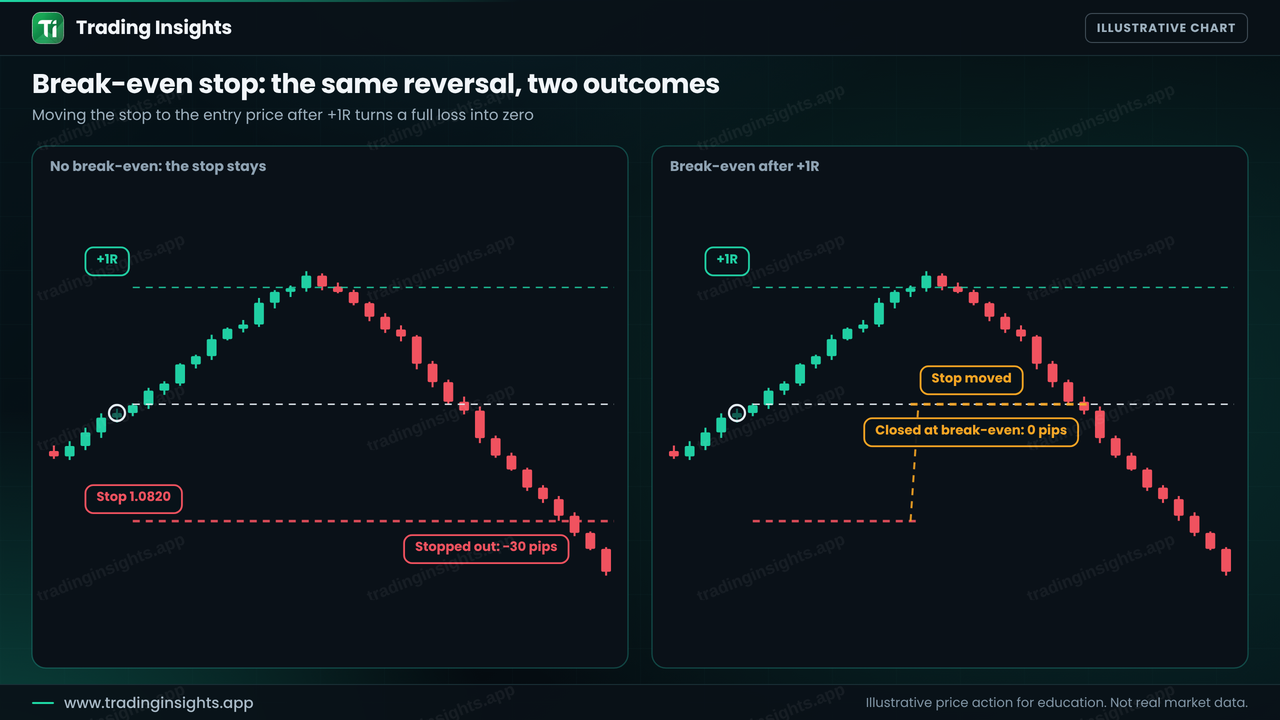
That looks like a clear win, but the other side of the trade-off matters too. Price often pulls back to the entry area and then continues in the original direction. If your stop sits exactly at the entry, a normal pullback can close you out at zero, and you then watch the trade go to the target without you. A break-even stop reduces the loss in the bad cases and also cuts some of the good ones. Many traders move it only when price has made a new structure point, such as a new higher low, and not just after a fixed distance. Some add a pip or two to cover costs, which are explained in forex trading costs explained.
The trailing stop: a step-by-step example
The most common way to trail a stop in forex is to follow market structure. In an uptrend, you move the stop up to just below each new higher swing low. Here is an illustrative trade on EUR/USD, H1, in four steps.
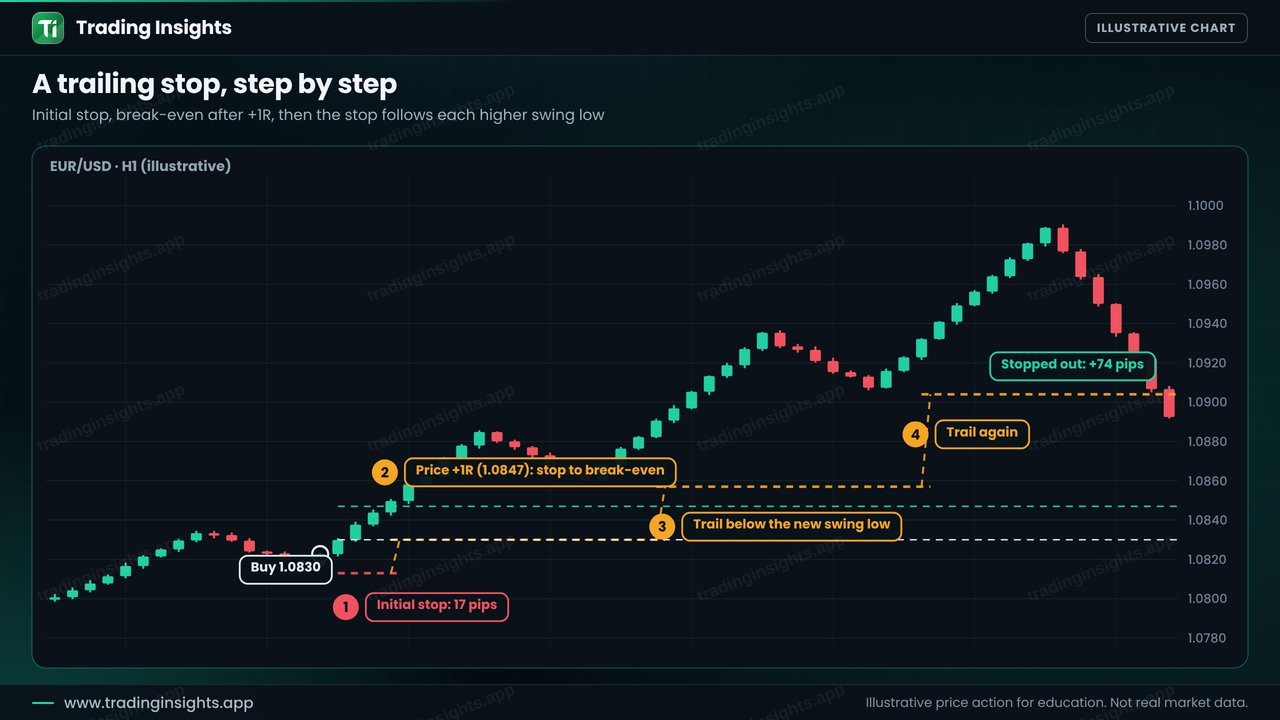
- Initial stop. Buy at 1.0830 with the stop at 1.0813, which is 17 pips of risk.
- Break-even. When price reaches 1.0847 (+1R), move the stop to 1.0830, the entry price.
- Trail below the first swing low. When price makes a higher low and moves on, move the stop to just below that low.
- Trail again. When the next higher low forms, move the stop up again. In the end, price falls and hits the trailing stop for a profit of 74 pips.
The trade made about 4.4 times the initial risk (74 pips against 17). With a $10,000 account risking 1% ($100), the position size is $100 / (17 pips x $10 per pip per lot), about 0.58 lot, and a 74 pip profit on that size is about $429. A fixed target at 2R would have closed the same trade for about $200. On the other hand, the trailing method gives back some profit at the end, because the stop only triggers after price has fallen from the high. Use the position size calculator to size your own trades.