
Swing trading is a style where you hold a forex position for a few days to a few weeks, trying to catch one "swing" in price, such as a pullback in a trend or a move between two levels. A swing trading strategy for forex beginners works well because it needs fewer decisions and less screen time than day trading. This article explains how the style works, gives a simple weekly routine and shows the arithmetic of one trade.
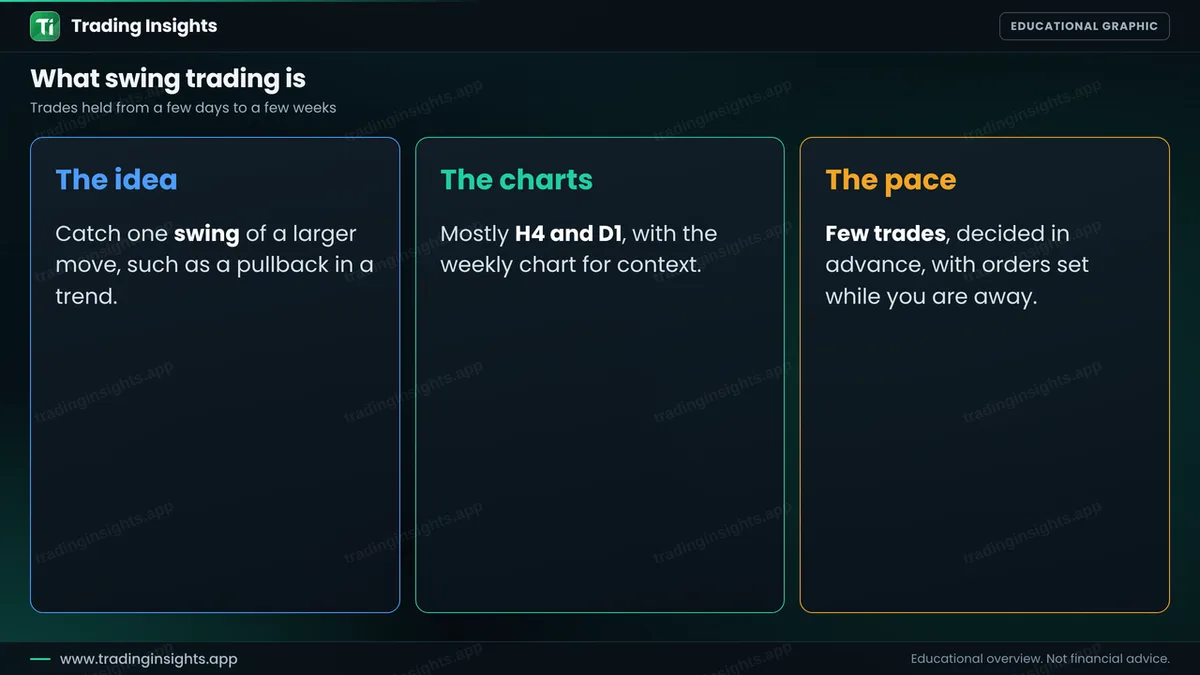
What swing trading is
Swing traders work mostly on the H4 and D1 charts, with the weekly chart for the larger trend. A candle takes hours or a full day to form, so signals are fewer and the noise is lower. Because stops are wider than on lower timeframes, the position size has to be smaller.
The style sits between day trading and long-term investing. It is compared with the other styles in scalping vs day trading vs swing trading, and it fits well with the routine in part-time forex trading.
Why beginners like swing trading
A day trader must react in seconds, and that pressure causes many beginner errors. A swing trader makes the decision once, places the orders and lets the market do the work. There is time to think, to check the calendar and to skip a bad week.
A simple swing trading routine
The work is done at set times, and the market does the rest.
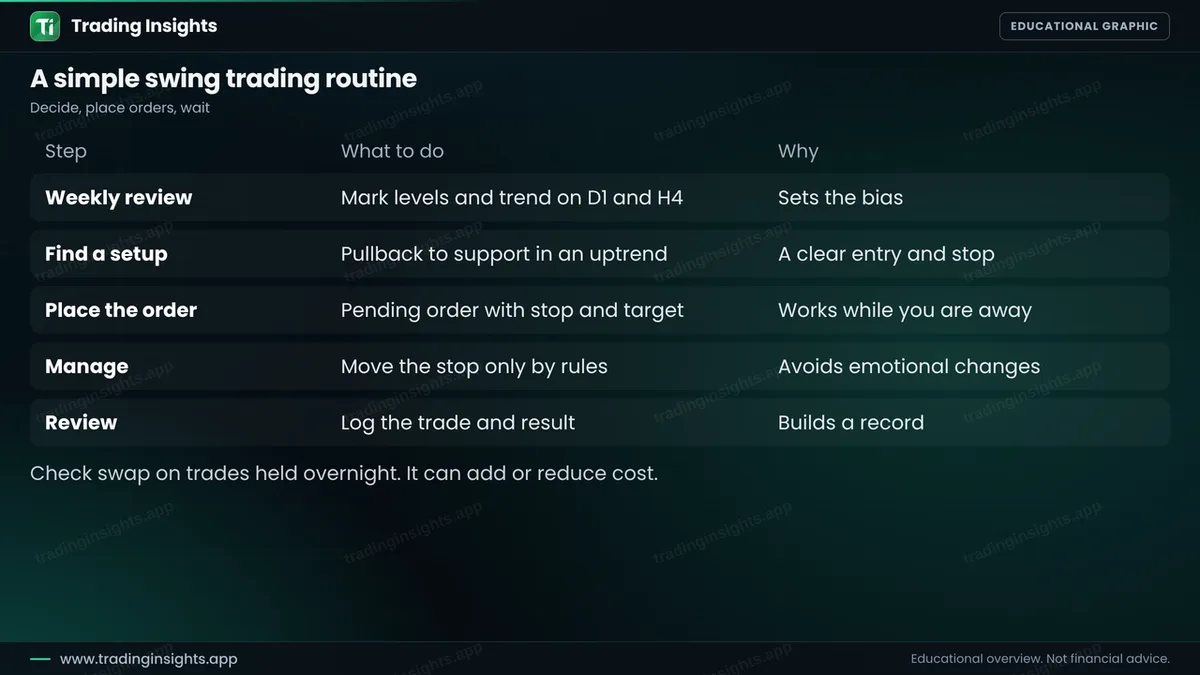
- Weekly review. Mark levels and the trend on D1 and H4. See top-down analysis and the previous week high low strategy.
- Find a setup. A common one is a pullback to support in an uptrend. See the EMA pullback strategy and the two-legged pullback.
- Place the order. Use a pending order, with the stop and the target, so that it works while you are away. See forex order types.
- Manage by rules. Move the stop only by rules, for example to break-even after a set gain. See trailing and break-even stops.
- Review. Log the trade and the result in your journal. See how to build a forex trading plan.
Check the swap on trades that are held overnight, because it can add to or reduce your result. See forex swap and rollover.
How to pick a swing trade
A good swing setup has three parts. The higher timeframe shows a clear trend or a clear range. Price has moved back to a level where buyers or sellers have acted before. And the stop can sit beyond that level with a target at least twice as far away.
If one part is missing, wait. Most weeks will offer zero to two trades, and that is normal for this style.
Rules that help
Three rules matter most for a swing trader.
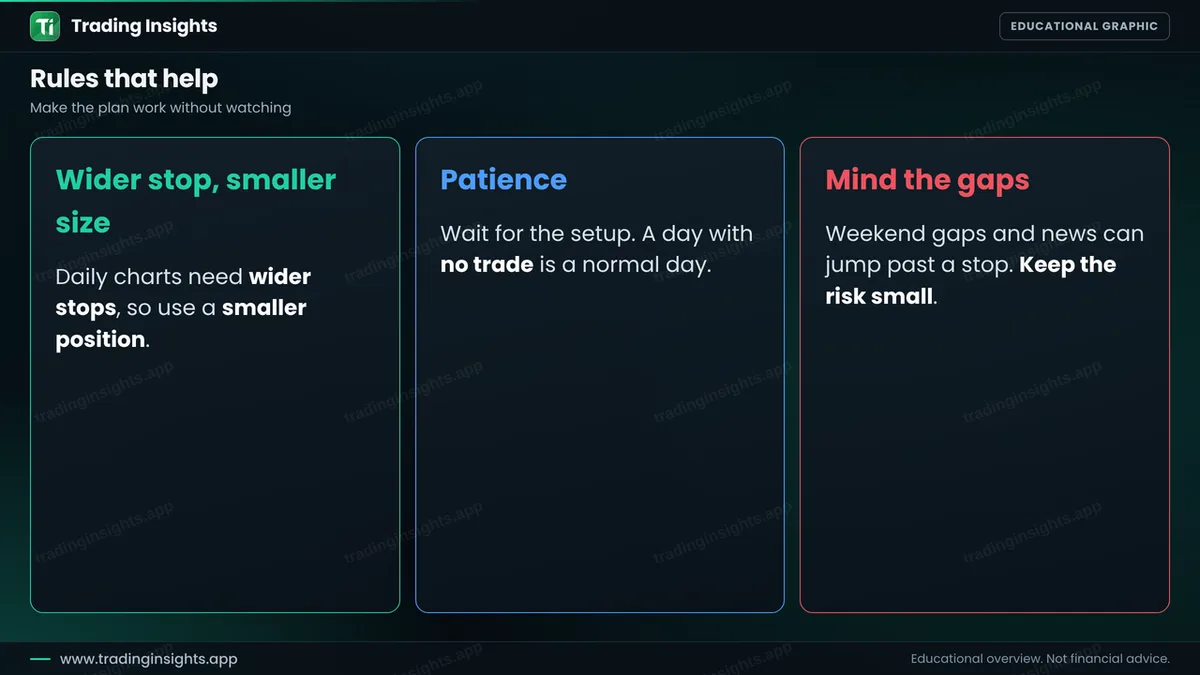
- Wider stop, smaller size. Place the stop at a chart level and size the trade to risk 1% or less. See how to calculate position size.
- Patience. A day with no trade is a normal day. See trading patience.
- Mind the gaps and news. A weekend gap or a data release can jump past your stop. See the weekend gap strategy and trading forex news.
Illustrative example: a swing buy on EUR/USD
This is an illustrative example, not a real trade. On Sunday, a trader sees on the D1 chart that EUR/USD is in an uptrend and has pulled back to a support level at 1.0850. She sets a buy limit order at 1.0852, with a stop at 1.0820 (32 pips) and a target at 1.0916 (64 pips), which is twice the risk.
With a $10,000 account risking 1% ($100), the position size is $100 / (32 pips x $10 per pip per lot) = about 0.31 lot. A win pays about $200, and a loss costs about $100.
On Tuesday the order is filled, and she goes to work. On Thursday price reaches the target or the stop. She did not watch the screen, and the decision was made in advance. If the setup had not appeared, she would have skipped the week. You can check your own numbers with the position size calculator.
Pros and cons
- Pros: little screen time, lower relative cost from spreads, clearer signals on higher timeframes.
- Cons: overnight and weekend risk, swap, and slow feedback, since each trade takes days to resolve.
Common mistakes
- Using a day-trading size with a swing-trading stop. A wide stop with a large lot size breaks your risk rule. Calculate the size from the stop distance.
- Checking the chart every few minutes and changing the plan. This turns a swing trade into a nervous day trade. Set the orders, then step away.
- Ignoring the calendar and weekend gaps. Gaps and data can jump past a stop. Check events before you hold through them.
- Taking trades on every pullback. Not every pullback is a setup. Wait for a level, a trend and a good reward-to-risk ratio.
Frequently asked questions
What is swing trading?
It is a style in which you hold trades for several days to a few weeks, to catch a swing in price, usually on H4 and D1 charts.
How much time does swing trading need?
Often a few sessions a week to analyse and place orders, plus short daily checks. It suits people with other jobs.
Is swing trading good for beginners?
It can be, since it needs fewer decisions and has less noise. But a beginner still needs a plan, a stop and a small risk.
What is the main risk?
Overnight and weekend gaps and news, which can jump past a stop. Keep the risk small and check the calendar.
Your next step
This weekend, open the D1 chart of one major pair and mark the two nearest support and resistance levels. Write down the trade you would take if price reached each level, with entry, stop and target. Then wait and see what happens, without risking money.
This is education, not financial advice. Trading carries risk, and swing trades can gap past a stop. The charts are illustrative and not real market data.


