
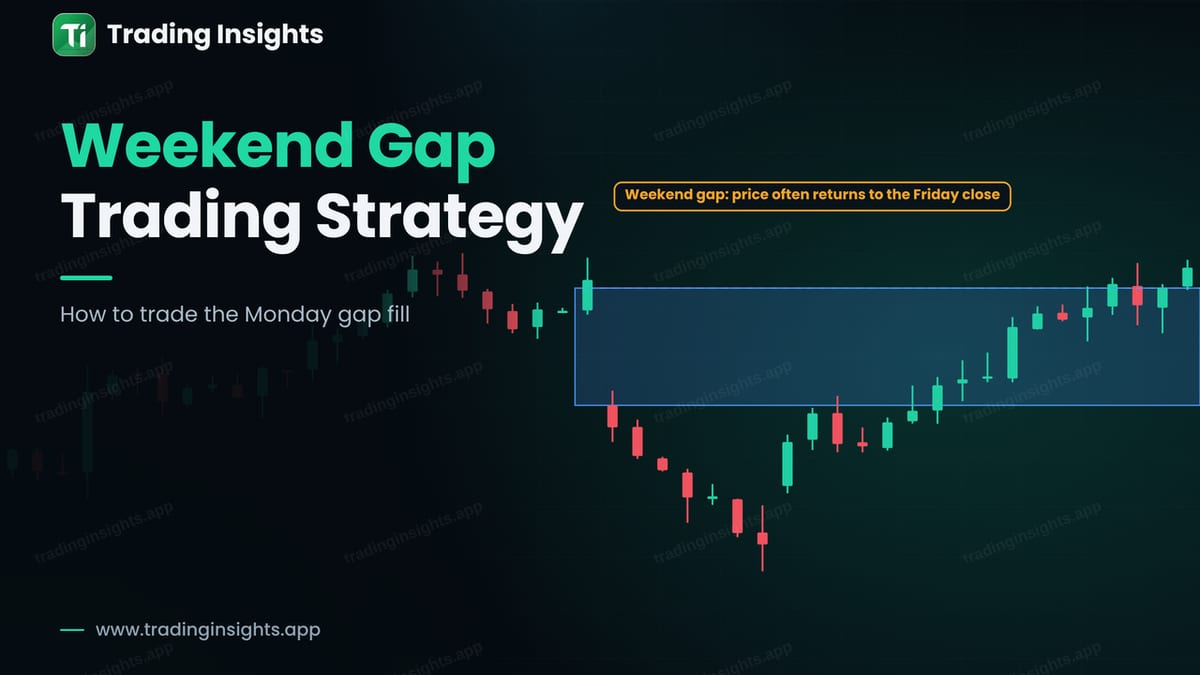
A weekend gap is the empty space on the chart between the Friday close and the Monday open. The forex market shuts from Friday evening to Sunday evening, so when it reopens, price can start somewhere new. The Monday gap fill strategy waits for price to return toward the Friday close, and plans a trade with a stop and a target. Small gaps often fill, large ones may not, so the plan has to work either way.
Why weekend gaps happen
News does not stop on the weekend. An election, a central bank comment or a change in risk mood can arrive while the market is closed. When traders react on Sunday evening, the first price can be far from the Friday close. Most gaps in major pairs are small.
There are three common situations:
- News gap. A real event changed the value of a currency while the market was shut. The gap reflects a new view and may stay open.
- Thin-liquidity gap. Few traders are active on Sunday evening, so these small gaps often fade.
- Trend gap. In a strong trend, the market simply continues at the open. These gaps are less likely to be filled soon.
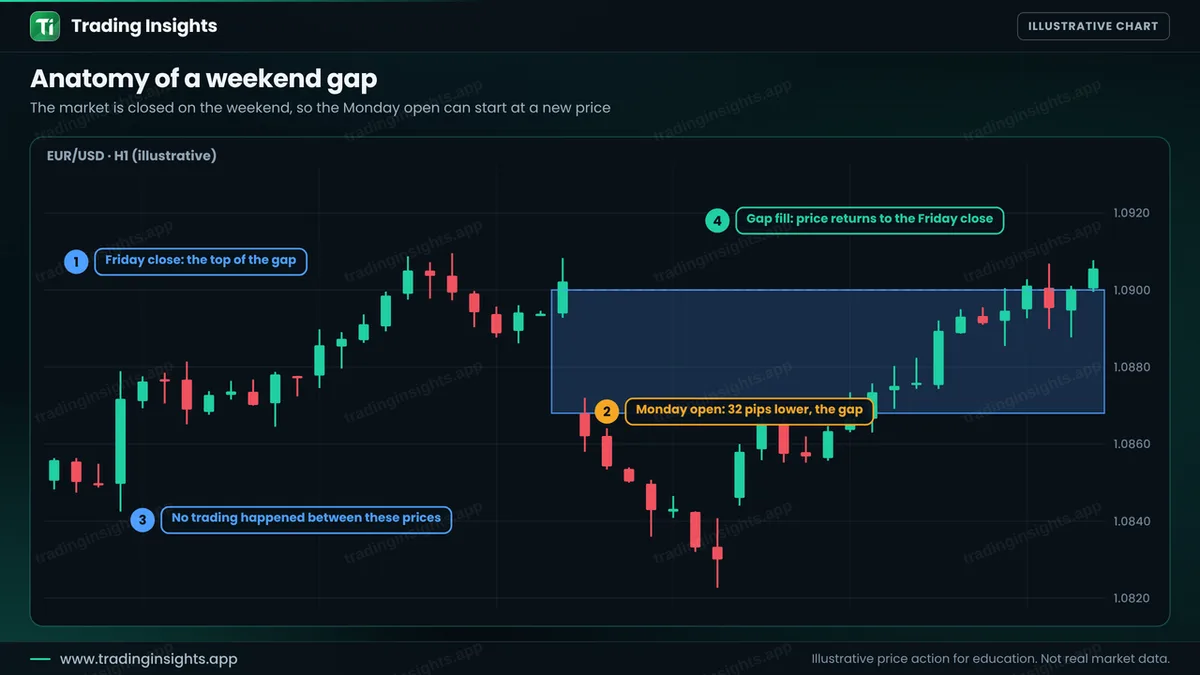
In the example, price closes the week at 1.0900 and opens Monday at 1.0868. The gap is 32 pips. No trading took place between those prices, so some traders see the Friday close as a level price may come back to.
How big is a big gap?
A gap is only large or small compared with how much the pair usually moves. Compare it with the average daily range. Suppose EUR/USD moves about 80 pips on a typical day. A 32-pip gap is then about 40% of a normal day: worth noticing, but not extreme. A 5-pip gap is noise, and a 150-pip gap means the market has probably changed its mind.
Does a weekend gap always fill?
No. Small gaps often fill within hours or days, because the reason for the gap fades. Large gaps caused by real news can stay open for a long time. So you do not buy a gap just because it exists. You wait for a sign that the move away from the gap has ended, and you use a stop in case it has not.
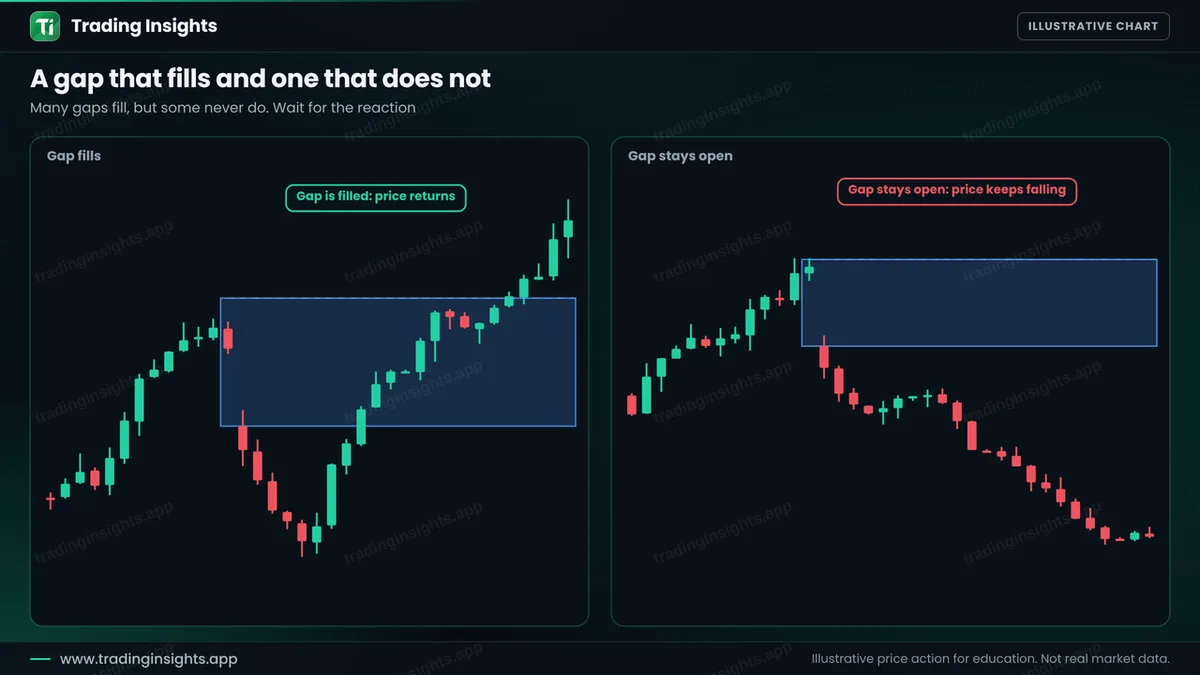
"This gap will fill eventually" is not a trade plan, because price can travel far against you first.
Gap fill strategy: the rules, step by step
- Measure the gap. Compare the Friday close with the Monday open. Small to medium gaps are the best candidates.
- Find the reason. Check the news. A gap with a major cause is less likely to fill. See trading forex news.
- Let the open settle. Spreads are wide and prices jump in the first minutes.
- Trade towards the gap. If the gap is down, look for a buy after price stops falling.
- Wait for a signal. A bullish candle at a low, such as a pin bar. See pin bar strategy.
- Place the stop below the low, with a buffer.
- Set the target at the Friday close, which is the full gap fill, or at part of it.
The idea is invalid if price closes below your stop level.
Illustrative example: a gap fill buy on EUR/USD
This illustrative example is a buy on EUR/USD, H1. After the gap down to 1.0868, price keeps falling to a low at 1.0842. A bullish candle then closes at 1.0858. You buy there, place the stop below the low at 1.0838, and target the Friday close at 1.0900.
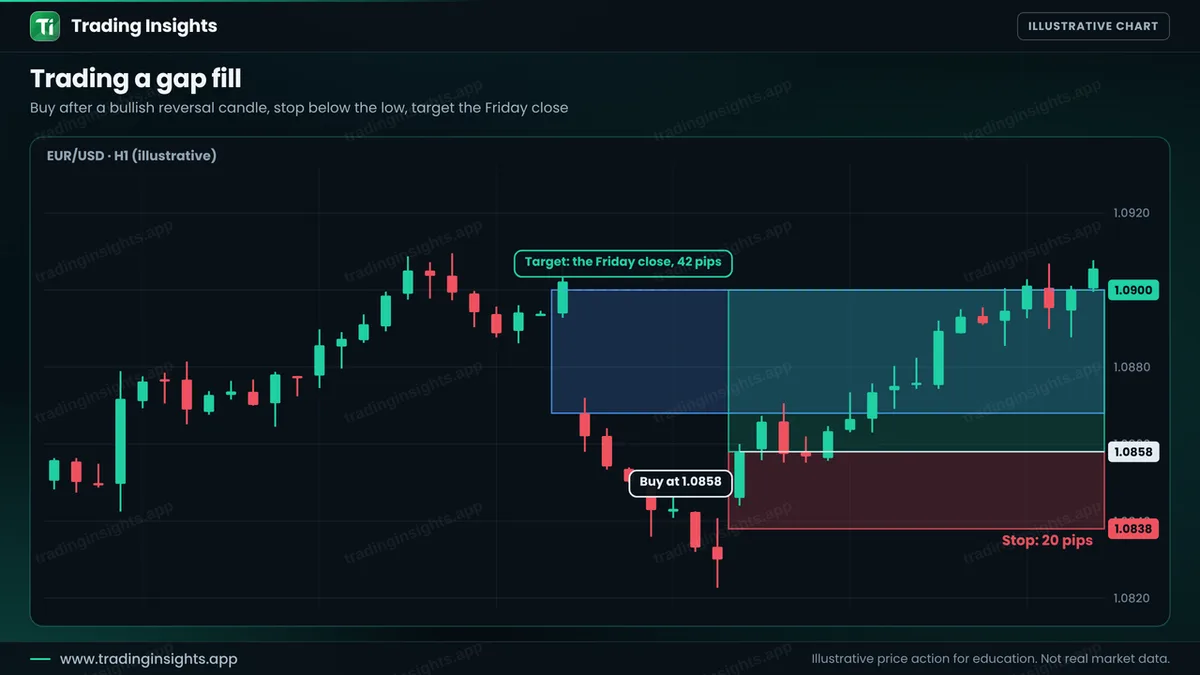
- Entry: 1.0858, after the bullish candle closes.
- Stop loss: 1.0838, below the low (20 pips).
- Take profit: 1.0900 (42 pips), a ratio of about 1:2.1.
With a $10,000 account risking 1% ($100), the position size is $100 / (20 pips x $10 per pip per lot) = 0.50 lot. A win pays about $210, and a loss costs about $100. Check it with the position size calculator and the risk reward calculator.
Managing the gap trade with a partial profit
You hold 0.50 lot. When price reaches 1.0878, which is 20 pips in profit and equal to your risk, you close half (0.25 lot) and move the stop on the rest to your entry.
- Stop hit before 1.0878: you lose about $100.
- Price reaches 1.0878, then falls back to the entry: the first half earned 0.25 lot x 20 pips x $10 = $50, and the rest closes at break-even, so you make about $50.
- Price reaches 1.0878, then the full fill at 1.0900: $50 plus 0.25 lot x 42 pips x $10 = $105, a total of about $155.
The best case drops from $210 to $155, but a full loss becomes less likely. See taking partial profits.
Do not hold a trade over the weekend
A stop loss does not protect you from a gap. If the market opens beyond your stop, the order is filled at the first available price, which can be much worse. If you hold through a weekend, trade smaller.
Common mistakes
- Assuming every gap must fill. Large news gaps can stay open. Wait for a signal and always use a stop.
- Entering at the first candle of the week. Spreads are wide and slippage is common. Let the open settle.
- Holding a loser because the gap "has to fill". Exit at the stop.
- Ignoring the trend. A gap in the direction of a strong trend is less likely to fill. See how to identify a trend.
Frequently asked questions
What is a weekend gap in forex?
It is the difference between the Friday close and the Monday open, caused by news or changes in mood while the market is closed.
Do all gaps fill?
No. Small gaps fill often, but large gaps caused by important news can stay open for a long time.
When should I trade a gap?
After the opening noise has settled and a reversal signal has formed, with a stop in place.
Can a stop loss protect me from a gap?
Not fully. If the market opens beyond your stop, the order fills at the first available price, which can be worse than your stop level.
Your next step
This Sunday evening, note the Friday close for the pair you trade. At the open, do nothing for the first hour except measure the gap against the daily range and mark the swings. If no clear signal appears, skip the week.
This is education, not financial advice. Trading carries risk, and you can lose some or all of your capital. No method guarantees results. The charts are illustrative and not real market data.


