
NZD/USD shows how many US dollars one New Zealand dollar buys, and it is moved mostly by Reserve Bank of New Zealand policy, dairy and farm prices, demand from China, global risk mood and the US dollar. Traders call the New Zealand dollar the "Kiwi", after the national bird. The pair is one of the majors, but its market is smaller than for the euro or the pound, so it needs a little extra care.
NZD/USD at a glance
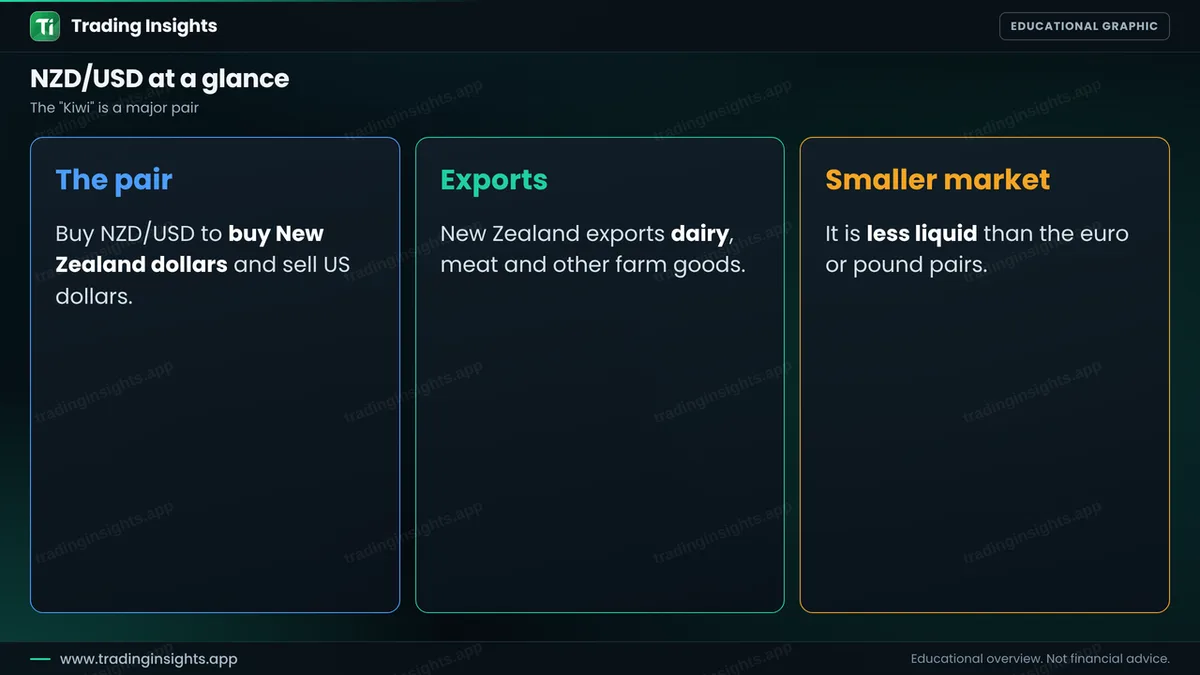
If you buy NZD/USD, you buy New Zealand dollars and sell US dollars. The pip is 0.0001, and on a standard lot a pip is worth about $10 because the pair is quoted in US dollars.
New Zealand is a small, open economy that exports dairy, meat, wool and other farm goods, so the currency belongs to the group of commodity currencies. Because the market is smaller, spreads can be wider than on EUR/USD, and prices can move sharply on news.
What moves NZD/USD
- RBNZ policy. The Reserve Bank of New Zealand's rate decisions and tone move the currency. See central banks and forex.
- Dairy and farm prices. Higher prices tend to support the Kiwi.
- China. China is a major buyer of New Zealand exports, so Chinese data matters.
- Risk mood. The Kiwi often falls when stocks fall. See forex volatility.
- The US dollar and the Fed. A strong dollar often pushes the pair down, whatever the local news. See interest rates and forex.
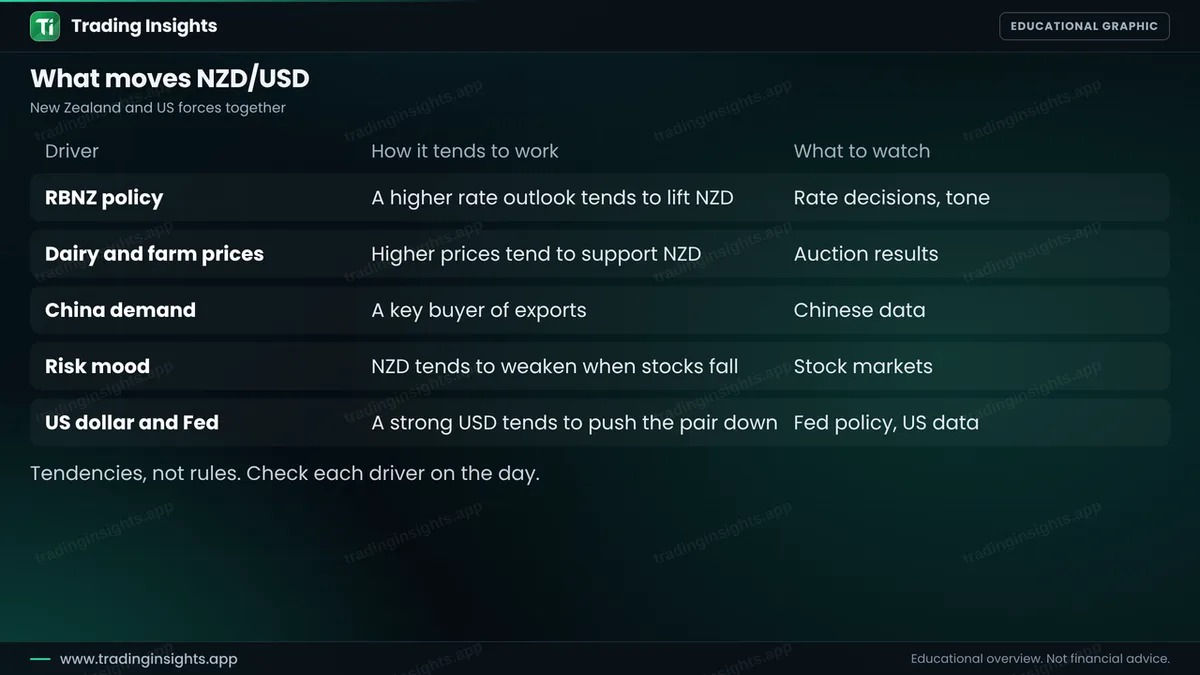
These are tendencies, not rules, and one driver can dominate on any given day. A pair can ignore dairy prices for weeks, then react to a single RBNZ statement.
Why NZD/USD is a risk-sensitive pair
The Kiwi is often grouped with currencies that investors favour when the mood is positive and sell when it turns negative. In a risk-off day, the pair can drop even if New Zealand news is quiet, because traders move money into the dollar. In calm, positive periods, the opposite can happen.
This means a broader look helps. Before you trade the pair, glance at global stock indices and the dollar. If they are moving sharply, the local story may not matter much that day.
NZD/USD and AUD/USD
The Kiwi and the Aussie are neighbors, with similar drivers, and their charts often look alike. See the AUD/USD guide. This is useful for context: if one breaks a level and the other does not, the move may be about local news.
But it is also a trap, because a trader who buys both has doubled the same bet. Count them as one idea when you set your risk. See currency correlation.
How to trade NZD/USD with care
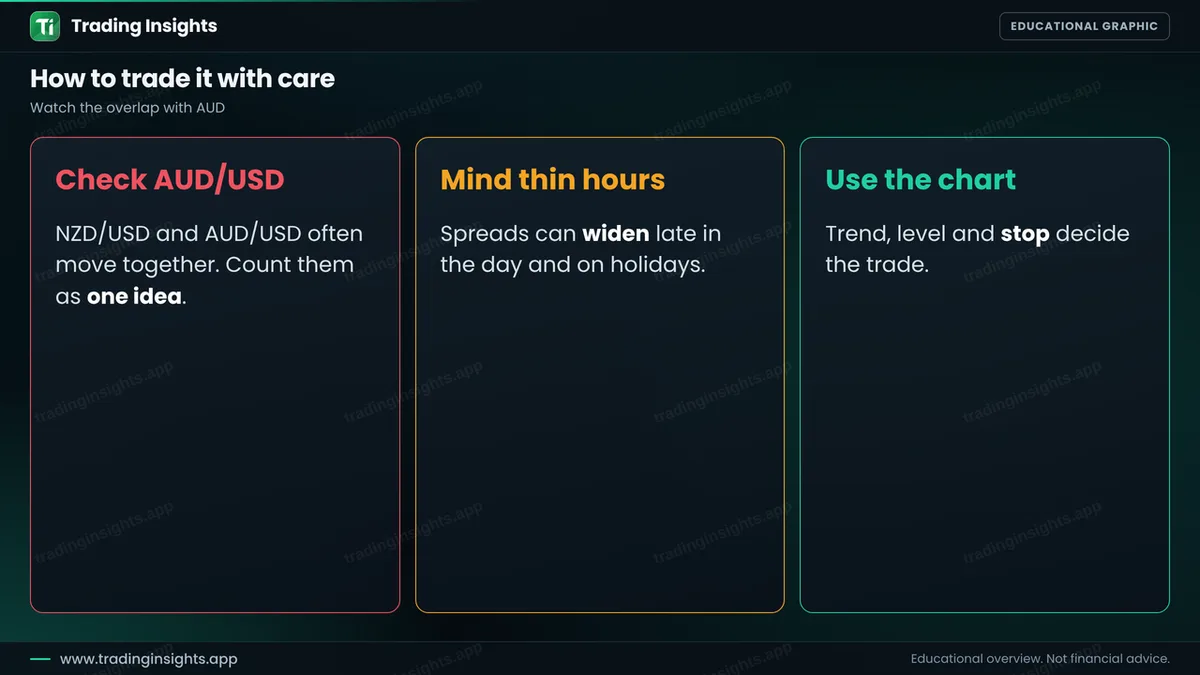
- Check AUD/USD. Count the two pairs as one idea.
- Mind thin hours. Spreads can widen late in the day and on holidays. See low-liquidity periods.
- Use the chart. Trend pullbacks and levels work. See the EMA pullback strategy.
- Size by the stop. See how to calculate position size.
- Plan for news. RBNZ decisions and Chinese data can cause spikes. See trading forex news.
Illustrative example: a pullback buy with correlation in mind
This is an illustrative example, not a real trade. NZD/USD is in an uptrend and pulls back to support at 0.6050. A bullish candle closes, and the trader buys at 0.6060 with a stop at 0.6020 (40 pips) and a target at 0.6140 (80 pips), a 1 to 2 reward-to-risk ratio.
With a $10,000 account risking 1% ($100), the position size is $100 / (40 pips x $10 per pip per lot) = 0.25 lot. A win pays about $200, and a loss costs about $100.
The same setup also appears on AUD/USD. If she bought both at 1% each, a risk-off shock could cost her about 2% at once. So she buys the pair with the cleaner chart at 1%, or both at 0.5% ($50 each). The idea is the same, but the risk stays under control. A position size calculator makes this quick.
Common mistakes
- Doubling the bet with AUD/USD. The two pairs often move together. Count them as one trade when you set risk.
- Ignoring the spread in thin hours. A wide spread eats into a tight stop. Trade when liquidity is better, or widen the stop and cut the size.
- Trading around RBNZ decisions with a tight stop. Spikes can hit it before price settles. Reduce size or wait for the reaction.
- Assuming dairy prices drive the pair every day. Risk mood and the dollar often matter more. Confirm on the chart before you trade the story.
Frequently asked questions
What is the Kiwi?
It is the nickname of the New Zealand dollar.
What moves NZD/USD?
RBNZ policy, dairy and farm prices, China demand, risk mood and the US dollar with Fed policy.
How is NZD/USD related to AUD/USD?
They often move together because of similar drivers, so holding both can be one bet in two trades.
Is NZD/USD liquid?
It is a major pair, but the market is smaller than EUR/USD, so spreads can be wider.
Your next step
Put NZD/USD and AUD/USD side by side on the daily chart for the last three months. Note when they moved together and when they split. This will show you how much extra risk you take when you hold both.
This is education, not financial advice. Trading carries risk, and the Kiwi can move sharply on news. The charts are illustrative and not real market data.


