
AUD/USD is the Australian dollar against the US dollar, known as the "Aussie", and it moves with Australian interest rates, China demand, commodity prices, risk mood and the US dollar. It is one of the seven major pairs, with good liquidity and tight spreads in most conditions. This guide explains what drives the pair and how to trade it without doubling your risk by accident.
AUD/USD at a glance
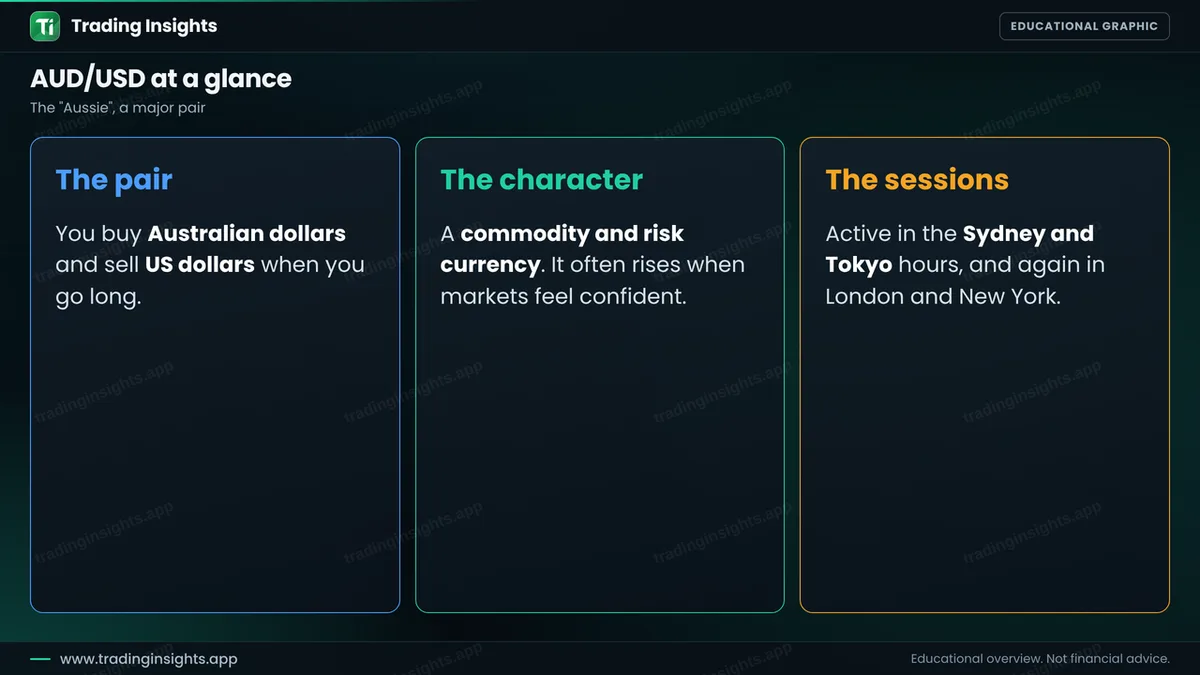
If you buy AUD/USD, you buy Australian dollars and sell US dollars. The pip is 0.0001. Because Australia exports a large amount of raw materials, the currency is linked to commodity prices and to demand from big trading partners, especially China. See commodity currencies for the wider group.
The Aussie is also a risk currency, so it tends to rise when markets are confident and fall when they are afraid. The pair is active in the Asian hours, when Australian data is released, and again in London and New York, when the dollar side dominates. See forex trading sessions.
What moves the Aussie dollar
Both sides of the pair matter: Australian forces and US forces together.
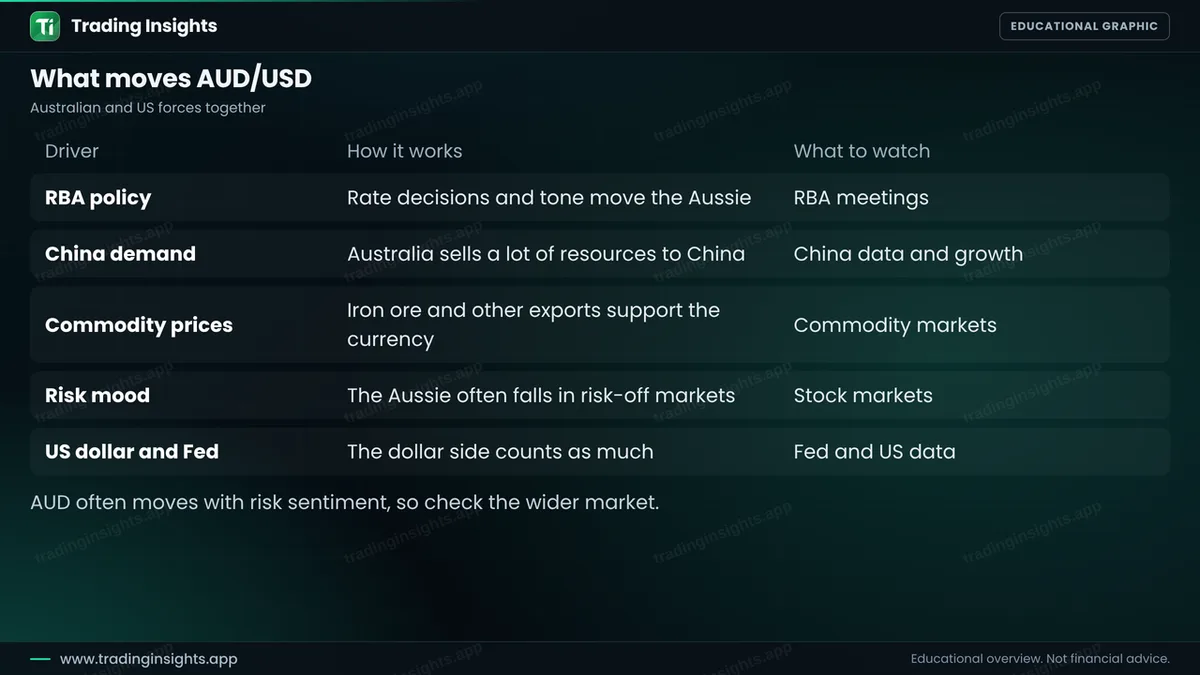
- RBA policy. The Reserve Bank of Australia's rate decisions and tone move the currency. See the RBA and the Australian dollar and central banks and forex.
- China. China is a major buyer of Australian exports, so Chinese data and policy often move the Aussie. See China data and the Australian dollar.
- Commodity prices. Iron ore and other exports can support or weigh on the currency.
- Risk mood. The Aussie often falls when stocks fall. This is the opposite of the safe havens in safe-haven currencies.
- The US dollar and the Fed. A strong dollar often pushes AUD/USD down, whatever the Australian news.
These links come and go. In some periods the dollar dominates and Australian news barely registers, and in others the RBA or China sets the tone. Treat each driver as context, then confirm on the chart.
How to trade AUD/USD with care
The Aussie is easy to follow, but it is easy to double up on the same view without noticing.
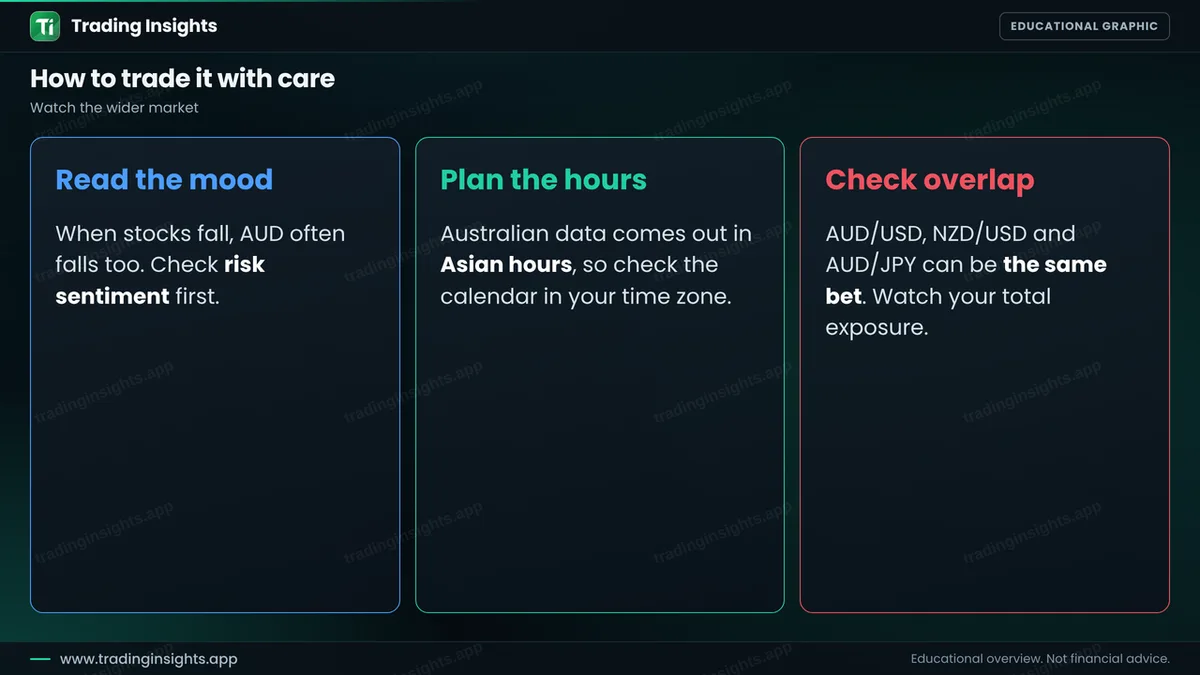
- Read the mood. When stocks fall, AUD often falls too. Check risk sentiment before a trade.
- Plan the hours. Australian data comes out during Asian hours, so check the calendar in your own time zone. See trading forex news.
- Check overlap. AUD/USD, NZD/USD and AUD/JPY often move together, and holding all of them can be one bet in three positions. See currency correlation.
- Use the chart. Trend pullbacks and levels work well on the Aussie. See the EMA pullback strategy.
- Size by the stop. See how to calculate position size.
Illustrative example: one AUD/USD pullback buy
This is an illustrative example, not a real trade. AUD/USD is in an uptrend, stocks are steady and price pulls back to support at 0.6500. A bullish candle closes there, and the trader buys at 0.6500 with a stop at 0.6460 (40 pips) and a target at 0.6580 (80 pips), a 1 to 2 reward-to-risk ratio.
With a $10,000 account risking 1% ($100), the position size is $100 / (40 pips x $10 per pip per lot) = 0.25 lot. A win pays about $200, and a loss costs about $100. AUD/USD is quoted in US dollars, so a pip is about $10 per standard lot.
If the Chinese data due the next morning is a high-impact release, the trader can cut the size or wait until after it.
Illustrative example: three Aussie trades are one bet
Imagine a trader who is long AUD/USD, long NZD/USD and long AUD/JPY, with 1% risk on each, because each chart looks good. A sudden risk-off event hits stocks, and all three pairs fall together.
On a $10,000 account, the planned risk is $100 per trade, but the shared cause means the loss can be close to $300, or 3%, instead of $100. A better plan is to treat them as one idea and risk 1% ($100) across the group, or to choose the best chart and skip the others.
Common mistakes
- Trading AUD/USD without a view on risk sentiment. The pair often follows stocks. Check the mood first.
- Holding several Aussie and Kiwi pairs at full risk each. They can fall together. Count them as one idea.
- Missing Australian data in the Asian session. Releases can move the pair while you sleep. Check the calendar and use a stop.
- Assuming that the Aussie will follow commodity prices in every period. The link comes and goes. Confirm on the pair's own chart.
Frequently asked questions
Why is AUD called a risk currency?
It tends to rise when investors are confident and fall when they are afraid, partly because of its link to commodities and global growth.
What moves AUD/USD?
RBA policy, China demand, commodity prices, risk mood and the US dollar with Fed policy.
When is AUD/USD most active?
During Asian hours, when Australian data is released, and in the London and New York sessions.
How do I avoid doubling up?
Check the correlation between your pairs. AUD/USD, NZD/USD and AUD/JPY can be the same bet, so count them as one idea for risk.
Your next step
List your open or planned trades and mark which ones contain AUD or NZD. If there are more than one, cap the total risk for the group at your single-trade limit. Use the position size calculator to set each size.
This is education, not financial advice. Trading carries risk, and the Aussie can move sharply on news and risk events. The charts are illustrative and not real market data.


