
Low-liquidity periods in forex are the times when few orders are in the market, mainly around the daily rollover, the Sunday open, major holidays and late Friday. At these times spreads widen, prices jump and your orders may be filled at poor prices. The forex market is the most liquid in the world, but it is not equally liquid at every minute, and knowing when it thins out is a simple way to avoid unnecessary costs and stop-outs.
What low liquidity means
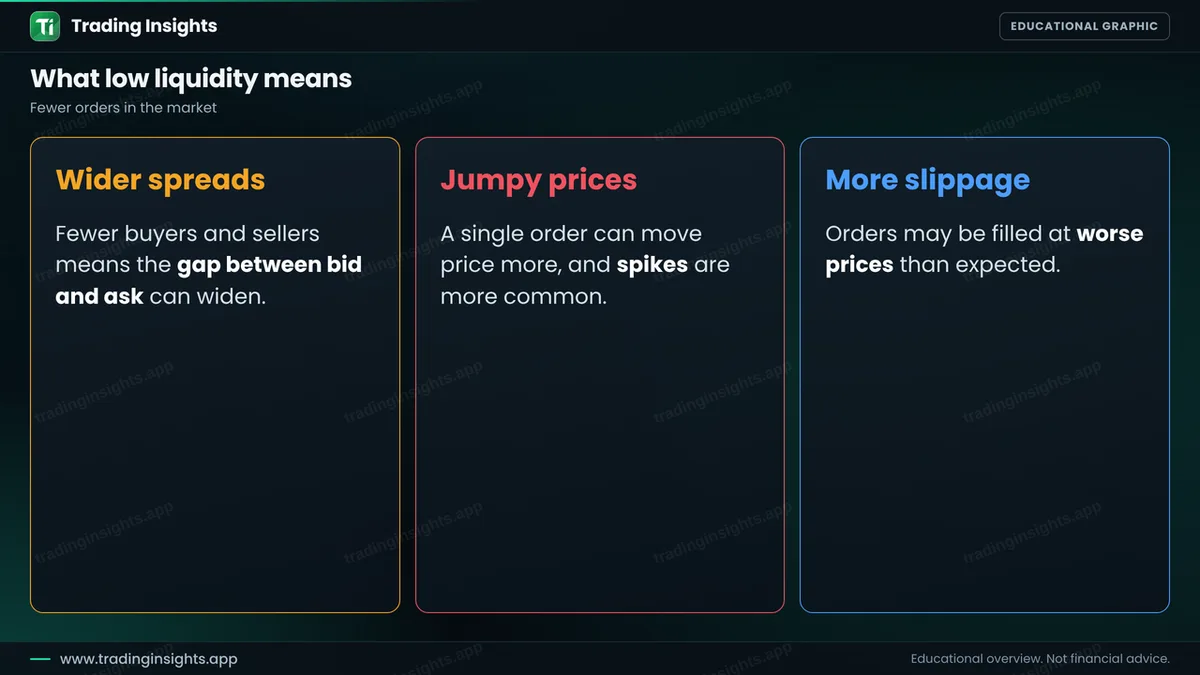
Liquidity is the amount of buying and selling interest at close prices. When it is high, orders are filled near the quoted price. When it is low, there are fewer orders, so the gap between the bid and the ask can widen, and a single order can move the price more.
The result is wider spreads, more spikes and more slippage. See bid and ask prices for the basics of the spread.
When liquidity is often thin in forex
- Daily rollover. Around the end of the New York trading day, many providers reset their prices and spreads often widen sharply for a short time. It is also when swap is applied. See forex swap and rollover.
- Sunday open. When the market reopens after the weekend, few participants are in place, spreads are wide and gaps can appear. See the weekend gap strategy.
- Major holidays. When large financial centres, such as the US or the UK, are closed, volume falls, especially in pairs that use those currencies. Around Christmas and New Year, the market can be very thin.
- Late Friday. Many traders close positions before the weekend, and liquidity falls.
- Quiet hours. Some pairs are quiet in the hours when their home markets are closed. See forex trading sessions.
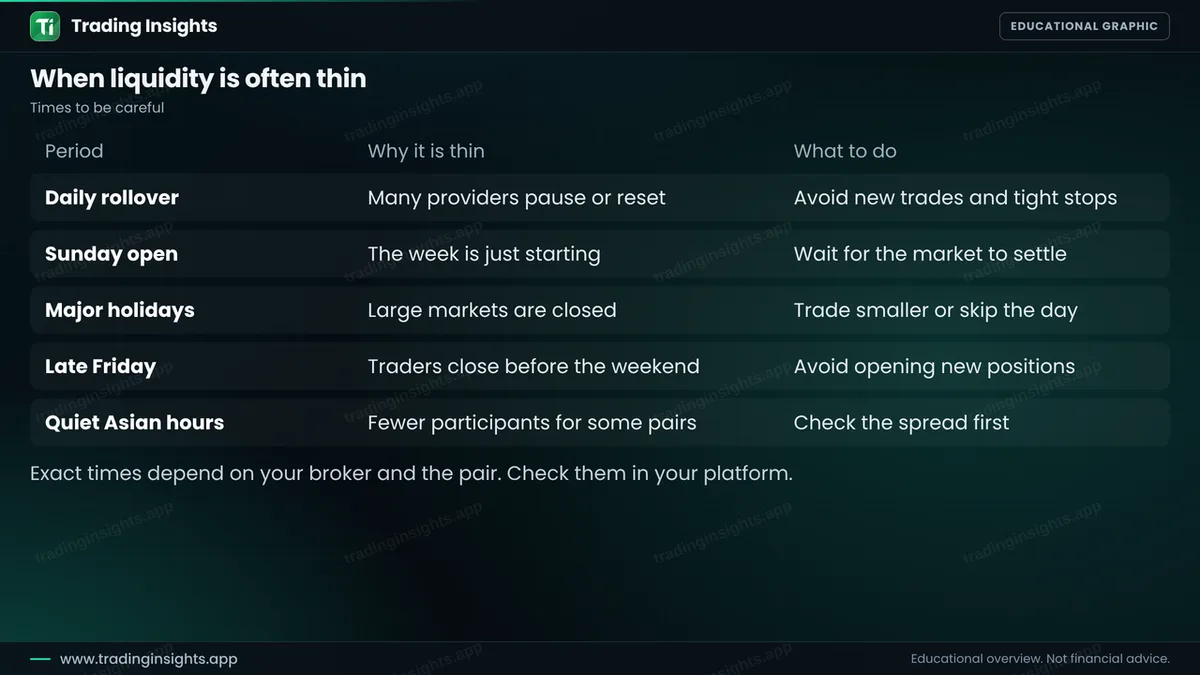
The exact times depend on your broker and on the pair, so check the times in your own platform. A simple way is to watch the live spread of your pair for a few days and note when it grows.
What thin markets do to your trading
Thin markets raise your real costs. They can also trigger stops: a spread spike can hit a stop that sits just beyond the normal price. A trader with a tight stop and a large size is most at risk. The costs are described in forex trading costs.
Orders also behave differently. A market order may fill several pips from the price you saw, and a stop order becomes a market order once triggered, so it can be filled worse than the stop level.
Illustrative example: what a wider spread costs
This is an illustrative example, not a real trade. A spread of 1 pip that grows to 5 pips adds 4 extra pips of cost. On EUR/USD with 1 lot, that is 4 pips x $10 per pip = $40 more, before the trade moves at all.
Now take a trader with a $10,000 account risking 1% ($100) on a 10-pip stop. The position size is $100 / (10 pips x $10 per pip per lot) = 1 lot. If the spread jumps to 5 pips at the rollover, the trade starts 5 pips down, half of the stop distance, and a small spike can end it.
With a 30-pip stop, the size is $100 / (30 x $10) = about 0.33 lot, and a 5-pip spread is a smaller share of the risk. The lesson: in thin conditions, a wider stop with a smaller size, or no trade, is safer than a tight stop with a large size. Check sizes with the position size calculator.
Habits for trading in thin markets
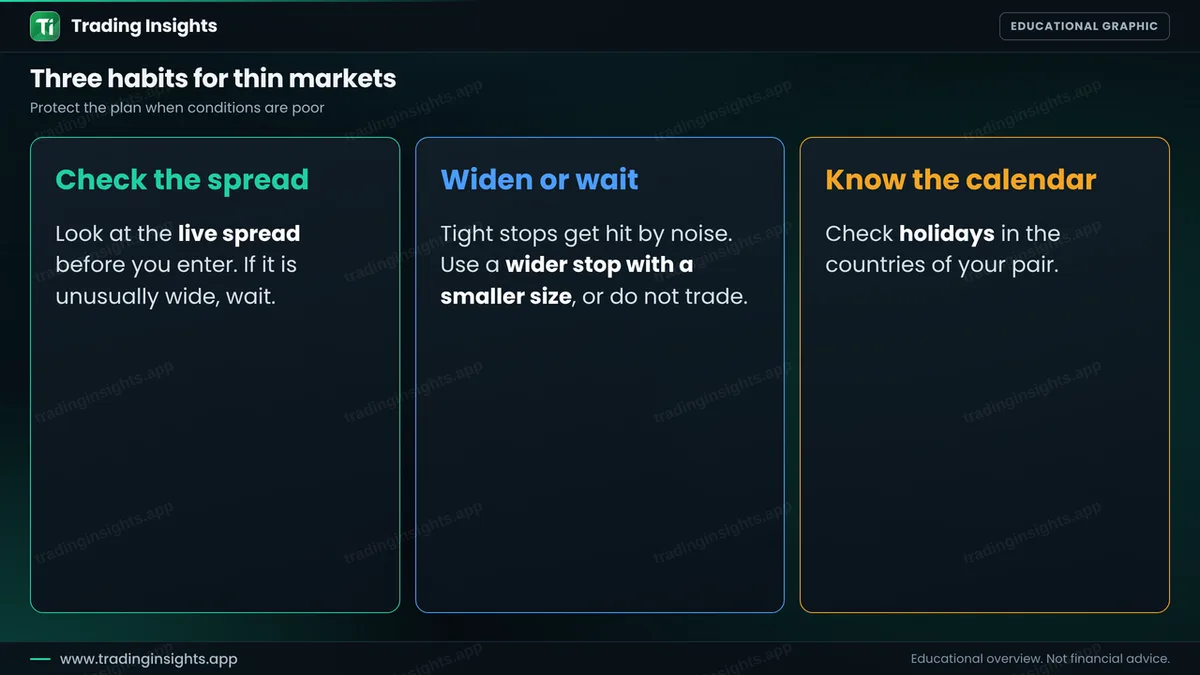
- Check the spread. Before you enter, look at the live spread. If it is unusually wide, wait until it returns to normal.
- Widen or wait. Tight stops are easily hit by noise. Either use a wider stop with a smaller position size, see how to calculate position size, or do not trade.
- Know the calendar. Check bank holidays in the countries of your pair, and avoid opening new trades just before rollover or the weekend.
- Avoid market orders at bad times. A limit order gives you control of the price. See forex order types.
- Be careful with news in thin markets. The effect can be larger. See trading forex news.
Is low liquidity always bad?
- Quiet markets can suit range strategies, with smaller targets. See range trading.
- But thin does not mean safe. A single spike can break a range quickly.
- If your strategy needs movement, it may be better to wait for a more active session.
Common mistakes
- Opening trades right at the rollover time. Spreads are often at their widest. Wait until they settle.
- Using a very tight stop during holiday weeks. Thin prices spike easily. Use a wider stop with a smaller size.
- Judging a broker only by its spread in busy hours. The spread in thin hours matters too. Compare at several times of day.
- Ignoring the holiday calendar of both currencies in the pair. A holiday in one country can thin the pair. Check both before you trade.
Frequently asked questions
What is liquidity in forex?
It is how easily you can buy or sell at a price close to the quoted one. High liquidity means many orders and tight spreads.
When is the forex market least liquid?
Often around the daily rollover, the Sunday open, major holidays and late Friday, though it depends on the pair and the broker.
Why do spreads widen in the evening?
Around the rollover time, many providers reset their prices and fewer orders are in the market, so spreads can widen sharply for a short time.
Should I avoid trading in thin markets?
Not always, but be careful. Check the spread, use stops that fit the conditions, and reduce the size or wait if conditions are poor.
Your next step
For one week, note the live spread of your main pair at the rollover, the Sunday open and a busy London hour. Then add a rule to your plan, such as no new entries when the spread is more than twice its normal level.
This is education, not financial advice. Trading carries risk, and thin markets can move fast and fill orders at poor prices. The charts are illustrative and not real market data.


