
Commodity currencies are the currencies of countries that earn a large part of their income by selling raw materials, and the best known are the Australian dollar (AUD), the Canadian dollar (CAD) and the New Zealand dollar (NZD). When the price of those materials changes, demand for the currency can change as well. For forex traders the link is a useful clue, but it is a tendency and not a rule. This article explains how commodity currencies work and how to use the link without over-trusting it.
Why a commodity can move a currency
When a country exports a lot of one product, buyers must exchange their own money for the local currency to pay. If the price of the product rises, the country earns more, and its currency often gains support. If the price falls, the opposite can happen.
This effect is one of the reasons why oil, metals and farm products are watched by forex traders. It also means a commodity chart can sometimes give an early hint about a currency pair.
The three main commodity currencies
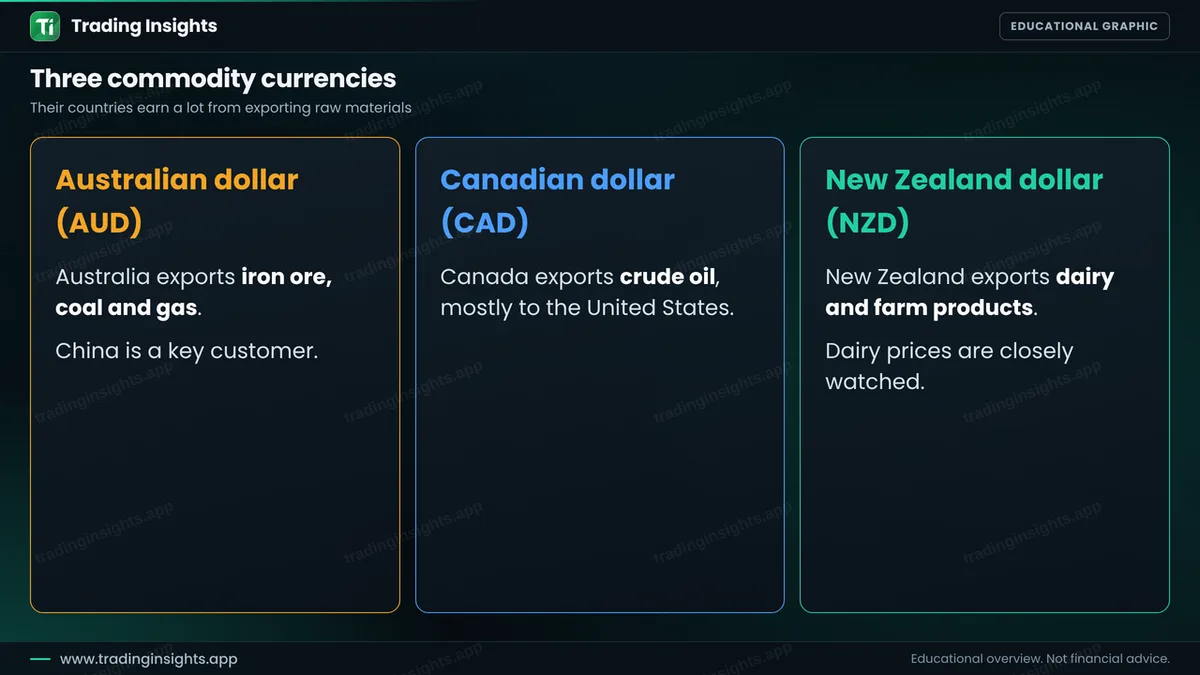
- AUD. Australia exports iron ore, coal, gas and other resources. China is a key customer, so Chinese demand and metal prices are often followed.
- CAD. Canada exports crude oil, mostly to the United States. Oil prices are the main commodity link for the Canadian dollar.
- NZD. New Zealand exports dairy and other farm products, and dairy auction results are closely watched. China is also an important buyer.
What to watch when trading commodity currencies
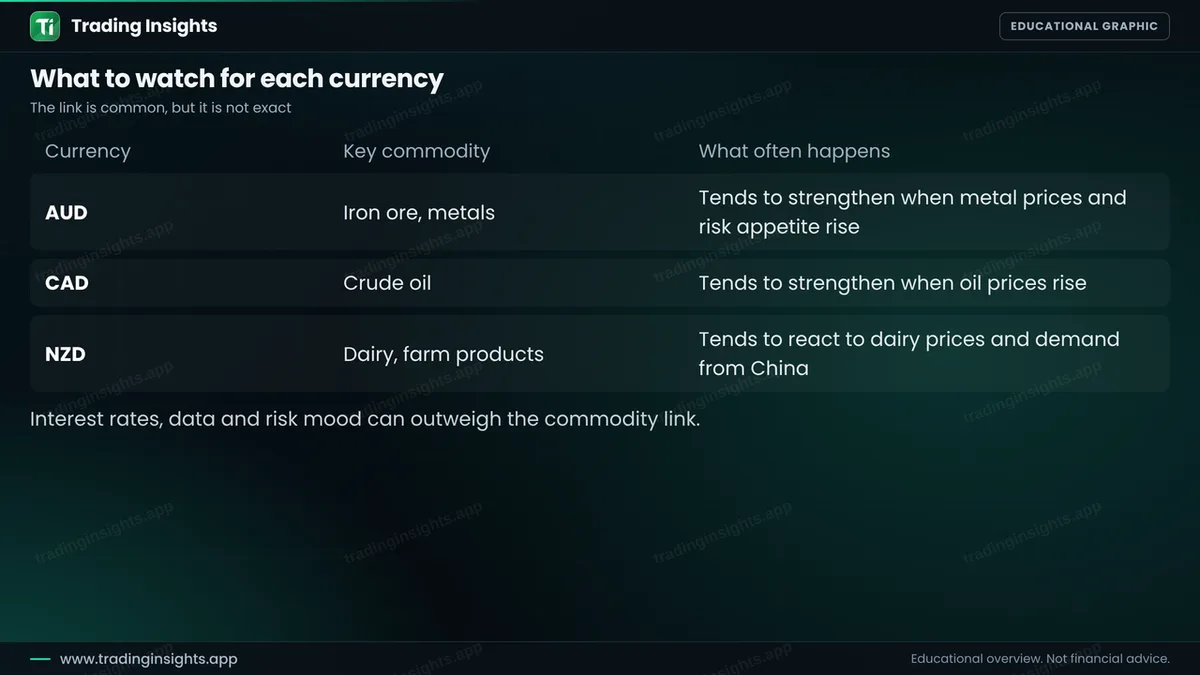
The words "tends to" matter. Sometimes oil rises and CAD does not, because the central bank, the data or the US dollar overpowers it. Some traders compare the currency pair with the commodity chart to see whether the link is working at that time.
You can also check the relationship with a correlation tool. See currency correlation in forex.
Risk mood and interest rates
AUD and NZD are also sensitive to the mood of the market. When investors feel confident, they often buy currencies that carry higher growth or yield, and these two often rise. When they feel nervous, they may sell them.
Interest rate policy matters as well: a central bank that raises rates can support its currency, whatever the commodity does. See interest rates and forex and what moves forex prices.
How to trade commodity currencies using the link
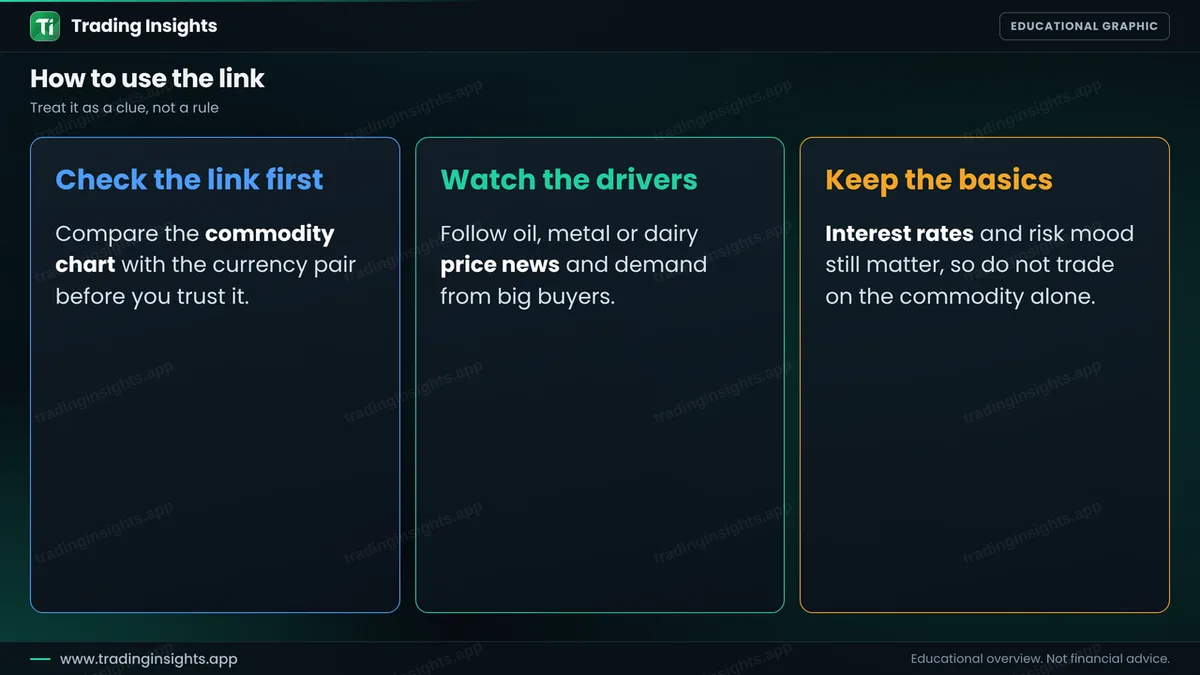
- Check the link first. Compare the commodity chart with the currency pair over the period you plan to trade.
- Watch the drivers. Follow commodity news, inventory reports and the demand of large buyers such as China.
- Keep the basics. A technical setup and a risk plan are still needed. A commodity story is not a trading plan. See top-down analysis.
- Mind the calendar. Data and decisions in the commodity-exporting country matter too. See trading forex news.
- Control risk. Commodity markets can be volatile, and so can the currencies. See how to calculate position size.
A quick pre-trade checklist
Before you take an AUD, CAD or NZD trade, spend a few minutes on four questions. Is the commodity trending on the daily chart? Is the pair moving in the same direction, or ignoring it? Is the US dollar strong or weak across the board? Is the market in a confident or nervous mood?
If the commodity, the pair and the mood agree with your setup, the trade has support. If they disagree, cut the size or wait. A mixed picture is a reason for caution, not a reason to force a trade.
Illustrative example: an AUD/USD buy with metal support
This is an illustrative example, not a real trade. Iron ore and other metals have been rising for several weeks, and AUD/USD is in an uptrend. Price pulls back to support at 0.6620, then prints a bullish candle. The trader buys at 0.6650 with a stop at 0.6620 (30 pips) and a target at 0.6710 (60 pips), a 1 to 2 reward-to-risk ratio.
With a $10,000 account risking 1% ($100), the position size is $100 / (30 pips x $10 per pip per lot) = about 0.33 lot. A win pays about $200, and a loss costs about $100. If metals had been falling while price pulled back, the picture would be mixed, and the trader would skip the trade or use a smaller size.
Common mistakes
- Assuming that the link works every day. It comes and goes. Check the pair's own chart before you rely on it.
- Looking only at the commodity. Every pair has two currencies. A strong or weak US dollar can overpower the commodity.
- Ignoring risk mood on AUD and NZD. These often fall when markets turn nervous, even if metals or dairy are steady.
- Trading a commodity headline without a stop. Prices jump on news. Use a chart level and define your risk first.
Frequently asked questions
What is a commodity currency?
It is the currency of a country that earns a large part of its income from exporting raw materials, such as AUD, CAD and NZD.
Does the Canadian dollar follow oil?
Often it does, because oil is Canada's major export, but the link is not exact. Interest rates, data and the US dollar can overpower it.
Why is the Australian dollar linked to China?
Because China buys a large share of Australia's resource exports, so Chinese demand can influence the price of those resources and the currency.
Can I trade commodity currencies using only the commodity price?
It is not wise. Use the commodity as one clue, and also look at the chart, interest rates, risk mood and your own risk plan.
Your next step
Put a daily chart of iron ore, oil or dairy prices next to AUD/USD, USD/CAD or NZD/USD for the last three months. Note when they moved together and when they did not. Then use the position size calculator to plan your risk before the next trade.
This is education, not financial advice. Trading carries risk, and commodity-linked moves can reverse quickly. The charts are illustrative and not real market data.


