
CNY and CNH are the same currency, the Chinese yuan (also called the renminbi), traded in two separate markets. CNY is the onshore yuan in mainland China, under capital controls. CNH is the offshore yuan, traded outside the mainland in places such as Hong Kong, and it is the one most retail brokers quote as USD/CNH. The two prices are usually close but not equal, and the gap itself is information. For context on how currency regimes differ, see the glossary entries on fixed and floating exchange rates.
Two markets, one currency
The yuan is among the most traded currencies in the world, yet it is not freely floating. Because mainland China restricts how money flows in and out, the onshore and offshore markets are partly separated.
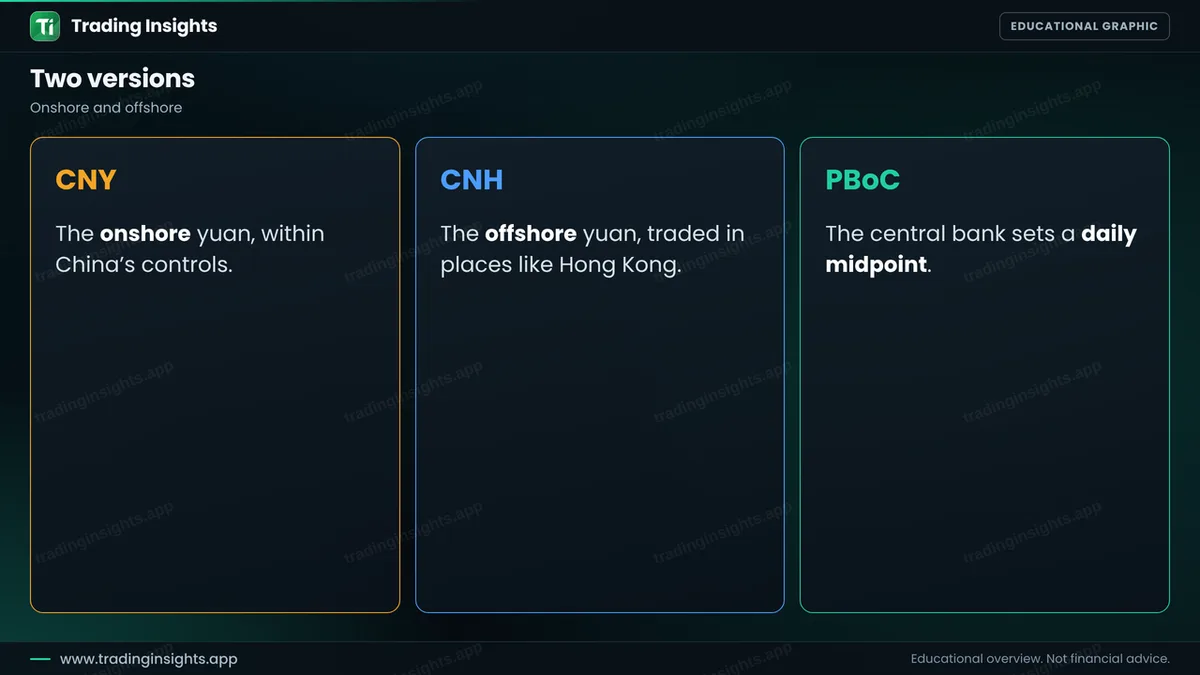
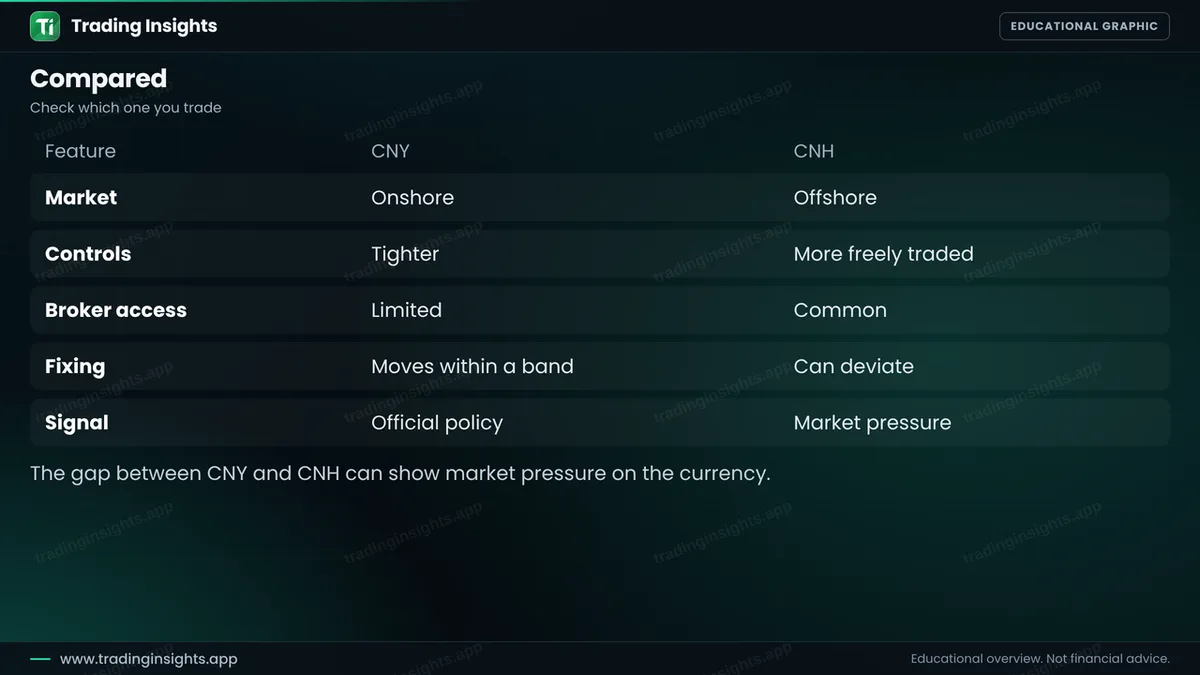
- CNY (onshore). Traded in mainland China, with tighter controls on who can trade and how money moves.
- CNH (offshore). Traded outside the mainland, more open to global investors, hedgers and speculators.
- Same currency, different price. Because the markets are linked by trade and arbitrage, the rates normally stay near each other, but supply and demand differ in each.
How the PBoC fits in
The People's Bank of China (PBoC) sets a daily midpoint, also called the fixing, for the onshore rate. The onshore price may then trade within a band around that midpoint. The offshore rate is not bound by the band.
This matters because the midpoint is the PBoC's way of showing its stance. A midpoint set much weaker or stronger than the market expected is a policy signal. A wide gap between CNH and CNY can also signal pressure: if CNH trades much weaker than CNY, offshore traders are betting on yuan weakness more strongly than the controlled onshore market allows. See central banks and forex.
Where the usual rules do not apply
- Tight technical ranges around policy dates. The price is shaped by officials, so a clean chart pattern can be overruled by one announcement.
- Round-number logic. The authorities may care more about the pace of change than any level.
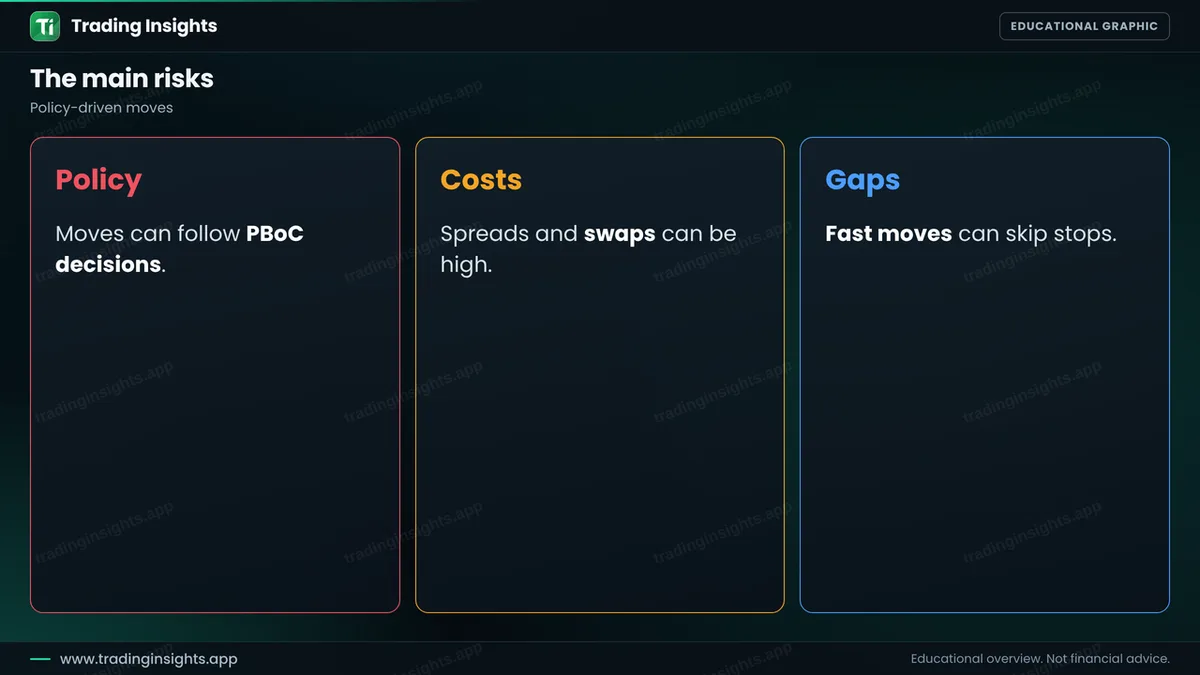
- Normal cost assumptions. Spreads and swaps are often larger than on major pairs.
- Assuming CNH equals CNY. The two can diverge in stress.
The main risks
Policy decisions, the midpoint setting and trade headlines can change the price suddenly. Costs can be higher than on major pairs. The pip value is in yuan, which adds a conversion step to sizing, so check it before you trade. For tariff headlines in particular, review your exposure in advance.
Step-by-step approach
- Check the instrument. Confirm whether your broker offers CNH or CNY and what the contract size is.
- Check the spread and swap. Compare them with the distance you expect the trade to move.
- Follow PBoC announcements and trade-news headlines on the calendar.
- Convert the pip value. For USD/CNH, one pip is 0.0001 yuan per dollar; on a 100,000-unit lot that is 10 yuan. This article assumes about $1.40 per pip per lot, which depends on the exchange rate, so check your platform.
- Place the stop beyond normal swings. The pair can have wide pip ranges, so a 250 to 350 pip stop is not unusual.
- Set the target at a multiple of the stop, such as 2R, or at the next structure level.
- Keep size small until you know how the pair behaves. Our pip calculator can help with the conversion.
Illustrative example: a win
Assume USD/CNH has pulled back after a rise and bounces from a support zone near 7.2000. A trader buys at 7.2050 with a stop 280 pips below at 7.1770 and a target 560 pips higher at 7.2610. The assumed pip value is $1.40 per pip per lot.
With a $7,500 account risking 0.75% ($56), the position size is $56 / (280 pips x $1.40 per pip per lot) = about 0.14 lot. A win of 560 pips pays about $110; a loss costs about $55.
Price reaches the target after a firm dollar session, and the trade makes about $110, a 2R result.
Illustrative example: a loss
In another hypothetical trade, the trader buys USD/CNH at 7.2400 after a trade headline, with a stop 340 pips below at 7.2060 and a target 680 pips higher. Officials then signal support for the yuan, the midpoint is set stronger than expected, and the pair falls through the stop.
With a $7,500 account risking 0.75% ($56), the position size is $56 / (340 pips x $1.40 per pip per lot) = about 0.12 lot. A win of 680 pips pays about $115; a loss costs about $57.
The loss is about 0.75% of the account. The small lot size, chosen because the stop is wide, kept the damage controlled even though the policy signal was against the trade.
Common mistakes
- Assuming CNY and CNH are the same price. They can differ, especially in stress. Know which one your broker quotes.
- Ignoring spreads and swap costs. Higher costs can wipe out a modest move. Compare cost to target before entering.
- Using a tight stop in a policy-driven pair. The market jumps on announcements. Use a stop beyond structure and reduce size to match.
- Skipping the pip value conversion. The pip value is in yuan, so wrong assumptions give wrong risk. Check the platform's contract details.
- Trading headlines without a plan. Trade-news spikes reverse quickly, so wait for a level and a trigger.
Pre-trade checklist
- Does my broker quote CNH or CNY, and what is the contract size?
- What are the spread and swap today?
- Is a PBoC announcement or trade headline due?
- Have I converted the pip value to my account currency?
- Is the stop beyond structure, with size set by a fixed risk percentage?
- Is the lot small enough for a wide stop?
Frequently asked questions
What is the difference between CNY and CNH?
CNY is the onshore yuan in mainland China, and CNH is the offshore yuan traded outside it. They are the same currency in two markets, so their prices are close but can differ.
What does the PBoC midpoint do?
It is a daily reference rate for the onshore yuan. The onshore price can trade within a band around it, so the midpoint shows the central bank's stance.
Is the yuan freely floating?
No. It is a managed currency, with a reference rate and capital controls onshore. The offshore market is freer but still influenced by policy.
Why can CNH and CNY differ?
The offshore market has fewer restrictions, so pressure shows up there more quickly. A wide gap can signal stress on the currency.
This is educational only, not financial advice. Trading carries risk of loss, and the trades above are hypothetical illustrations with assumed pip values. Check real specifications and costs before trading, and risk only what you can afford to lose.


