
You buy EUR/USD and GBP/USD, each with 1% risk. It looks like two trades, and 2% in total looks fine. But if both pairs move together, you do not have two separate bets. You have one bet, repeated. Currency correlation is the idea behind this problem, and ignoring it is a common reason for big losses in a few hours.
What is correlation?
Correlation is a number between -1 and +1 that shows how two prices move in relation to each other. At +1 they move together all the time. At -1 they move in opposite directions. Near 0 there is no link. In forex, many pairs share a currency, so they are linked. EUR/USD and GBP/USD both have the US dollar as the quote currency, so they often rise and fall together when the dollar changes. For a reminder about pairs, see forex currency pairs.
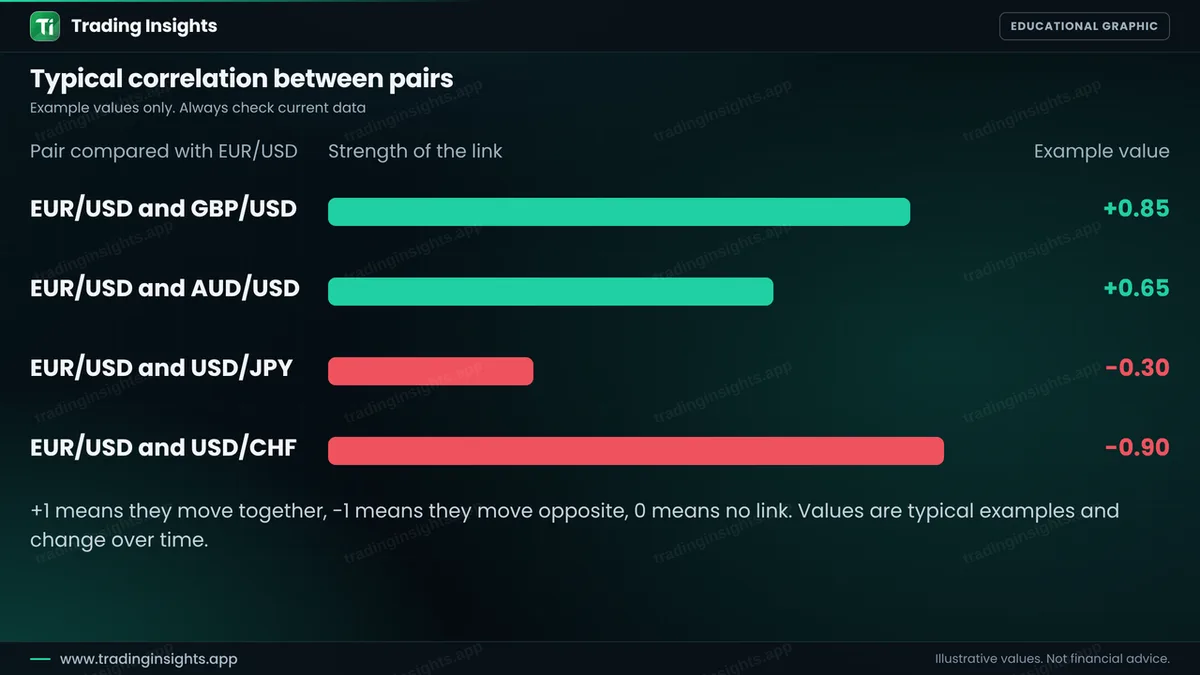
The values above are only examples. Correlation is not fixed. It can be strong for months and weak for weeks. Do not treat any number as a law.
Two trades, one big bet
The main danger is hidden risk. If you buy EUR/USD and buy GBP/USD, both trades are really a bet that the dollar will fall. If the dollar rises, both can lose at the same time. Your real risk is closer to 2% than 1%. The same happens when you buy EUR/USD and sell USD/CHF, because USD/CHF is negatively correlated: selling it is also a bet against the dollar.
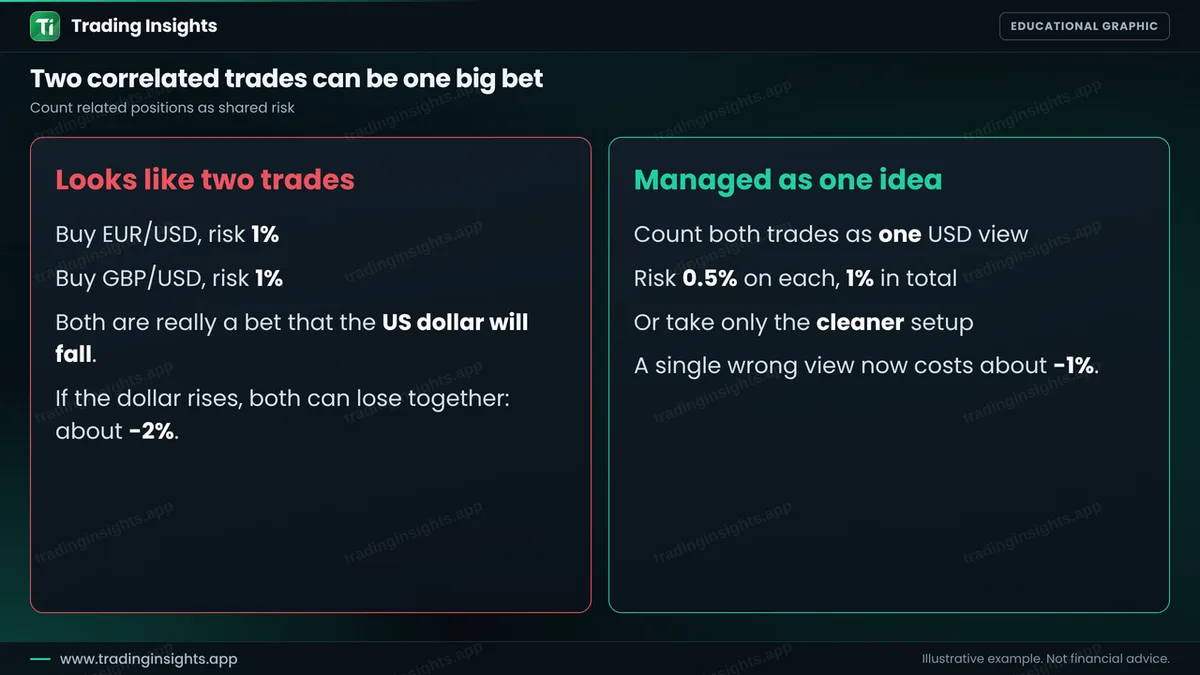
Think in terms of currencies, not pairs. Ask yourself: which currency am I really buying or selling? If the answer is the same for two trades, then they share risk. This is also why overtrading can be more dangerous than it looks: ten trades on dollar pairs can be one trade ten times.
Three steps to manage correlation
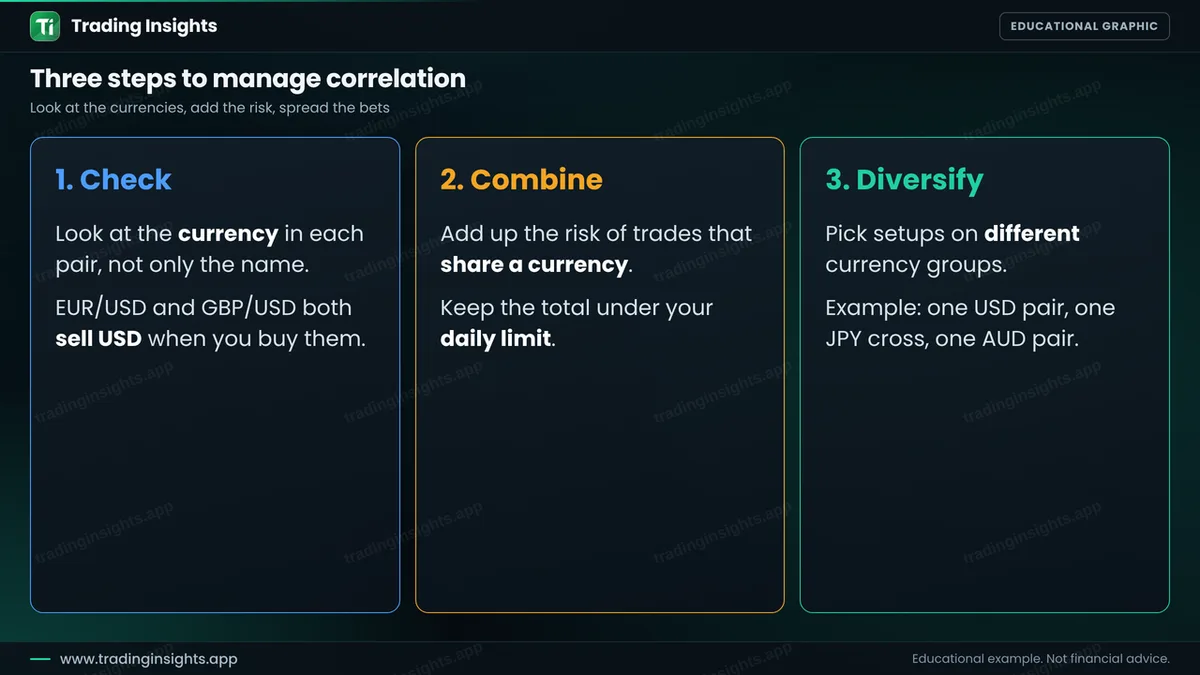
- Check. Before you open a second trade, list the currencies of the first. Does the new trade add the same exposure?
- Combine. Add the risk of the trades that share a currency. Two trades with 0.5% each are about 1% of shared risk. Keep the total within your limit. See position sizing.
- Diversify. Look for setups on different currency groups, such as one dollar pair, one yen cross and one Australian dollar pair.
You can use the position size calculator to size each trade with a smaller percent when you hold more than one related position.
Can correlation be useful?
Yes. It can warn you, but it can also help you confirm a view. If EUR/USD shows a strong buy setup and GBP/USD shows the same direction, the dollar weakness is shown in more than one place. But do not use both to double the size. Use the second as a confirmation, or choose the cleaner of the two. A pair that is normally correlated and suddenly moves away can also warn you about news in one currency. See trading forex news.
Common mistakes
- Opening many trades on the same currency and calling it diversification.
- Forgetting that a sell on one pair can be the same bet as a buy on another.
- Trusting an old correlation number without checking.
- Keeping full risk on every correlated trade.
- Not having a total risk limit across all open trades. See drawdown and risk of ruin.
Frequently asked questions
What is currency correlation?
It is a measure of how closely two currency pairs move together. It ranges from -1 (opposite) to +1 (same direction).
Which pairs are positively correlated?
Pairs that share the same quote currency and have similar drivers, such as EUR/USD and GBP/USD, often move together. Check current data, because it changes.
Is correlation constant?
No. It changes over time with the market conditions, so you should check it from time to time.
How can I reduce correlation risk?
Count related trades as one idea, reduce the risk on each, or choose only the cleanest setup. Also keep a limit on the total risk of all open trades.
Trading involves risk. This is education, not financial advice. The charts are illustrative and not real market data. Trading carries risk, and no method guarantees results.


