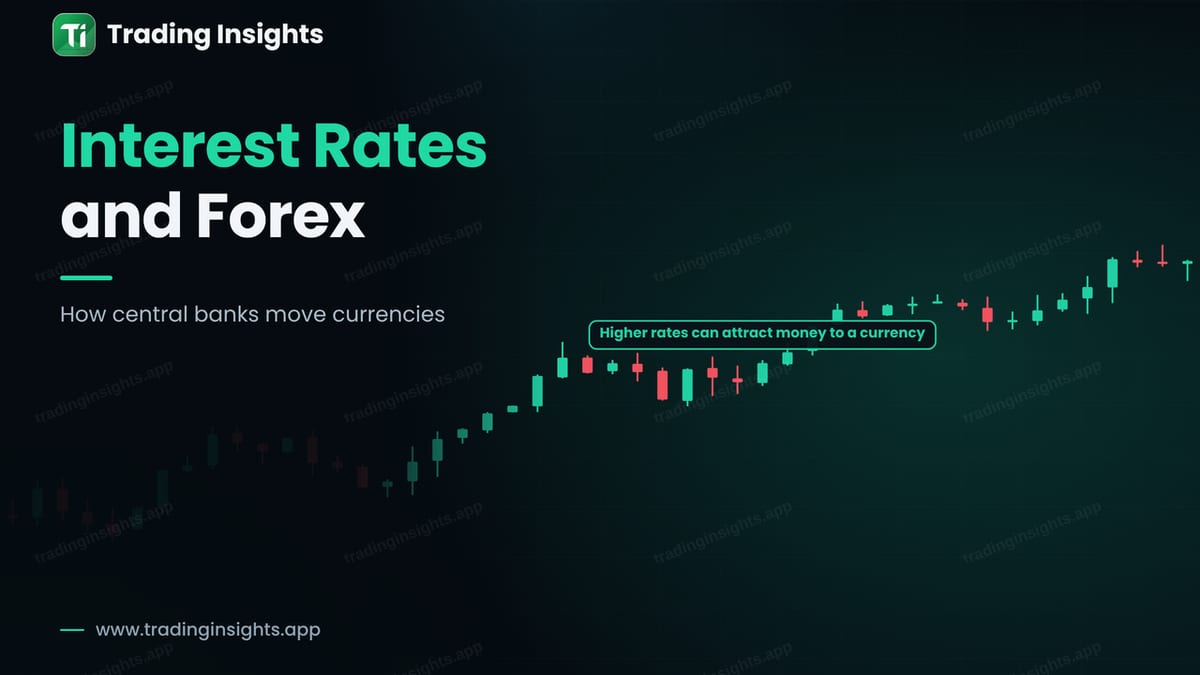
If you follow forex news, you will hear about central banks and interest rates all the time. There is a good reason. A currency is the money of a country, and the interest rate is the price of that money. When the rate changes, or when traders expect it to change, the value of the currency often moves. This article explains the basic link in simple steps.
What is an interest rate?
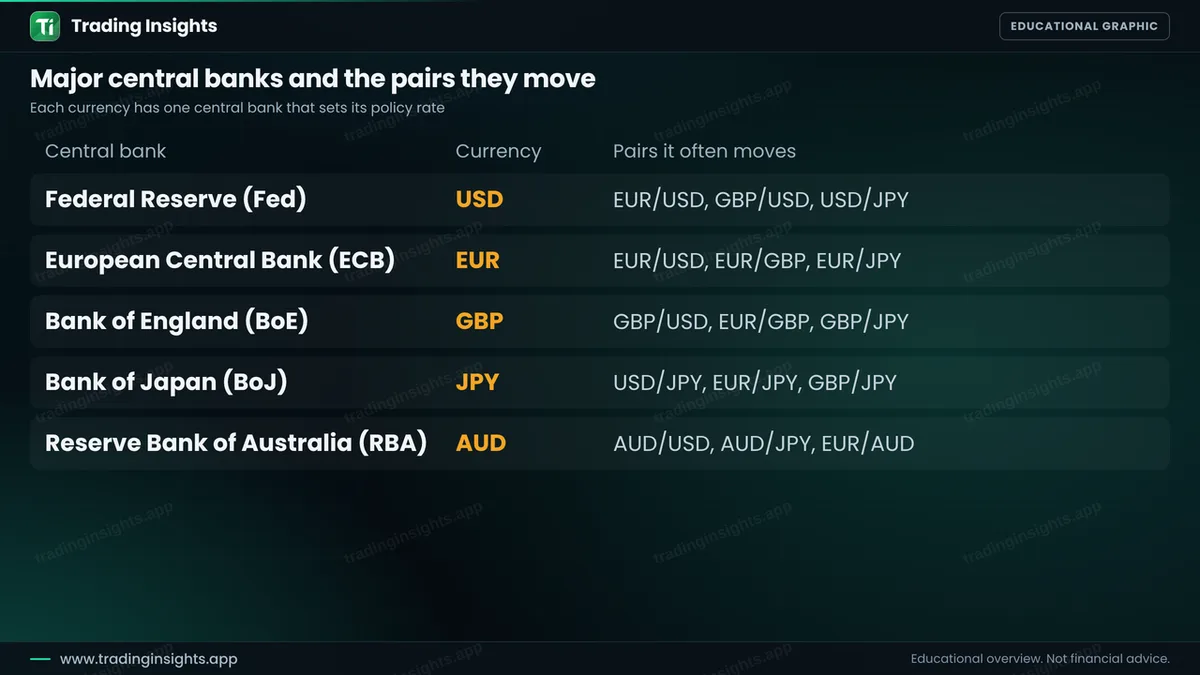
Each major currency has a central bank, such as the Federal Reserve for the US dollar or the European Central Bank for the euro. The central bank sets a policy rate. It affects how much banks pay to borrow money, and indirectly how much savers earn and borrowers pay. A higher rate usually means a higher return for holding that currency. A lower rate means a lower return.
How rates can move a currency
The simple chain has four steps. First, the central bank raises its rate. Second, deposits and bonds in that currency pay more. Third, investors buy the currency to get the higher return. Fourth, the extra demand can push the currency up against others. When rates fall, the chain goes the other way, and the currency can weaken.
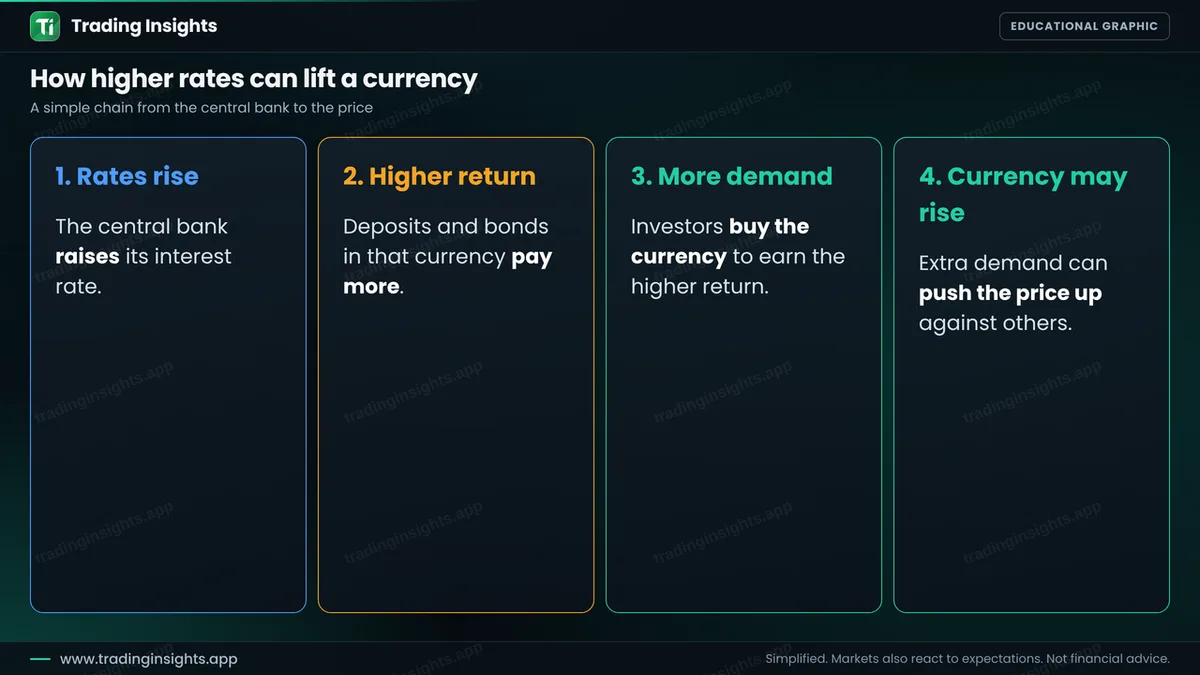
This is a simplification. Many other things matter, such as growth, inflation, risk sentiment and the rates of the other currency in the pair. A pair always compares two currencies, so you need to think about both. See forex currency pairs.
Expectations matter more than the decision
Markets look forward. If everyone expects a rate rise, the price often moves before the meeting. When the decision arrives as expected, the price may barely move, or even reverse. What moves price most is a surprise: a decision different from expectations, or a change in the tone of the statement. That is why traders watch the economic calendar. Read how to trade forex news for the practical side.
Hawkish and dovish
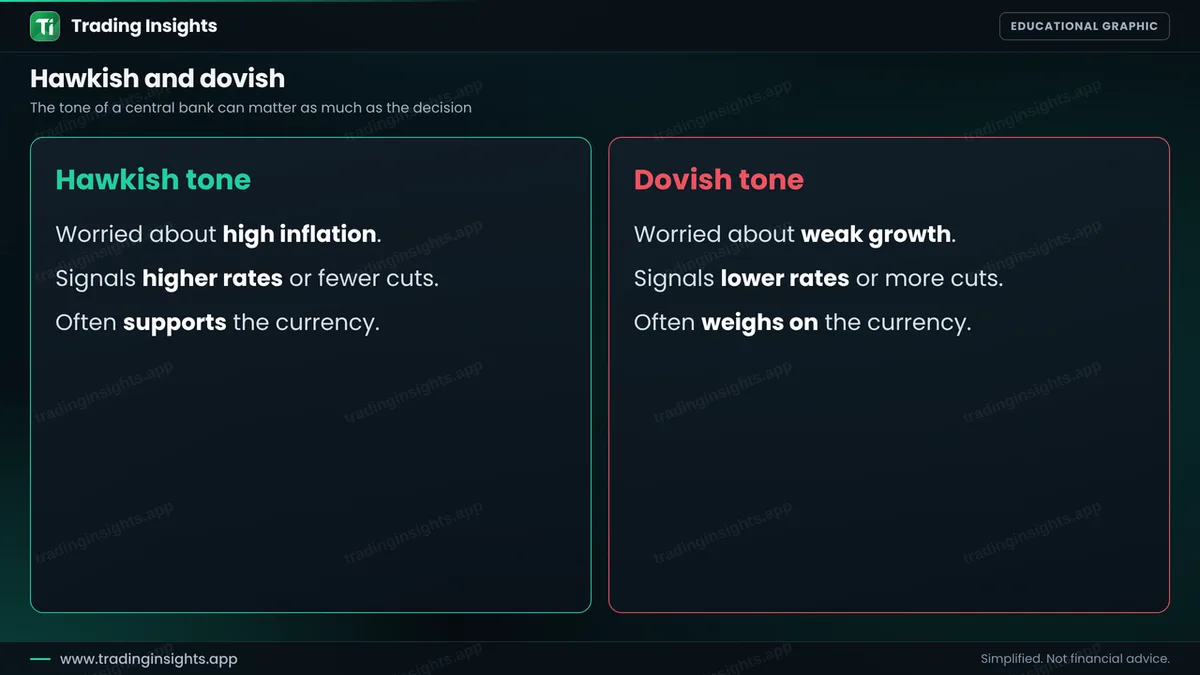
A hawkish central bank is focused on fighting inflation and signals higher rates or fewer cuts. This often supports its currency. A dovish central bank is focused on growth and signals lower rates or more cuts. This often weighs on its currency. The words in a statement or a press conference can move the market in a few seconds, even if the rate did not change.
Rates and your trading costs
Interest rates also affect your account directly. When you hold a position overnight, you pay or receive a swap, which depends on the rate difference between the two currencies. See forex trading costs. Some traders hold a pair with a positive swap for a long time, which is called a carry trade, but the price risk can be larger than the interest earned.
How to use this as a beginner
- Know the calendar. Note the dates of the central bank meetings for the currencies you trade.
- Avoid trading blind into the event. Spreads widen and prices jump. Many beginners prefer to stay out until the market calms.
- Combine with the chart. A fundamental view does not give an entry. Use levels and a stop. See top-down analysis.
- Keep the risk small. Use a fixed risk per trade. See position sizing and the position size calculator.
Common mistakes
- Thinking that a rate rise always makes a currency go up.
- Looking at one currency and ignoring the other side of the pair.
- Trading the first spike after a decision without a plan.
- Forgetting that expectations are already in the price.
- Ignoring the swap when holding trades for a long time.
Frequently asked questions
Why do interest rates affect currencies?
A higher rate can offer a better return for holding a currency, which can attract investors and raise demand. A lower rate can do the opposite.
Does a rate rise always make the currency stronger?
No. If the rise was expected, the price may not react, and other factors can matter more. Surprises and the tone of the statement often move the price most.
What does hawkish mean?
It means a central bank is focused on controlling inflation and may raise rates or keep them high.
What does dovish mean?
It means a central bank is focused on supporting growth and may lower rates or keep them low.
Trading involves risk. This is education, not financial advice. The charts are illustrative and not real market data. Trading carries risk, and no method guarantees results.


