
A tariff announcement is one of the few pieces of market-moving news that can arrive at any hour of any day, including weekends, and that can be partially or fully reversed within days of the original headline. That combination of unpredictable timing and genuine reversibility makes tariff-driven currency moves distinctly riskier to trade than a scheduled economic data release.
The basics
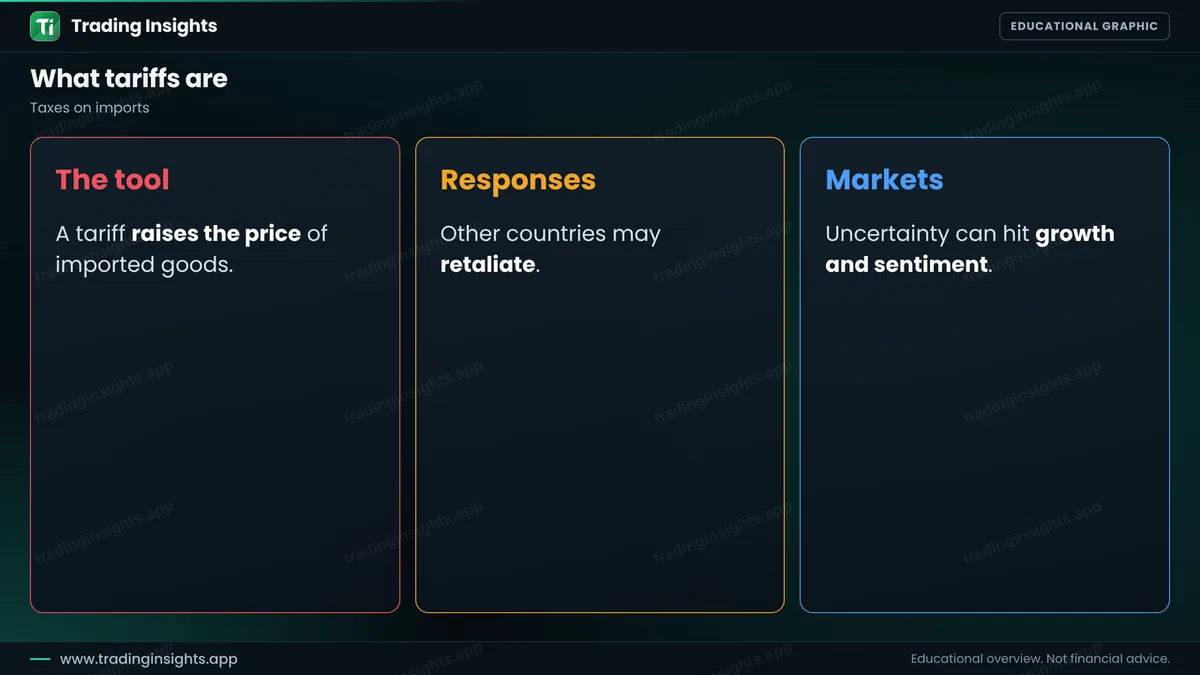
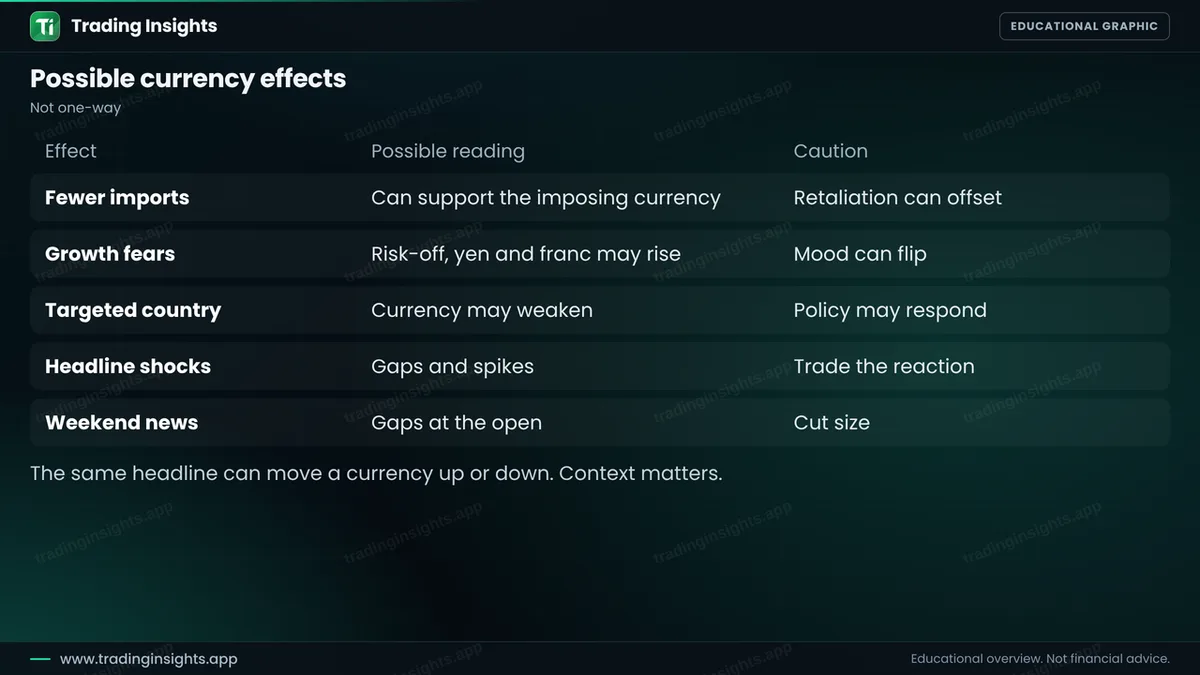
A tariff is a tax imposed on imported goods, and when countries raise tariffs against each other, currencies often react — though not always in the direction many traders initially expect. Tariffs can raise the price of imported goods, which feeds into inflation, and they can reduce overall trade volume, which feeds into growth; central banks may then adjust their own policy path in response to either or both of these effects. Some observers argue a tariff tends to strengthen the currency of the country imposing it, by reducing that country's import volumes and improving its trade balance mechanically; others point to the growth-dampening effect and the near-certainty of retaliation as reasons it can just as easily weaken the same currency. The honest answer is that the net effect genuinely depends on the specific situation, the scale of the measures, and how other countries respond.
The channels, and why they can point in different directions at once
Several distinct channels operate simultaneously whenever a significant tariff announcement hits the market, and they do not always reinforce each other. Trade flows themselves change directly as tariffs alter the relative cost of importing from different countries. Inflation and interest-rate expectations shift as the direct price effect of tariffs feeds through to consumers and businesses. Growth expectations shift as reduced trade volume weighs on economic activity. Risk sentiment often reacts fastest of all the channels, since trade-war headlines can quickly push capital toward safe havens regardless of the specific economic mechanics still being worked out. Trade-linked currencies — such as the Australian dollar, the Mexican peso, or the Chinese yuan — tend to be particularly sensitive to this kind of headline-driven sentiment shift, given how directly their underlying economies depend on global trade flows.
Why retaliation specifically can undo an initial move
An initial tariff announcement often produces an immediate currency reaction based on the market's first-pass read of the news. But trade measures routinely provoke retaliation from the targeted country, and that retaliatory response can shift the overall picture considerably, sometimes reversing part or all of the initial currency move once the fuller back-and-forth becomes clear. A trader who reacts only to the first headline, without anticipating that a retaliatory response is a near-certain part of the broader sequence, risks being caught on the wrong side once that retaliation is actually announced.
Why headline risk is the dominant practical concern here
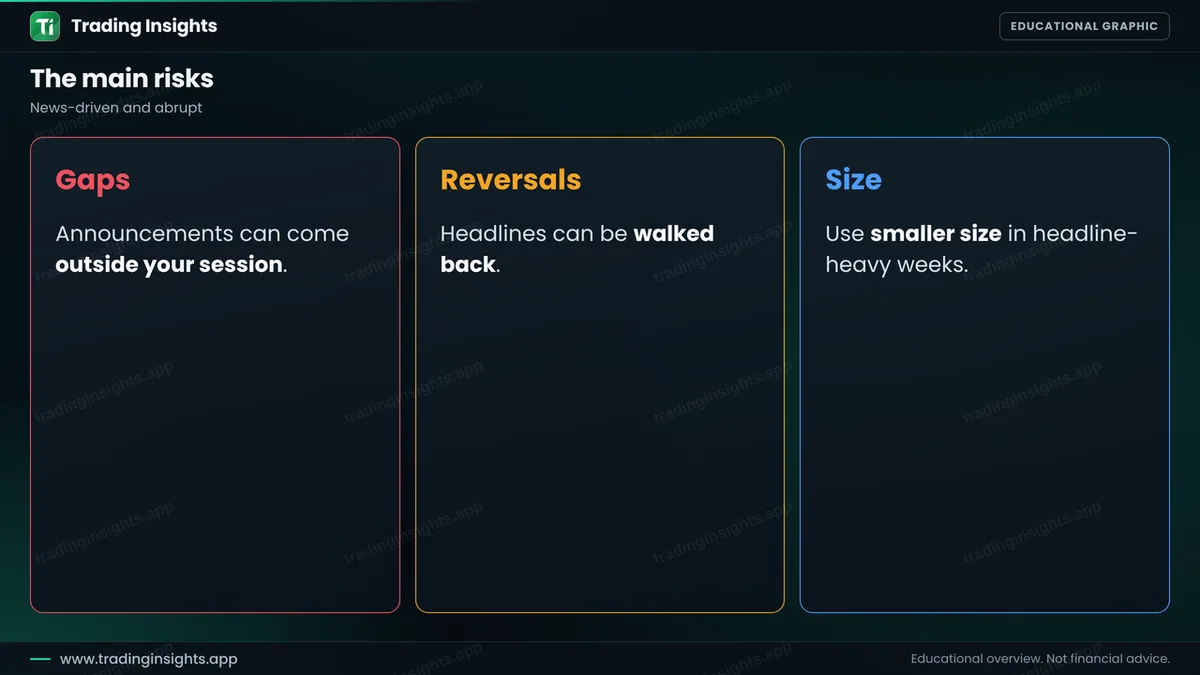
Tariff-related announcements, delays, and reversals can arrive at literally any hour, including over a weekend when liquidity is at its thinnest and most retail trading platforms are closed or operating with reduced depth. This combination of unpredictable timing and the possibility of a sudden, large move produces real gap risk: a stop-loss order placed before a weekend can fill at a considerably worse price than intended if a major tariff headline breaks while markets are effectively closed, consistent with the broader issue of slippage during periods of reduced liquidity.
Step-by-step rules
- Follow the calendar of announced tariff deadlines and scheduled trade talks closely, since these dates are the periods of highest headline risk.
- Reduce position size specifically around these deadlines and active negotiation periods, rather than trading your normal size through genuinely heightened uncertainty.
- Trade from clear chart levels with a defined stop, confirmed using the risk-reward calculator and sized with the position size calculator, rather than reacting to the headline alone.
- Avoid holding large positions over a weekend during active trade tensions, given the genuine possibility of a major headline breaking while markets are closed or thin.
- Review how a specific pair actually reacted to previous similar headlines, rather than assuming a fixed, universal direction for tariff-related news.
Illustrative example 1: waiting for a stable reaction before entering (win)
A new tariff announcement lifts broad risk aversion, and AUD/JPY drops sharply toward a known support level. A trader with a $11,000 account waits for a stable candle to form at that level, rather than reacting to the first spike, and buys at 96.20 with a stop at 95.70 (50 pips) and a target at 97.20 (100 pips), a 2:1 reward-to-risk setup, using half the usual position size specifically because of the elevated headline risk, risking 0.5% ($55) instead of the usual 1%. Using the position size calculator, that sizes to roughly 0.11 standard lot. The initial risk-off reaction fades as expected and the pair recovers toward target, for a gain of about $110.
Illustrative example 2: trading the first headline at full size (loss)
A second trader, on a $8,000 account, reacts immediately to the same tariff announcement with a full-size position, selling AUD/JPY at 96.50 expecting continued weakness, with a stop at 97.00 (50 pips) and a target at 95.50 (100 pips), risking the full 1% ($80), sizing to about 0.16 standard lot. Within two days, a partial de-escalation headline reverses much of the initial risk-off move, and AUD/JPY rallies back through the stop, for a loss of about $80 — a direct consequence of trading the first headline at full conviction and full size, without allowing for the genuine possibility of a fast reversal.
Common mistakes
- Assuming tariffs always strengthen, or always weaken, the currency of the country imposing them. The combination of growth, inflation, retaliation, and risk-sentiment effects can point in different directions depending on the specific situation.
- Trading the very first headline with a full-size position. Initial reactions can be exaggerated and are genuinely prone to partial or full reversal within days.
- Ignoring weekend gap risk during periods of active trade tension. Major headlines can break when markets are closed or thin, producing considerably worse fills than planned.
- Forgetting that retaliation is a near-certain part of the broader sequence. An initial move based only on the first announcement often needs to be reassessed once a retaliatory response follows.
Pre-trade checklist
- Are there known tariff deadlines or scheduled trade talks coming up that could produce a sudden headline?
- Have I reduced my position size specifically to reflect this elevated headline risk?
- Is my entry based on a clear chart level and a stable price reaction, rather than the first spike itself?
- Am I about to hold a large position over a weekend during a period of active trade tension?
- Have I checked how this specific currency pair reacted to similar tariff headlines in the past, rather than assuming a fixed direction?
- Would my trade thesis survive a retaliatory response reversing some or all of the initial move?
Frequently asked questions
Do tariffs reliably strengthen a currency? Not reliably. Effects on growth, inflation, retaliation, and risk sentiment can all point in different directions depending on the specific circumstances involved.
Which currencies tend to react most to trade policy news? Trade-linked currencies such as the Australian dollar, the Mexican peso and the Chinese yuan, along with safe havens like the yen and the Swiss franc during periods of broad risk aversion.
Why are tariff headlines considered especially risky to trade? They can arrive at any hour, including weekends, and can reverse quickly within days, which raises the risk of gaps and slippage around stop-loss orders.
How can I reduce exposure to this kind of risk? Use smaller position sizes around known deadlines, trade from clear chart levels with defined stops, and avoid holding large positions over weekends during periods of active trade negotiation.
This article is for general education only and is not financial advice. The figures in the illustrative examples are not real market data, and trading carries risk of loss.


