
Forex volatility is the size and speed of price moves over a period. In a quiet market candles are small and slow, and in a fast market a single candle can cover more than a normal day. It affects how wide your stop should be, how big your position should be and what the spread costs, so a trader who ignores it uses the same settings in all conditions and gets surprised.
What forex volatility is
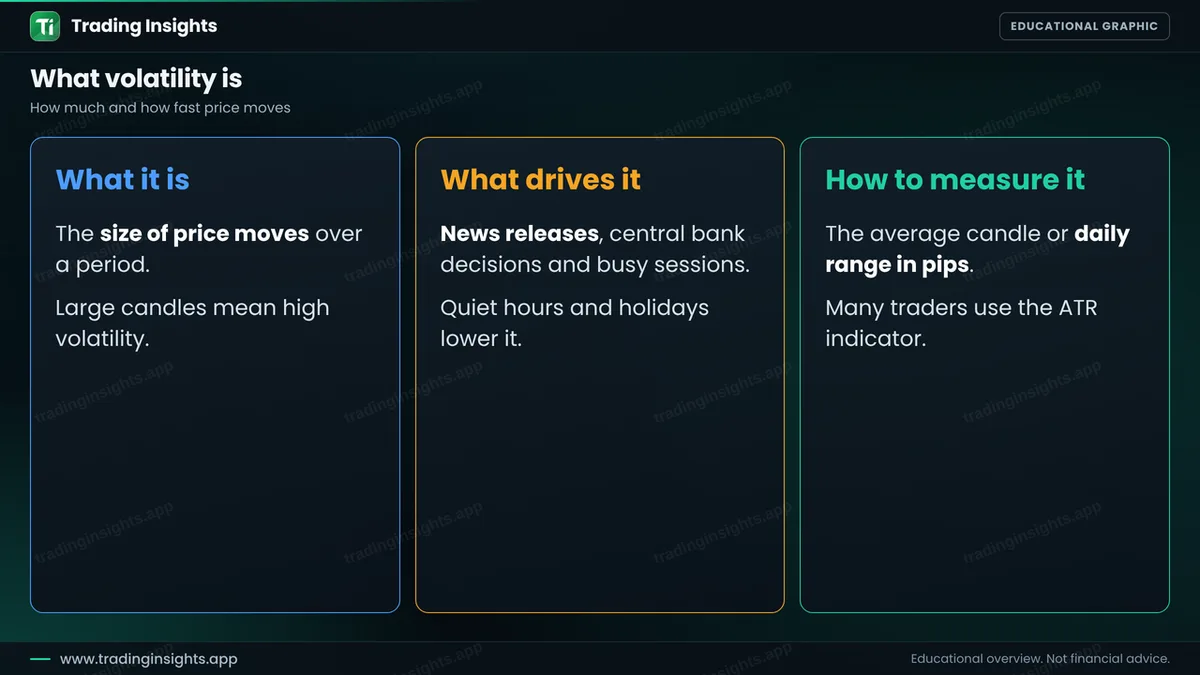
Volatility is the size of price moves over a period. High volatility means large candles and quick moves. Low volatility means small candles and slow moves.
It is not the same as direction: price can be volatile in an uptrend, a downtrend or a range. It also does not say whether the market is good or bad, only how active it is.
What drives volatility
- News. Releases such as interest rate decisions and jobs data cause spikes. See trading forex news and what moves forex prices.
- The session. Volatility is usually higher when London and New York are open, and lower in quiet hours. See forex trading sessions.
- The pair. Some pairs move more than others. See forex currency pairs.
- Mood and events. Political events and changes in risk appetite can raise volatility for days.
Volatility also comes in waves. Quiet periods tend to be followed by faster ones, and fast periods calm down again. You cannot time it exactly, but you can notice which phase you are in.
How to measure volatility
The simplest way is to look at the average range of recent candles or days, in pips. Many traders use the ATR indicator, which averages the range over a set number of candles. See the ATR stop loss for how to use it.
If the average daily range of a pair is 80 pips, a stop of 10 pips is likely to be hit by normal movement. If the average is 40 pips, a stop of 60 pips is probably too wide.
Compare today with the recent average as well. If the range so far is already close to the average by mid-session, the day is fast. If it is a small fraction of the average, the day is quiet.
Trading quiet and fast markets
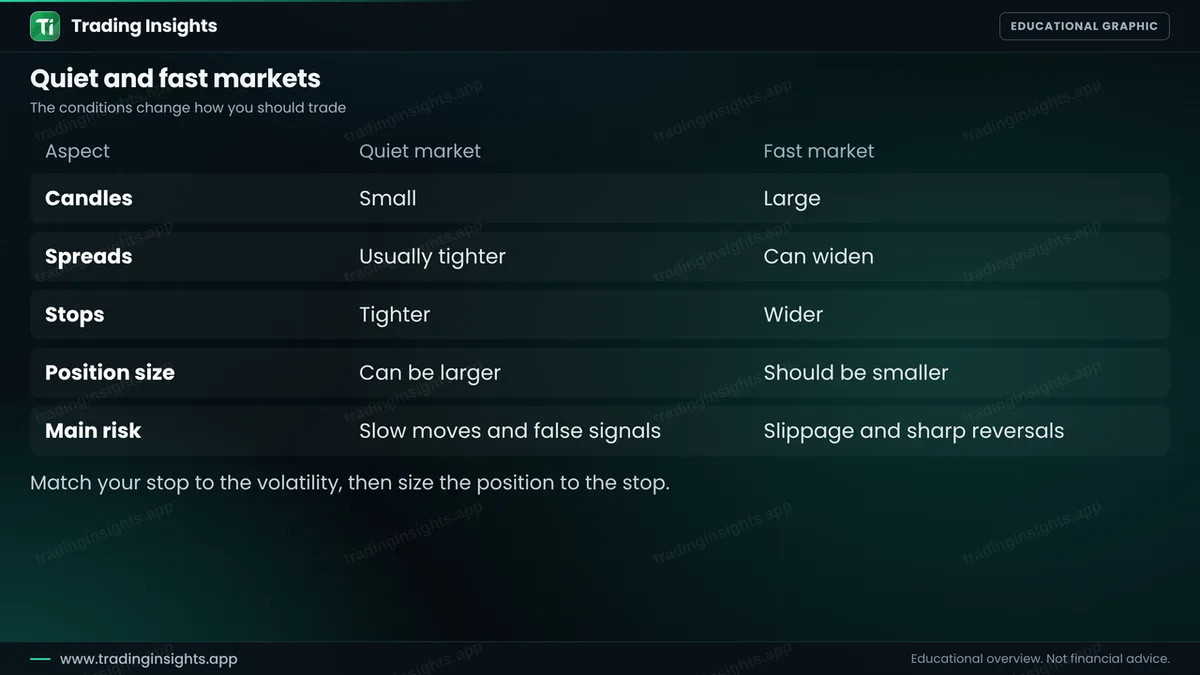
In a quiet market, candles are small, spreads are usually tight, and stops can be tighter. The risk is slow moves, small targets and false signals.
In a fast market, candles are large, spreads can widen, and stops must be wider to survive the movement. The risk is slippage and sharp reversals. See bid and ask prices for how spreads work.
Keep the risk the same
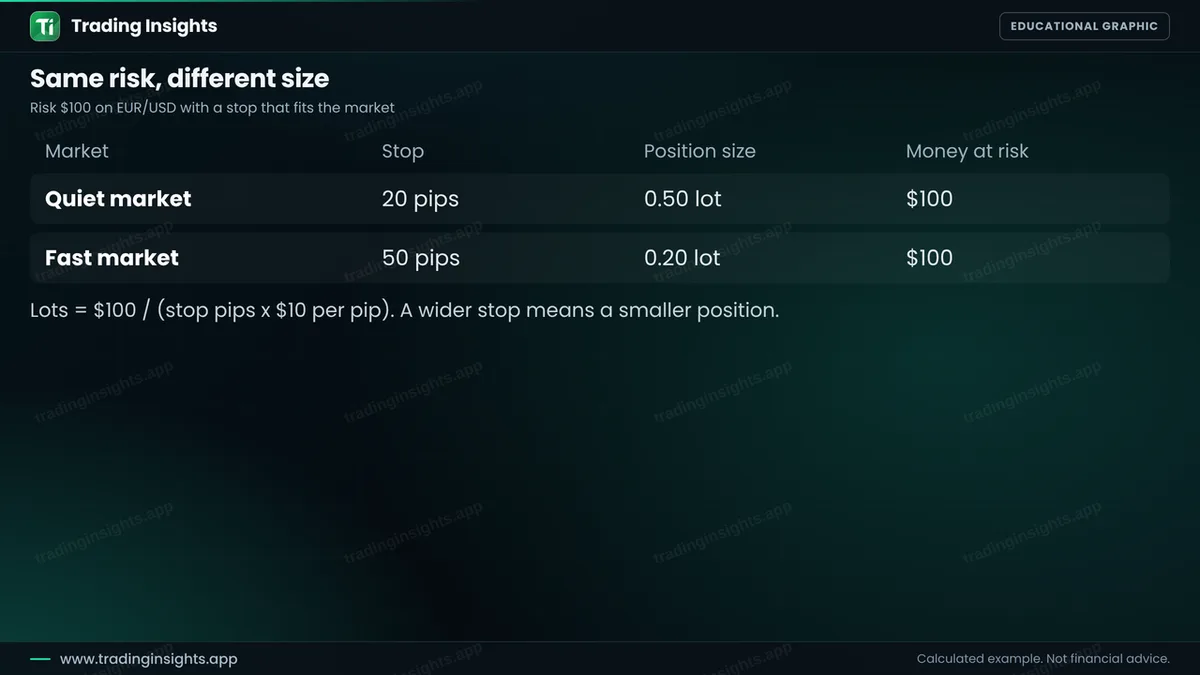
The most important lesson is that you should not change the money at risk because the market is fast. You change the stop to fit the market, and then you change the position size to fit the stop.
On EUR/USD, risking $100 with a stop of 20 pips means 0.50 lot ($100 / (20 x $10)). With a stop of 50 pips, it means 0.20 lot. The risk is $100 in both cases. Use the position size calculator to do the calculation, and see how to calculate position size for the method.
How to adapt step by step
- Check the recent range. Look at the ATR or the last few days.
- Place the stop at a logical level with enough room for normal movement.
- Adjust the position size to keep the risk at your fixed percent.
- Adjust the target. Targets should also fit the range, or the reward ratio will be unrealistic. See risk to reward ratio.
- Be careful around news. Reduce the size or stand aside if you cannot accept a spike.
- Skip very quiet periods if your strategy needs movement.
Illustrative example: the same setup in two markets
This is an illustrative example, not a real trade. A trader wants to buy EUR/USD after a pullback to support, with a 1 to 2 reward-to-risk ratio and a $10,000 account risking 1% ($100).
- Quiet day, daily range about 40 pips: entry 1.0850, stop 1.0830 (20 pips), target 1.0890 (40 pips). Size is $100 / (20 pips x $10) = 0.50 lot. A win pays about $200, and a loss costs about $100.
- Fast day, daily range about 100 pips: entry 1.0850, stop 1.0800 (50 pips), target 1.0950 (100 pips). Size is $100 / (50 pips x $10) = 0.20 lot. A win pays about $200, and a loss costs about $100.
The money at risk and the reward ratio are identical. Only the stop, the target and the lot size changed to fit the market. A 20-pip stop on the fast day would likely be hit by ordinary movement.
Common mistakes
- Using the same stop in quiet and fast markets. A stop that is fine on a slow day is noise on a fast one. Size the stop from the recent range or from structure.
- Keeping the same lot size when the stop gets wider. The loss then grows with the stop. Recalculate the lot so the risk stays at your fixed percent.
- Trading a tight scalping plan during news. Spreads widen and prices jump. Wait until the release has passed.
- Thinking that high volatility means easy profit. Larger moves also mean larger losses and more slippage. Treat it as a condition to manage, not an opportunity by default.
Frequently asked questions
What is volatility in forex?
It is the size and speed of price movements over a period. Large and fast moves mean high volatility.
How do I measure volatility?
Look at the average range of candles or days in pips. The ATR indicator is a common tool. For a deeper method, see volatility position sizing.
Is high volatility good for trading?
It gives larger moves but also larger risks, such as wide spreads and slippage. It is neither good nor bad in itself.
How should I change my trade size in a volatile market?
Widen the stop to fit the movement and reduce the position size so that the money at risk stays the same.
Your next step
Add the ATR to a pair you trade and write down its value on the daily chart today. Then compare your usual stop size with it, and ask whether normal movement would hit your stop.
This is education, not financial advice. Trading carries risk, and fast markets can move against you quickly. The charts are illustrative and not real market data.


