
In forex, every pair has two prices: the bid, at which you can sell, and the ask, at which you can buy. The ask is always a little higher than the bid, and the gap between them is the spread. This explains why every trade starts with a small loss, and why some pairs and some times of day cost more than others.
What are the bid and the ask price in forex?
The bid is the price at which you can sell. The ask is the price at which you can buy. The difference between them is the spread, and it is one of the main costs of trading.
A quote like EUR/USD 1.0899 / 1.0901 means that the bid is 1.0899, the ask is 1.0901, and the spread is 2 pips.
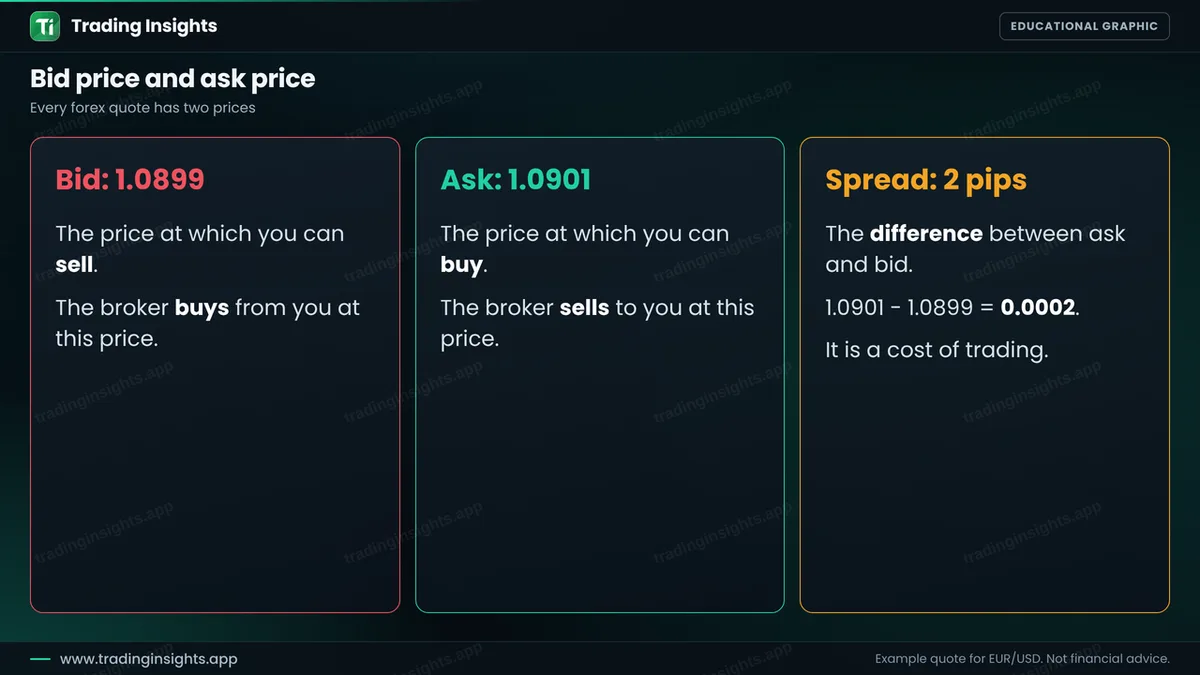
A simple way to remember it: from the broker's point of view, you buy high and sell low. You buy at the higher price (ask), and you sell at the lower price (bid). The chart on most platforms shows the bid price, so a buy trade has to start from a price that is slightly above what you see.
What happens when you buy and close
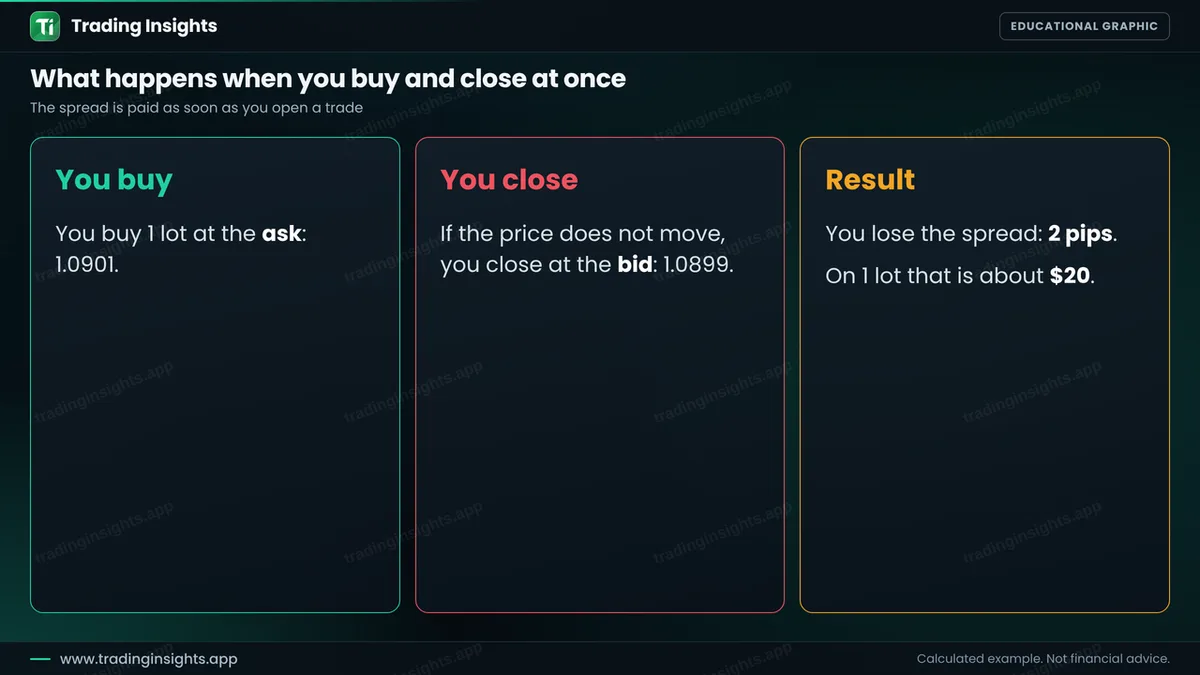
Suppose that you buy 1 lot at the ask, 1.0901. If the market does not move at all and you close right away, you sell at the bid, 1.0899. You lose 2 pips, which is about $20 on 1 lot.
This is why a trade starts slightly in the negative, and why price has to move in your favour by the size of the spread before you are even. For more about this cost and others such as commission and swap, see forex trading costs.
What a spread costs you
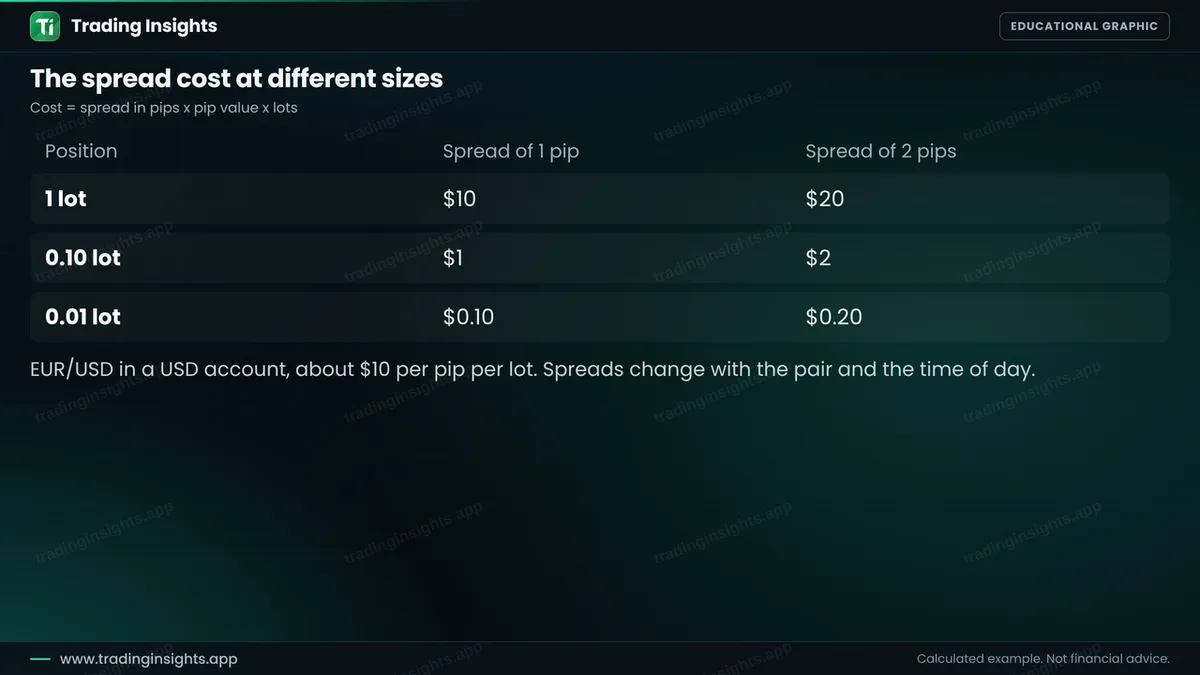
The cost in money depends on the spread, the pip value and the size of your position. On EUR/USD, one pip is about $10 per lot. So a 1-pip spread costs about $10 on 1 lot, and $1 on 0.10 lot.
For how to calculate the value of a pip for other pairs, see how to calculate pip value. A cost that looks small can add up when you trade often, or when your stops and targets are small.
Illustrative example: the spread inside a trade
This is an illustrative example, not a real trade. EUR/USD is quoted 1.0899 / 1.0901. You decide to buy with a 20-pip stop and a 40-pip target. You buy at the ask, 1.0901, place the stop at 1.0881 and the target at 1.0941.
With a $10,000 account risking 1% ($100), the position size is $100 / (20 pips x $10 per pip per lot) = 0.5 lot. A win pays about $200, and a loss costs about $100.
The spread you paid at entry was 2 pips x $10 x 0.5 lot = about $10. That is 10% of your $100 risk, spent before price moves. Note that a buy is closed at the bid, so your stop and target are triggered by the bid price, not the ask. A tighter spread or a wider stop would lower that share.
For a sell trade the roles flip: you open at the bid and close at the ask, so a stop above your entry is triggered by the ask. For other pairs, such as USD/JPY, the pip value differs a little from $10, so use the position size calculator for the real figure.
Why the spread changes
- The pair. Major pairs such as EUR/USD usually have tighter spreads than exotic pairs. See forex currency pairs.
- The time of day. Spreads are often tighter in busy sessions and wider when the market is quiet. See forex trading sessions.
- The news. Around big releases, spreads can widen a lot. See trading forex news.
- The broker and the account type. Some accounts have a fixed spread, some a variable one, and some charge a commission instead. Exact figures vary by broker.
How to use bid and ask in your trading
- Know the spread before you enter. Look at the live quote, not only at the chart.
- Add it to your stop. A sell trade is closed at the ask, so a stop above the entry can be hit by the ask, not the bid. A small buffer helps.
- Do not trade tiny targets. If the spread is 2 pips and your target is 5 pips, the cost is 40% of the profit.
- Avoid the worst times. Wide spreads at the rollover time or during news can hurt.
- Compare brokers. The same pair can have different spreads and commissions.
Common mistakes
- Thinking that the chart price is the price you will get. The chart often shows the bid, and a buy fills at the ask. Check the live quote before you enter.
- Forgetting that stops on sell trades are triggered by the ask. A stop can be hit while the chart looks safe. Add a small buffer.
- Choosing very small targets on pairs with a wide spread. The spread eats a large share of the profit. Aim for targets many times larger than the spread.
- Comparing brokers by spread alone. A raw spread plus commission can cost more or less than a wider spread with no commission. Add up the total cost.
Frequently asked questions
What is the difference between bid and ask?
The bid is the price at which you can sell, and the ask is the price at which you can buy. The ask is higher than the bid.
What is a spread?
It is the difference between the ask and the bid. It is a cost of trading, paid when you open a trade.
Why does my trade start with a small loss?
Because you buy at the ask and the value of the position is measured at the bid, so you start by losing the spread.
Which price does the chart show?
Most platforms show the bid price, so a buy trade is opened at a slightly higher ask price.
Your next step
Open your platform's market watch and write down the live spread of three pairs at three times of day: London morning, New York afternoon and late evening. Then use the glossary to look up any term you are unsure about. You will quickly see which pairs and hours cost less.
This is education, not financial advice. Trading carries risk, and no method guarantees results. The charts are illustrative and not real market data.


