
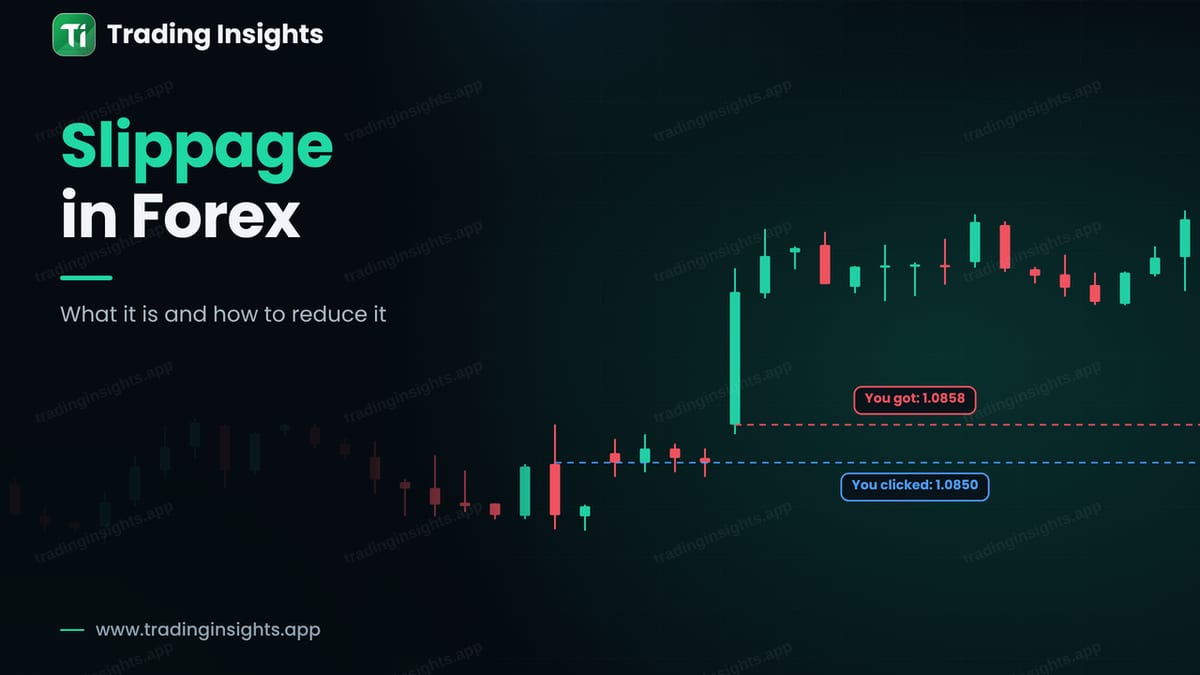
Slippage is the difference between the price you expect for an order and the price at which it is actually filled. You click buy at 1.0850, but the order fills at 1.0858. The market moved in the few moments between your click and the fill. Slippage can work against you or for you, but traders feel the bad cases more.
What slippage looks like
Orders are not filled instantly at the price on the screen. A request goes to the broker, who looks for the best available price. When price is calm, the fill is usually at or very near the price you saw. When price moves fast, the next available price can be far away.
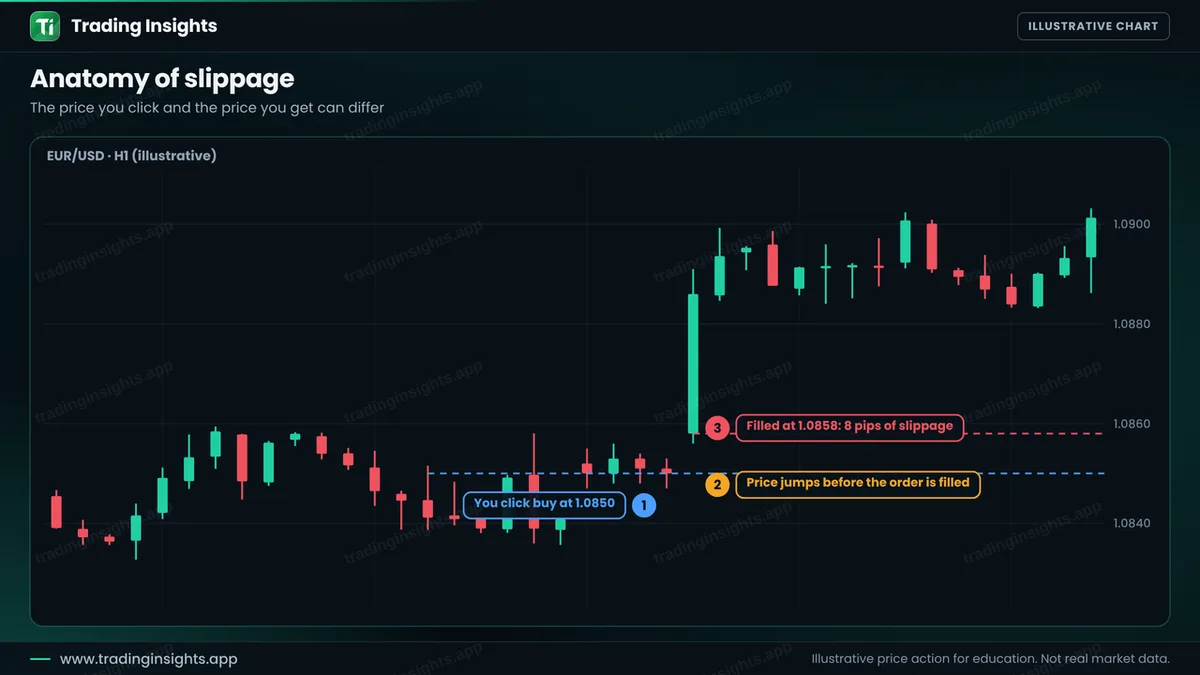
Slippage can be positive, when the fill is better than the price you saw. It can also be negative, when the fill is worse. In practice, both happen, but a fast spike in the direction of your order tends to give a worse fill.
What slippage costs
Take a buy with a size of 0.50 lot on EUR/USD. A pip is worth about $10 per lot, so $5 per pip at 0.50 lot. An 8-pip slippage costs 8 x $5 = $40. That is $40 on top of the spread, and it lowers your reward-to-risk ratio from the start. See forex trading costs.
Stop orders can suffer too. Suppose you risk $100 with a stop of 20 pips at 0.50 lot. If the stop fills 8 pips worse, the loss is 28 pips, or $140. That is why a stop loss limits risk but does not guarantee a price. For the order types, see stop loss vs stop limit.
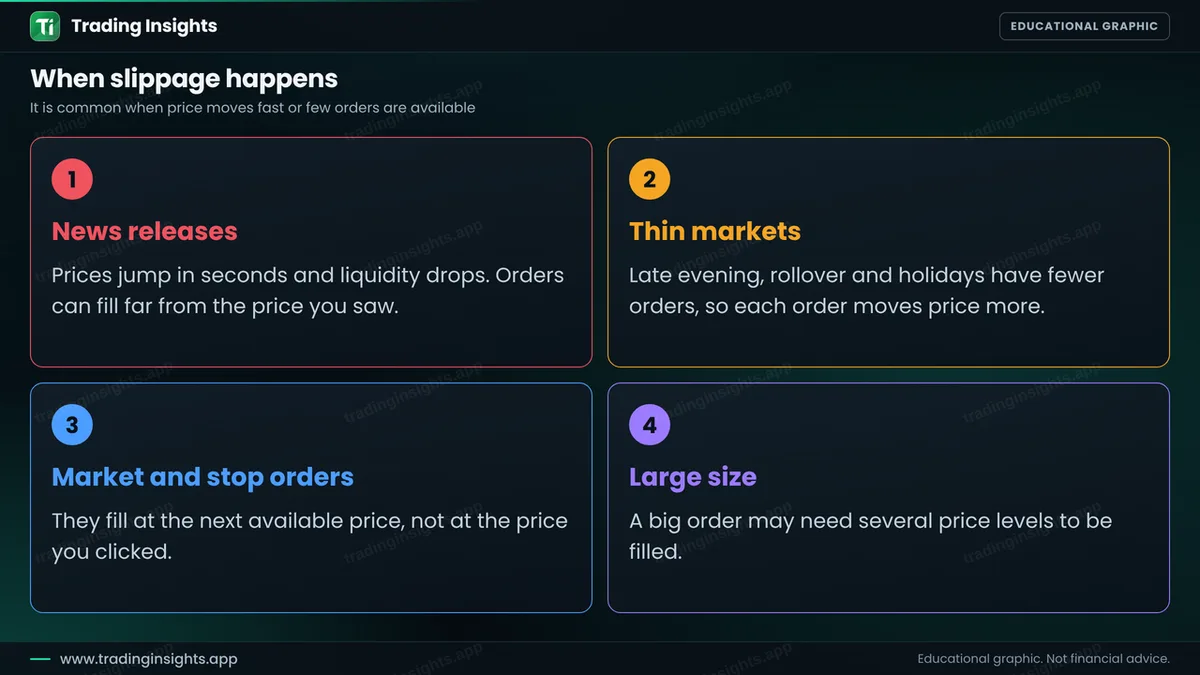
When slippage happens
- News releases. Prices jump in seconds and liquidity drops. See trading forex news.
- Thin markets. Late evening, rollover and holidays have fewer orders, so each order moves price more.
- Market and stop orders. They fill at the next available price, not at the price you clicked.
- Large size. A big order may need several price levels to be filled.
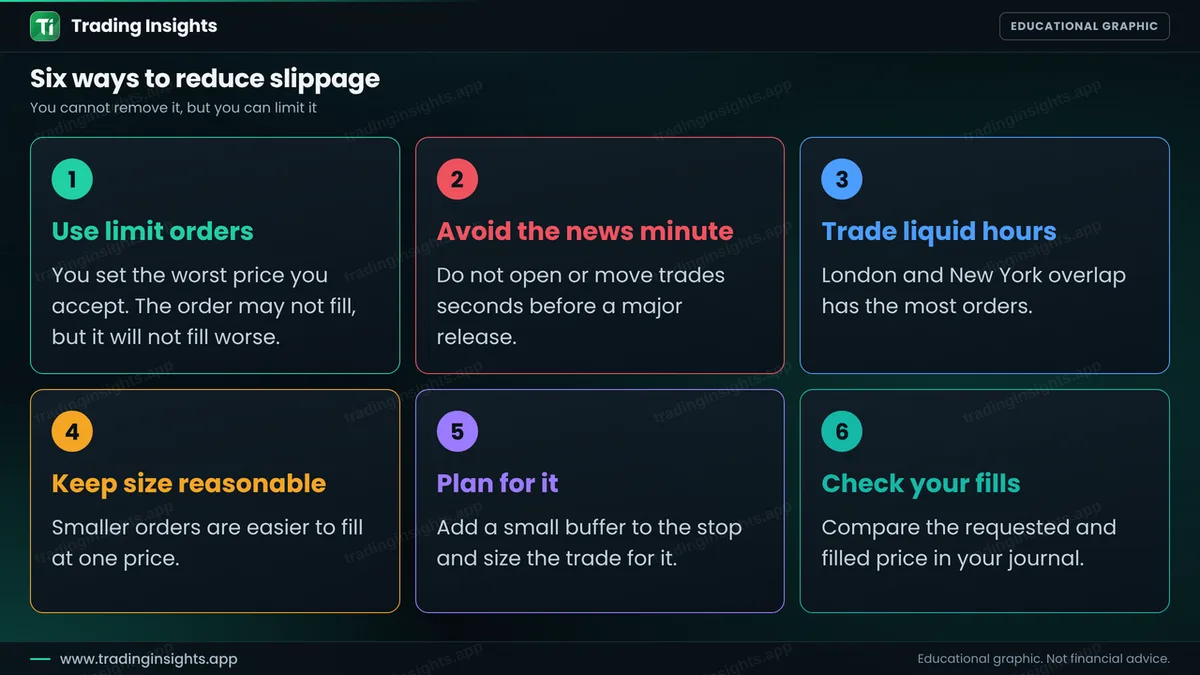
Six ways to reduce slippage
- Use limit orders. You set the worst price you accept. The order may not fill, but it will not fill worse.
- Avoid the news minute. Do not open or move trades seconds before a major release.
- Trade liquid hours. The London and New York overlap has the most orders. See forex trading sessions.
- Keep the size reasonable. Smaller orders are easier to fill at one price.
- Plan for it. Add a small buffer to the stop and size the trade for it. See position sizing.
- Check your fills. Compare the requested and filled price in your journal. If slippage is often large, review your broker.
Slippage and your backtest
A backtest usually assumes perfect fills. In live trading, small amounts of slippage on every trade can turn a thin edge into a loss, especially for short-term strategies. When you test, add a pip or two of cost per trade to see if the strategy still works. See how to backtest a forex trading strategy.
Common mistakes
- Opening a market order right at a news release.
- Assuming that a stop loss always fills at its price.
- Using a tight stop in a thin market.
- Ignoring slippage in the backtest.
- Never checking the difference between the requested and filled price.
Frequently asked questions
What is slippage in forex?
It is the difference between the price you expected for an order and the price at which it was filled.
Can slippage be positive?
Yes. If the price moves in your favour before the fill, you can get a better price. It happens, but negative slippage is more noticeable.
Does a limit order avoid slippage?
A limit order will not fill at a worse price than the one you set. The trade-off is that it may not fill at all.
Is slippage a sign of a bad broker?
Not always. Some slippage is normal in fast markets. Repeated large slippage in calm markets is worth checking.
Trading involves risk. This is education, not financial advice. The charts are illustrative and not real market data. Trading carries risk, and no method guarantees results.


