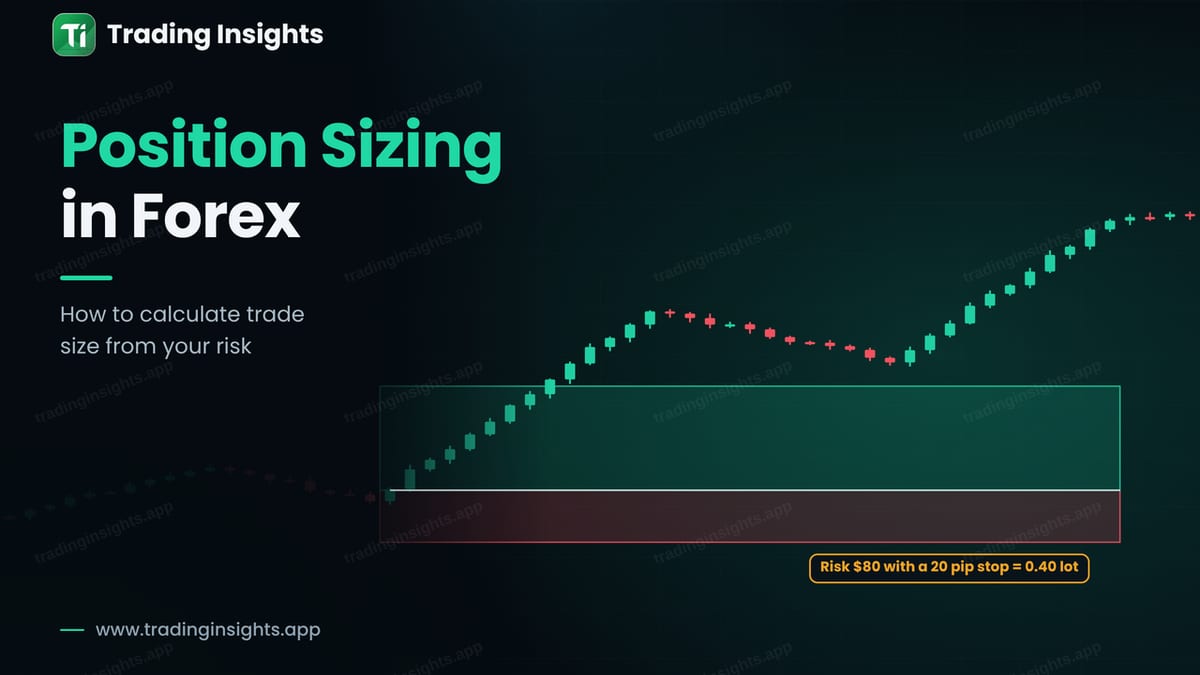
Position sizing is the step that decides how much money you lose when your stop loss is hit. It is not about guessing the best lot size, but about calculating it from three inputs: how much of your account you accept to risk, how far the stop is from the entry, and what a pip is worth. This guide gives a four-step formula, a table showing how lot size changes with the risk percentage, and a comparison of fixed lots with fixed risk. All the examples use an $8,000 account and EUR/USD, where one pip on a standard lot is worth about $10.
The four-step formula
- Risk in money. Account balance times the risk percentage. $8,000 x 1% = $80.
- Stop in pips. The distance from entry to the stop loss, taken from the chart. For example, 20 pips.
- Pip value. About $10 per pip for one standard lot on EUR/USD in a US dollar account.
- Lot size. Risk in money divided by (stop in pips x pip value). $80 / (20 x $10) = 0.40 lot.
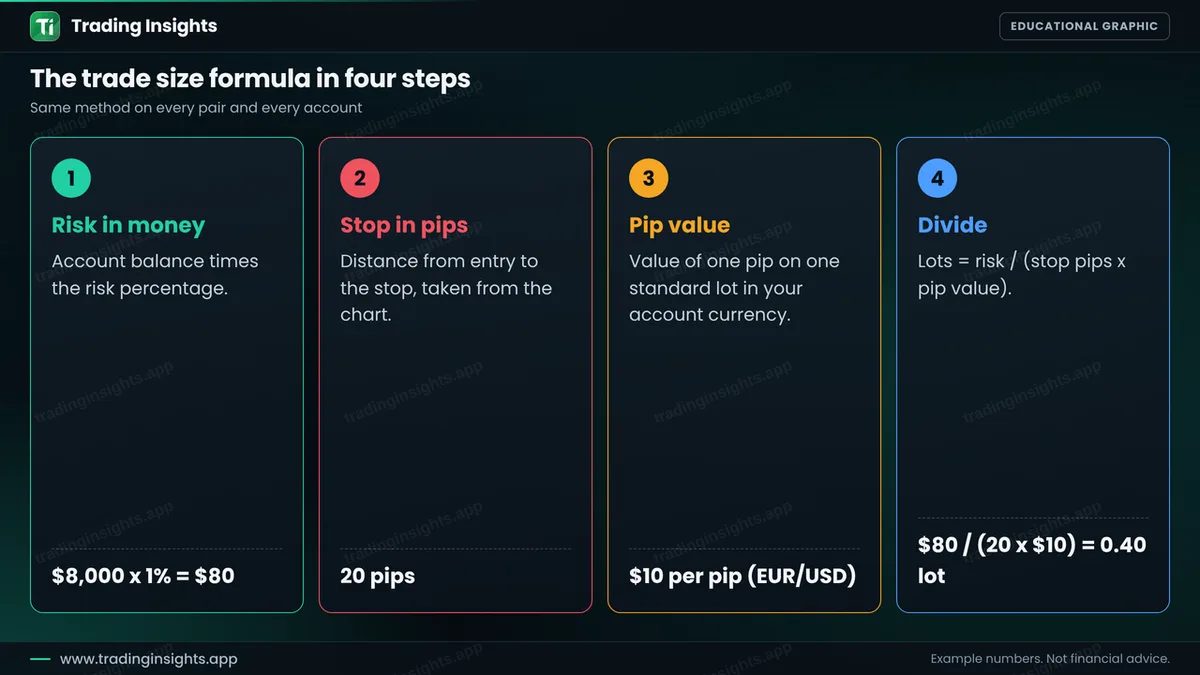
The key point is the order. The chart decides the stop first, and then the size follows from it. Many beginners do the reverse: they pick a lot size and then place the stop wherever the loss feels acceptable, which gives stops that are not based on the market. You can check your calculation with the position size calculator. If lots and pips are new to you, read what a pip is and what a lot is first.
How the lot size changes with the risk percentage
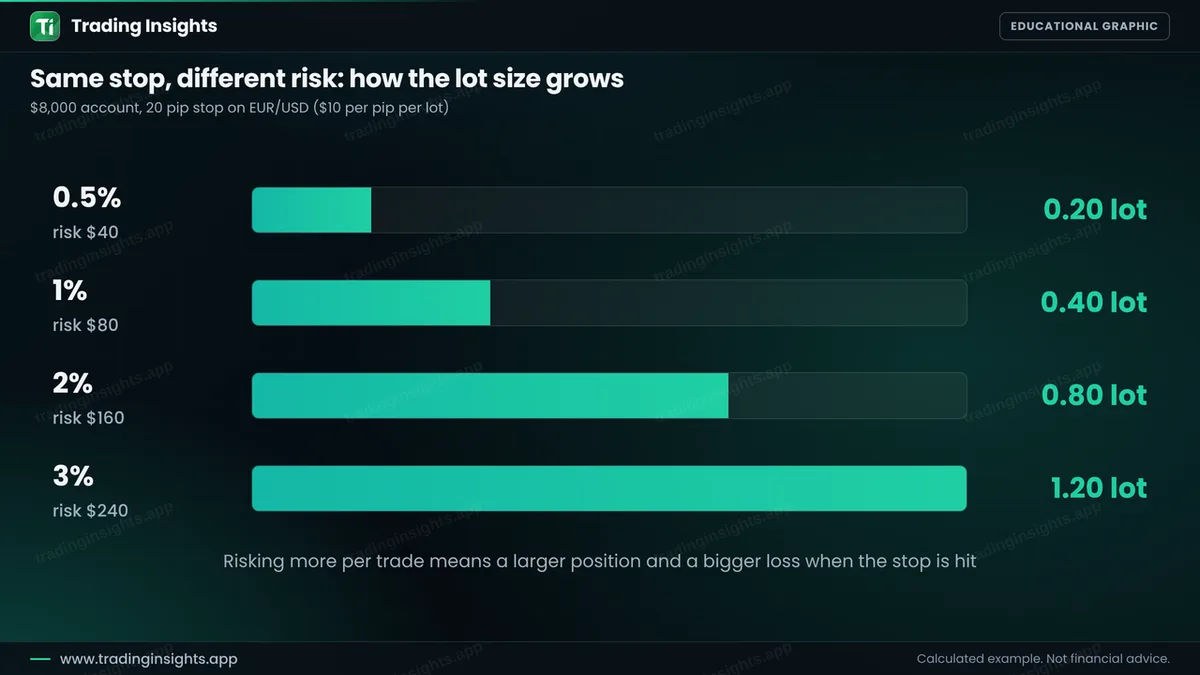
With the stop fixed at 20 pips, risking 0.5% means 0.20 lot and a $40 loss, 1% means 0.40 lot and $80, 2% means 0.80 lot and $160, and 3% means 1.20 lots and $240. Each step up makes the position larger and the loss on a stop-out bigger. Most risk guides suggest staying near 1% or lower per trade, because a string of losses is certain at some point. For the maths of losing streaks see risk of ruin and what drawdown is.
Fixed lot size versus fixed risk
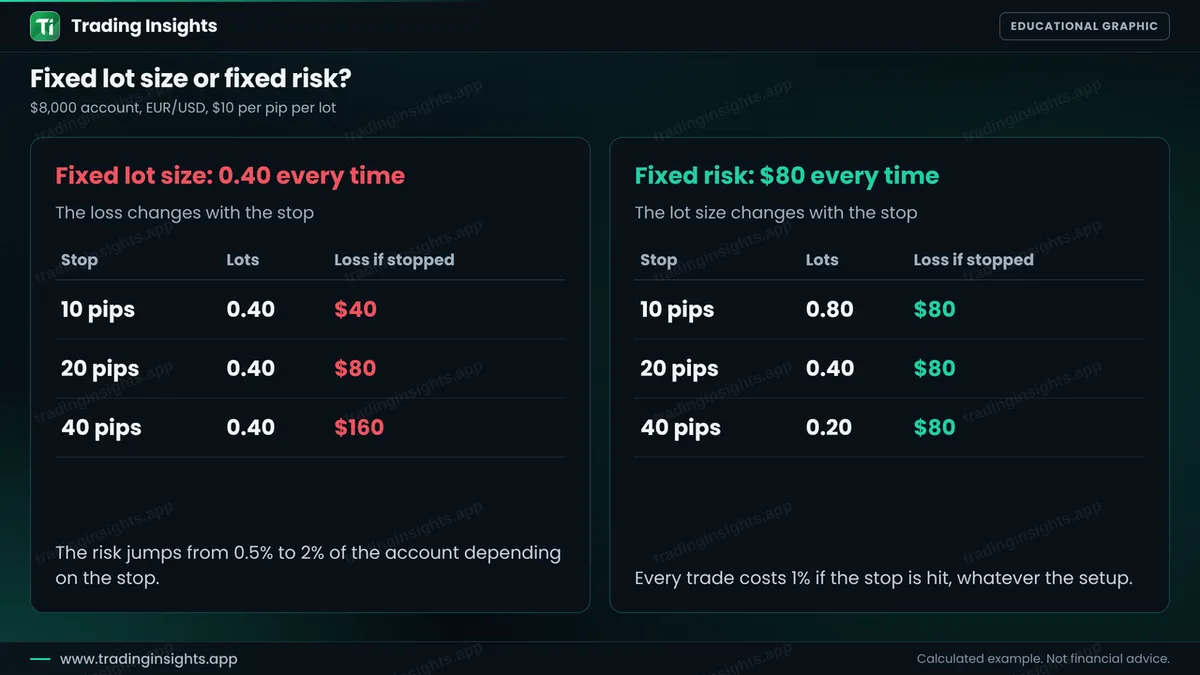
If you always trade 0.40 lot, a 10 pip stop loses $40, a 20 pip stop loses $80 and a 40 pip stop loses $160. That is a risk from 0.5% to 2% of the account, set by chance. With a fixed risk of $80, the lot size is 0.80 for a 10 pip stop, 0.40 for 20 pips and 0.20 for 40 pips, so every stop-out costs the same. Fixed risk keeps your results comparable across trades and keeps the damage of a bad streak under control.