
Greed in trading is the urge to take more than your plan offers: moving a target when the trade is almost there, raising the size after a few wins, or holding a winner until it turns into a loss. It does as much damage as fear, and it is harder to notice because it feels like confidence or ambition. The fix is to write the rules before the trade and make them hard to change in the moment. This article lists the signs of greed and the rules that keep it in check.
What greed looks like
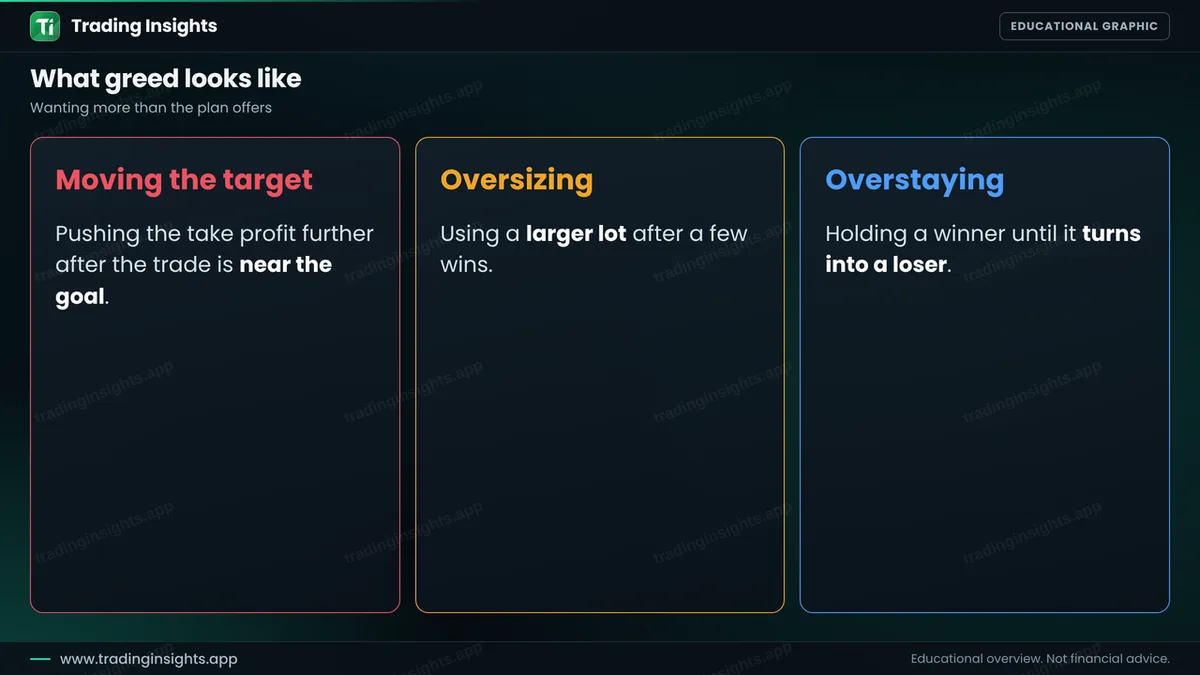
- Moving the target. The trade reaches 90% of the plan, and you push the take profit further, because "it is going to run". Sometimes it does, but a plan that changes whenever the price is near the target is not a plan.
- Oversizing. After three wins, the next trade gets a larger lot. This is close to overconfidence. A larger size on a random trade just raises the risk of a big loss.
- Overstaying. A winner is held past the exit because of the hope of more, and a +60-pip gain turns into a stop-out. See cutting winners short for the opposite error.
- Chasing. Entering late in a move because "it keeps going". See FOMO.
- Overtrading. Taking more and more trades after a good day. See overtrading.
Greed is not the same as ambition. A trader can aim high and still follow rules. The sign of greed is that the rules change in the middle of a trade because of the wish for more.
Why greed is hard to spot
Fear feels bad, so you notice it. Greed feels good. A winning streak brings a sense of skill, and each new idea looks like a sure thing, which is exactly when the plan gets bent.
A useful test is to ask, "Would I take this change if I were flat and looking at the chart for the first time?" If the answer is no, the change comes from wanting more, not from new information.
Rules that keep greed in check
Because greed is persuasive in the moment, the rules must be written before the trade.
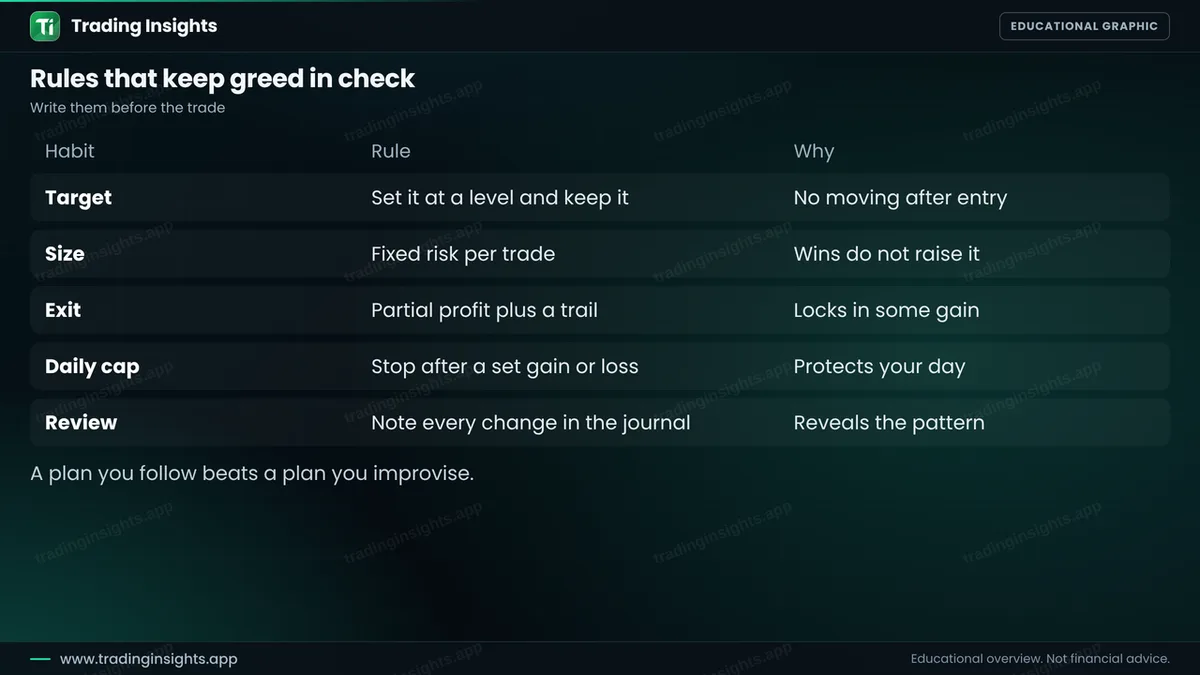
- Fix the target. Place it at a chart level, and do not move it after entry. If you want to let a part of the trade run, use a trail. See taking partial profits.
- Fix the risk. Use the same percentage on every trade, whatever the last results. See the 1% rule and fixed risk sizing.
- Use an exit plan. Partial profit plus a trailing stop locks in a gain and still leaves room. See trailing and break-even stops.
- Set a daily cap. Many traders have a daily loss limit; a daily gain limit is less common, but it can protect a good day from being undone by overtrading. See the daily loss limit.
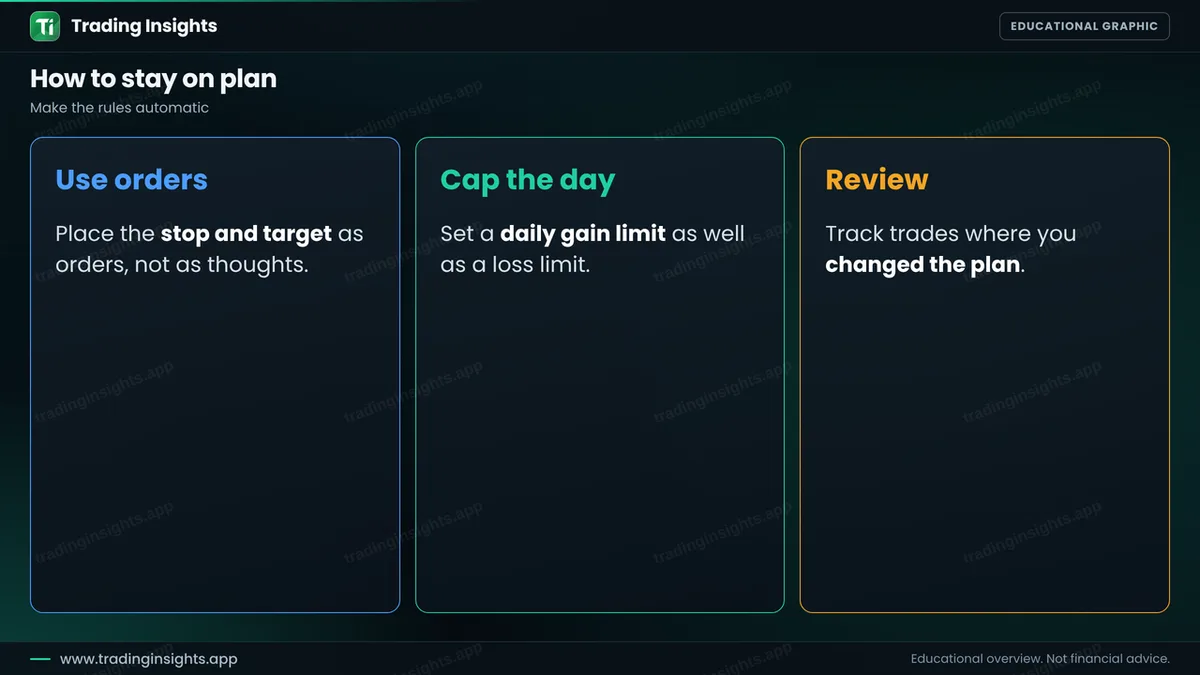
- Review changes. Note every time you changed a target, a size or an exit, and compare the result with the plan. See trading journal metrics.
How to stop moving your take profit
- Use orders. Place the stop and the target as real orders. A plan that exists only in your head is easy to change. See forex order types.
- Cap the day. Decide in advance when to stop.
- Look at the data. If your journal shows that moved targets cost you more than they earned, the numbers can do what advice cannot.
- Keep the process in view. Judge a trade by whether you followed the plan, and not only by how much it made. See how to build a forex trading plan.
Illustrative example: oversizing after a winning streak
This is an illustrative example, not a real trade. The plan on EUR/USD is a stop of 40 pips and a target of 80 pips, risking 1% of a $10,000 account ($100). The position size is $100 / (40 pips x $10 per pip per lot) = 0.25 lot. A win pays about $200, and a loss costs about $100.
The trader wins three times in a row, so +$600 in total. On the fourth trade he doubles the size to 0.50 lot. The stop is hit, and the loss is 40 pips x $10 x 0.50 = $200, twice the planned risk.
The account ends at +$400 instead of the +$500 it would show with a normal $100 loss. One greedy trade erased a sizeable part of the streak, and the real damage is bigger if he also moves the stop or the target. Check your own sizing with the position size calculator.
Common mistakes
- Raising the size after a winning streak. A streak says little about the next trade. Keep the risk fixed and change it only by a written rule.
- Moving the take profit when the trade is almost there. This turns a defined plan into a guess. Place the target as an order, and use a trail on part of the trade instead.
- Holding a winner with no exit rule. Hope is not an exit. Decide a target, a trail or a time limit before entry.
- Treating a good day as proof of skill and trading more. Good days often come from a few clean setups. Stop at your daily cap, and let the day stand.
Frequently asked questions
What does greed look like in trading?
Moving targets, increasing size after wins, holding winners too long, chasing moves and taking too many trades. The common thread is that the plan changes in the middle of the trade.
Is greed the same as ambition?
No. Ambition can coexist with discipline. Greed shows when you break your rules for the wish of more.
How can I stop moving my take profit?
Fix the target at a chart level before entry, place it as an order, and use a trailing stop on part of the trade if you want to let it run. Log every change you make, so the cost becomes visible.
Should I raise my size after winning?
Not by feeling. Keep the risk fixed, and change it only by a written rule, based on a larger sample of results.
Your next step
Go through your last 20 trades and mark each one where you moved a target, raised the size or held past your exit. Add up the result of those trades against the ones you left alone. That number is the best argument for a written rule.
This is education, not financial advice. Trading carries risk, and no method guarantees results. The charts are illustrative and not real market data.


