
Taking partial profits means closing a part of a trade at a first target and letting the rest run to a bigger one. It lets you bank some gain while keeping a chance at a larger move. It is a trade management tool, not a way to turn a weak strategy into a strong one.
How partial profits work in forex
The common plan has three steps. First, you enter with a clear stop and a position size based on your risk. Second, when price reaches a first target, often 1R (a profit equal to your risk), you close part of the position, for example half. Third, you move the stop of the remaining half to break-even and let it run to a bigger target.
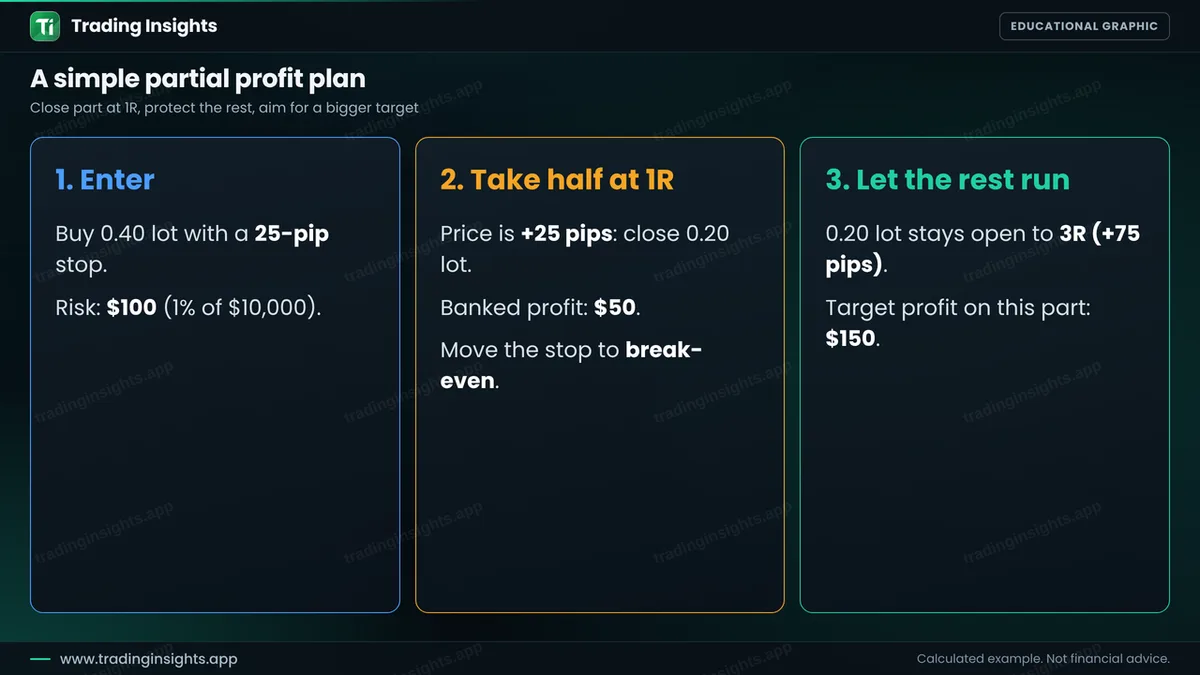
In the plan above, you buy 0.40 lot with a 25-pip stop, so the risk is $100. At +25 pips you close 0.20 lot and bank $50. The stop of the other 0.20 lot goes to break-even, and it aims for +75 pips (3R), which would pay another $150. For the break-even move, see trailing and break-even stops.
What scaling out does to your results
A partial exit changes the shape of your outcomes. It gives up some profit in the best case and saves some in the middle case.
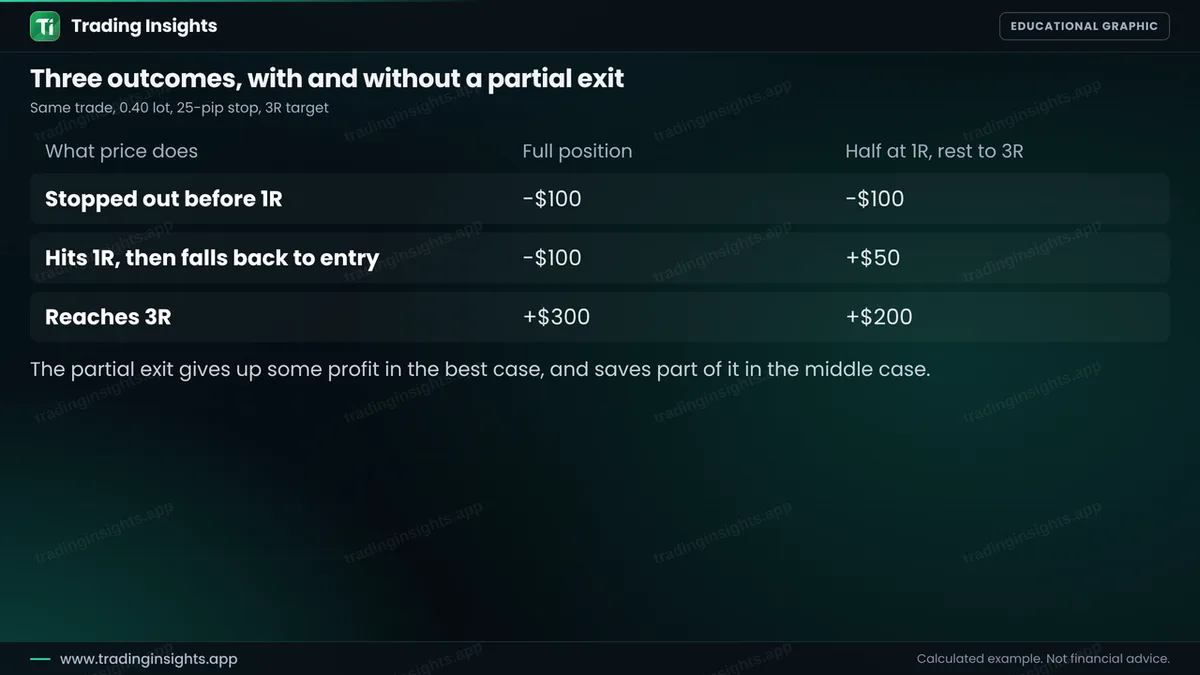
If price never reaches 1R, nothing changes. If price reaches 1R and then returns to your entry, the partial plan makes $50 instead of losing $100. If price runs to 3R, you make $200 instead of $300.
Which plan is better depends on how often each case happens in your strategy. Test it. See how to backtest and trading expectancy.
Benefits and costs
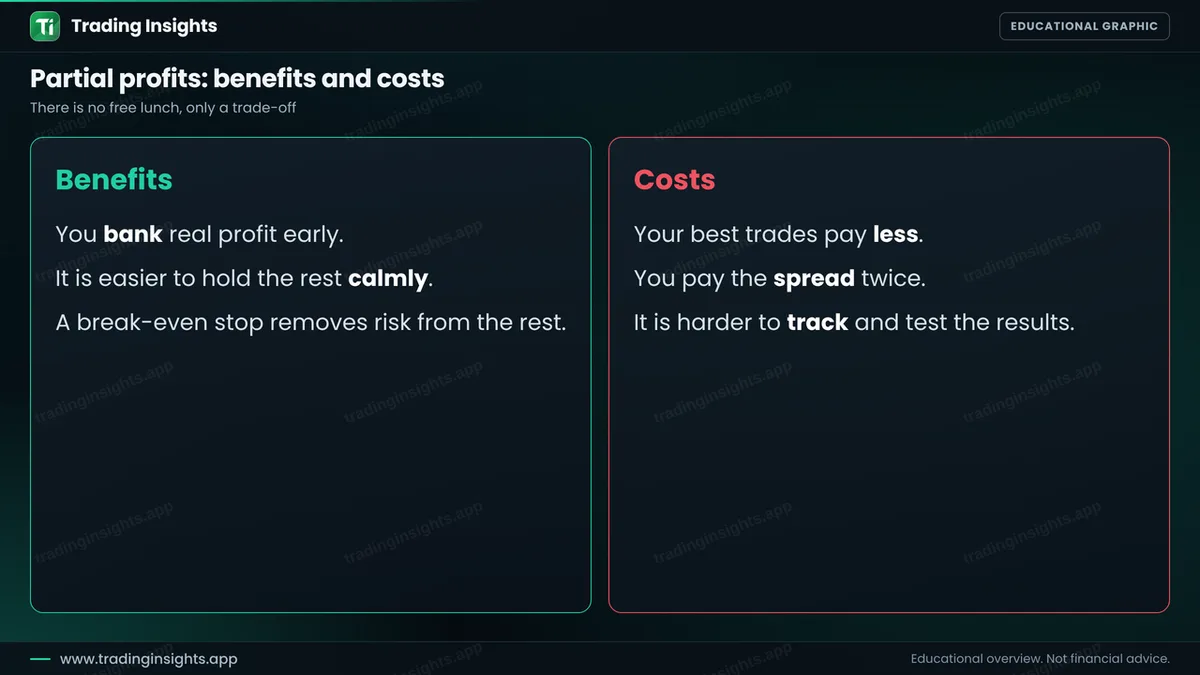
The main benefit is psychological. Having some profit banked makes it easier to hold the rest and follow your plan. That can reduce the fear that leads to early exits and FOMO.
The costs are real. Your best trades pay less, you pay the spread on two closes, and your records are more complex.
How to scale out of a trade step by step
- Decide the plan before you enter. Choose the fraction, the first target and the final target.
- Check the minimum lot size. You need enough size to split. With 0.01 lot you cannot close half.
- Choose the first target. 1R is common, or the nearest level.
- Move the stop to break-even after the partial exit, or leave it where it is if the trade needs room.
- Choose the final target. Use a bigger ratio or the next level. See risk to reward ratio.
- Record both parts to see if the plan helps.
When partial profits make sense
- Trending markets. The final target has a good chance to be reached.
- Near a strong level. A level before the final target is a natural place for the first exit.
- When you tend to exit too early. Banking part of the profit can help you hold the rest.
- Before news. If you hold through a release, a smaller position is safer. See trading forex news.
Illustrative example: half at 1R, the rest at 3R on EUR/USD
This is an illustrative example, not a real trade. A trader buys EUR/USD at 1.0800 with a stop at 1.0775 (25 pips). With a $10,000 account risking 1% ($100), the position size is $100 / (25 pips x $10 per pip per lot) = 0.40 lot.
At 1.0825 (+25 pips) the trader closes 0.20 lot for $50 (0.20 x 25 x $10) and moves the stop on the rest to 1.0800. Three things can happen next:
- Price returns to 1.0800. The second half closes at break-even, and the trade ends with +$50.
- Price reaches 1.0875 (+75 pips). The second half pays 0.20 x 75 x $10 = $150, so the trade makes $200 in total.
- Price stops out before 1R. The loss is the full $100, the same as without a partial plan.
A full position held to 1.0875 would have paid $300, so the partial plan gave up $100 of upside to protect against the pullback.
Common mistakes
- Taking the first target too close. If you bank at 0.3R, the rest must win too often to pay for the losses. Use a target that matters.
- Moving the stop to break-even too soon. Normal noise can knock you out, then price runs without you. Give the trade room or wait for a new swing.
- Changing the plan during the trade. Write the plan first and follow it.
- Using it to avoid ever losing. Partial profits do not remove losses. Judge the method by many trades, with costs included.
Frequently asked questions
What does taking partial profits mean?
It means closing a part of a trade at a first target and leaving the rest open for a bigger target.
How much should I close?
Many traders close a half, but there is no rule. Test the fraction and the target that fit your strategy.
Does taking partial profits improve results?
It can smooth the results and help with discipline, but it can also lower the profit on the best trades. Test it with your own data.
Should I always move the stop to break-even?
Not always. A stop at break-even can be hit by normal noise, so some traders wait for a pullback or a new swing before moving it.
Your next step
Take your last 20 trades and recalculate them with a half-at-1R plan, including the spread on two closes. Compare the total with your real result, and see which version you would rather trade. Use the position size calculator for lot sizes.
This is education, not financial advice. Trading carries risk, and no exit method guarantees results. The charts are illustrative and not real market data.


