
Overconfidence in trading is the belief that you are sharper or luckier than you really are, and it often shows up after a winning streak. You feel sure of your read, the rules feel too small for you, and you start to risk more. That is why a good run so often ends in one big loss, even when the strategy itself did nothing wrong.
Why winning streaks are risky
A winning streak does not always show skill. In any strategy, wins and losses come in clusters. Five wins in a row can be normal luck, with a positive edge or without one.
But the brain takes the streak as proof that it has understood the market. It starts to trust its feeling more than its plan. The risk is not the wins. The risk is what you change because of them.
Warning signs of overconfidence in trading
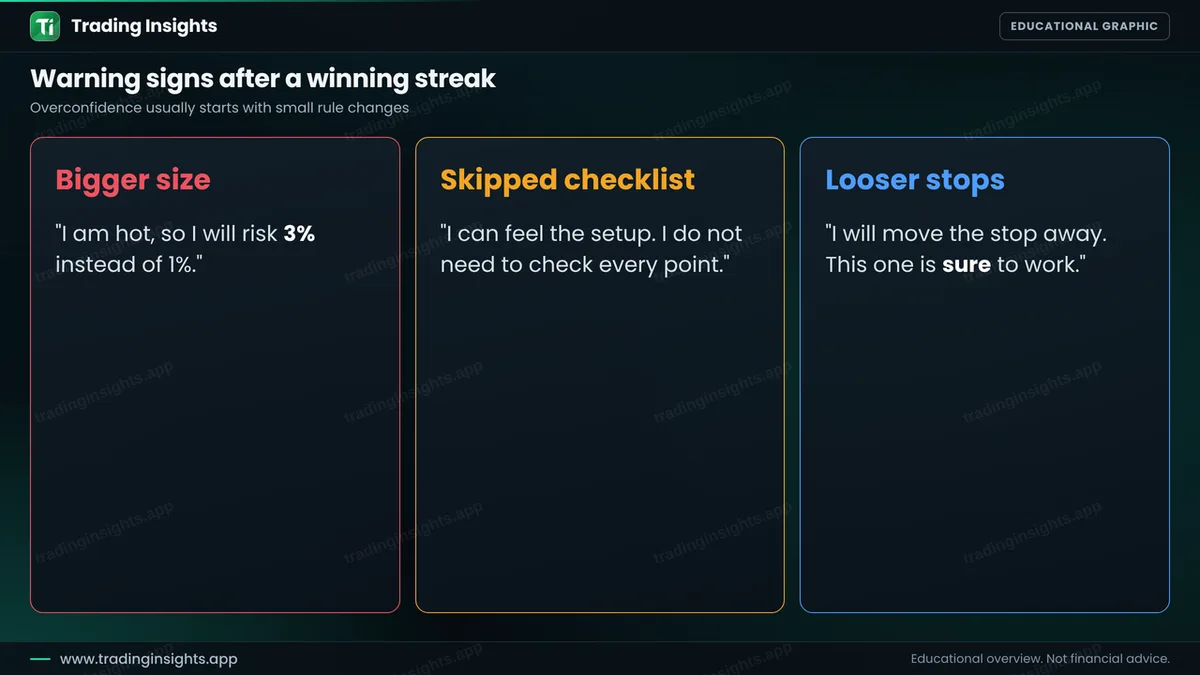
The signs are often small at first. You risk 2% instead of 1%, because you feel hot. You skip one item of your checklist, because you can feel the setup. You move a stop a little further away, because this trade is sure to work.
Each change looks harmless. Together, they remove the safety of your plan. This is the same family of mistakes as overtrading and FOMO.
Other signs are harder to see: you stop journaling because "it is going well", you take setups that you would have skipped last month, and you feel annoyed when a trade is stopped out, as if the market made an error.
Illustrative example: what one overconfident week can cost
This is an illustrative example, not a real record. A trader risks 1% per trade and wins five trades of 1R. The account is up about 5%. Feeling strong, the trader triples the risk to 3%. Then two normal losses arrive. They cost about 6%. The account ends the week down about 1.2%, even though the strategy did nothing wrong.
The sizing shows how this happens. With a $10,000 account risking 1% ($100) on a 30-pip stop, the position size is $100 / (30 pips x $10 per pip per lot) = about 0.33 lot. Tripling the risk to 3% ($300) gives $300 / (30 pips x $10) = 1 lot. A loss now costs about $300 instead of $100, so two losses cost about $600.
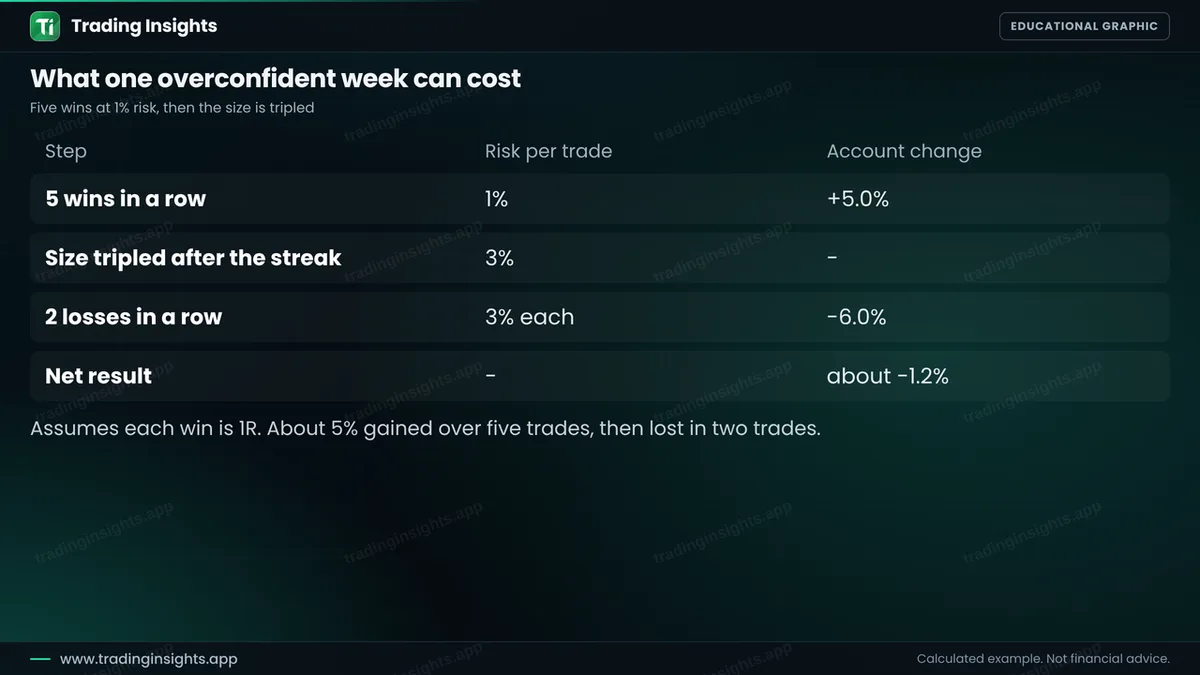
A few days of bigger size erased the whole run. Losing streaks happen to everyone, as explained in losing streaks in trading, and the bigger your size, the more they hurt.
How to avoid overconfidence: three habits
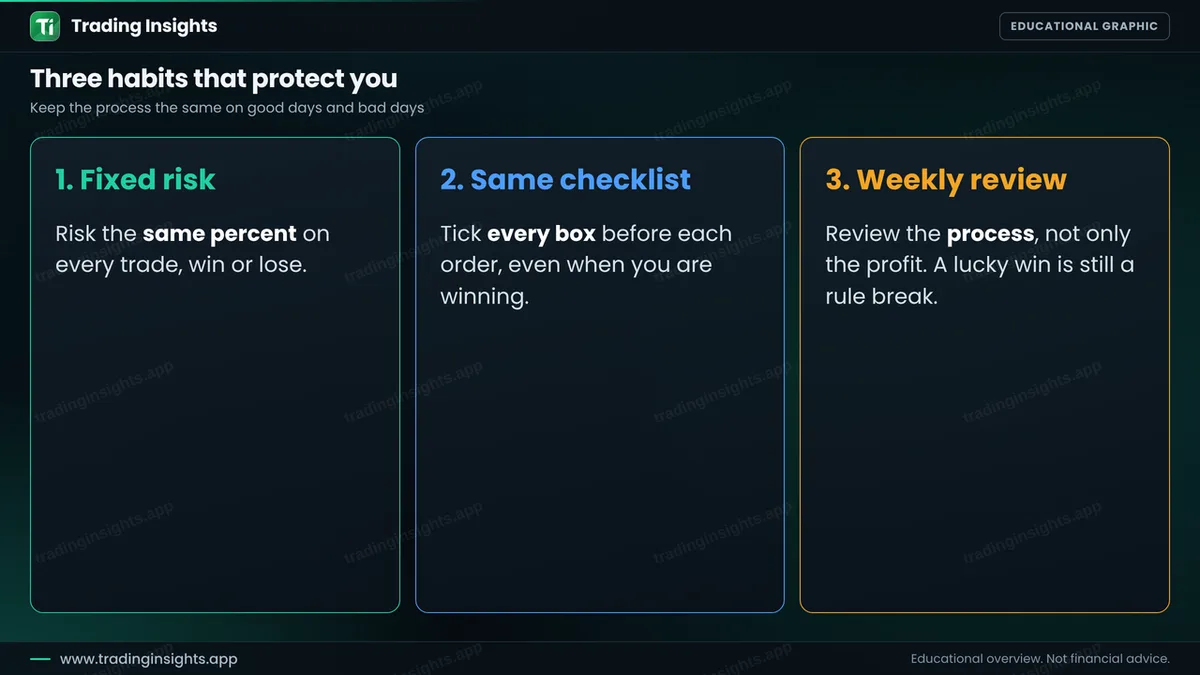
- Fixed risk. Risk the same percent on every trade, whatever happened before. If you want to change it, change it by a written rule, for example after a longer period, not after a streak. See how to calculate position size.
- The same checklist. Tick every box before every order. Put it in your trading plan.
- A weekly review of the process. Look at whether you followed the rules, not only at the profit. A lucky win that broke the rules is still a rule break. Record it in your journal.
Other useful defences
- A daily loss limit. It caps the damage if a day goes wrong. See daily loss limit.
- A pause after a big win. Take a short break and re-read your plan.
- Withdraw part of the profit. Moving money out makes the gain real and reduces the temptation to risk it all.
- Keep expectations realistic. A strategy has an expectancy, not a guarantee. See trading expectancy.
A short check after every winning streak
After three or four wins in a row, ask four questions before the next trade. Is my risk the same as it was before the streak? Does this setup meet every item of my checklist? Is my stop where the chart says it should be? Would I take this trade if I had just lost three in a row?
If any answer is no, you are probably trading the streak, not the plan. Reduce to your normal size or step away for the day.
Common mistakes
- Increasing the size right after a streak of wins. The streak says nothing about the next trade. Change size only by a written rule.
- Taking trades outside the plan because "this one looks great". Strong feelings are not a setup. If it is not in the plan, skip it.
- Believing that a few wins prove the strategy is perfect. A short run is weak evidence. Judge the strategy on many trades.
- Ignoring the stop loss on a trade that is "sure". No trade is sure. Keep the stop, and do not widen it.
Frequently asked questions
What is overconfidence in trading?
It is the belief that you are better or luckier than you are, often after a series of wins, which leads to bigger risks and broken rules.
Is a winning streak a sign that my strategy is good?
Not necessarily. Wins come in clusters, and a short streak is not enough evidence. Only a large number of trades shows the real edge.
Should I increase my size after wins?
Only by a written rule that you decided in advance, and not because you feel confident. Many traders increase size slowly, after long, consistent results.
How can I tell if I am overconfident?
Check whether you changed the size, skipped checklist items or moved stops after a good run. Those are the common signs.
Your next step
Write your fixed risk percent and your checklist on one page, and put it next to your screen. Before every order, read it. Use the position size calculator so that the size comes from the rule, not from your mood.
This is education, not financial advice. Trading carries risk, and a winning streak does not reduce it. The charts are illustrative and not real market data.


