
Fixed risk position sizing is safer than fixed lot sizing, because it keeps the loss on each trade within a known limit. Many beginners pick one lot size and use it every time, such as 0.10 lot. It feels simple and consistent, but consistent lots do not mean consistent risk. The loss depends on the distance to the stop, so the same lot can risk a small amount on one trade and a large amount on the next.
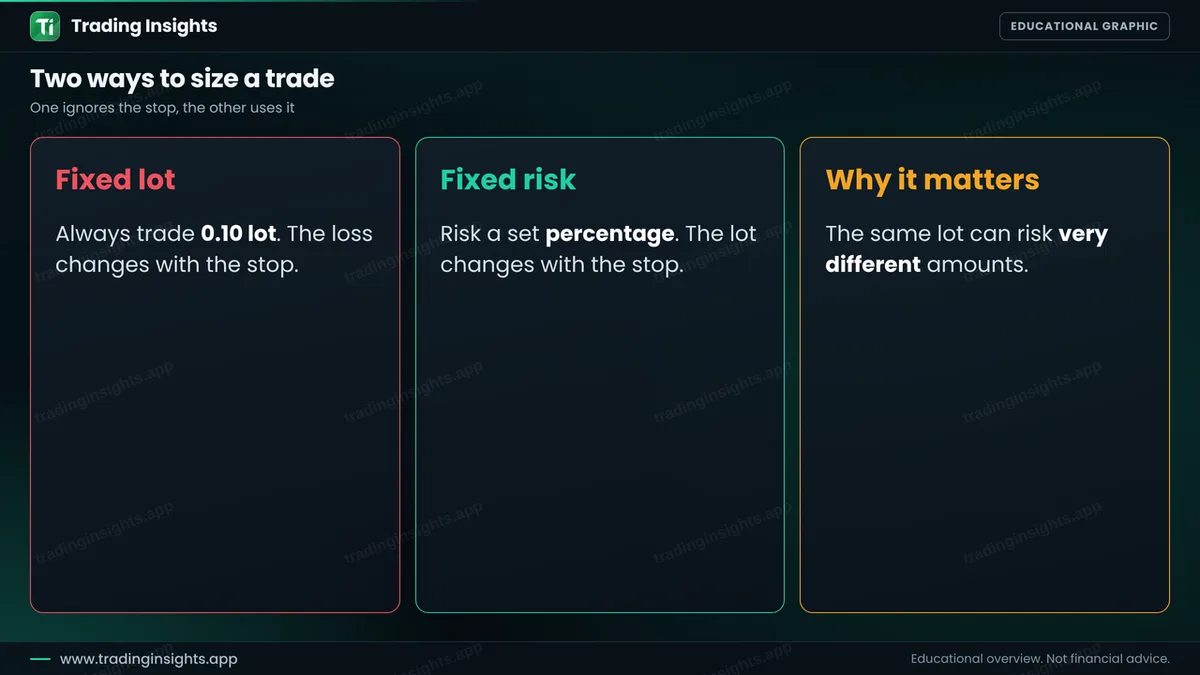
Fixed lot vs fixed risk: the two methods
Fixed lot means the position size is the same on every trade. Fixed risk, also called fixed fractional, means you risk the same percentage of your account on every trade, and the lot size changes with the distance to the stop. This is the method behind position sizing and the 1% rule.
The difference matters most when stops differ, which is almost always.
The same lot, different stops
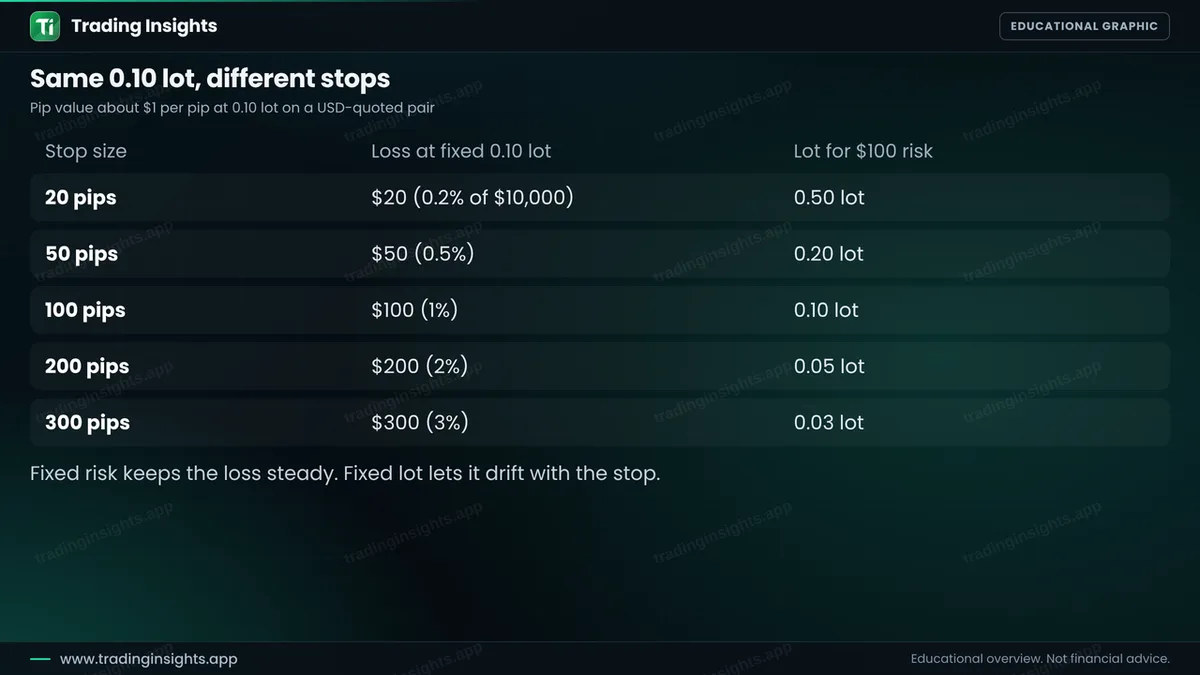
On a USD-quoted pair such as EUR/USD, 0.10 lot is worth about $1 per pip. With a 20-pip stop, a loss is $20, or 0.2% of a $10,000 account. With a 300-pip stop, the loss is $300, or 3%. The lot did not change, but the risk grew fifteen times.
Fixed risk adjusts the lot instead: 0.50 lot for the 20-pip stop and about 0.03 lot for the 300-pip stop, so every trade risks about $100. See how to calculate pip value for other pairs.
Fixed lot has one clear problem: you cannot control the risk. A string of trades with wide stops can cause a deep loss, while a string with tight stops is too small to matter. It also does not adjust to the size of the account. After a loss, the same lot is a larger share of what remains. See drawdown and risk of ruin.
When fixed lot may be acceptable
- When every trade has a nearly identical stop, such as a system with a fixed stop distance.
- In a demo account, while learning the platform. See demo vs live accounts.
- For a very small test size, when the total risk is tiny.
Even then, check the dollar risk of each trade, and do not let the lot define it.
How to switch to fixed risk position sizing
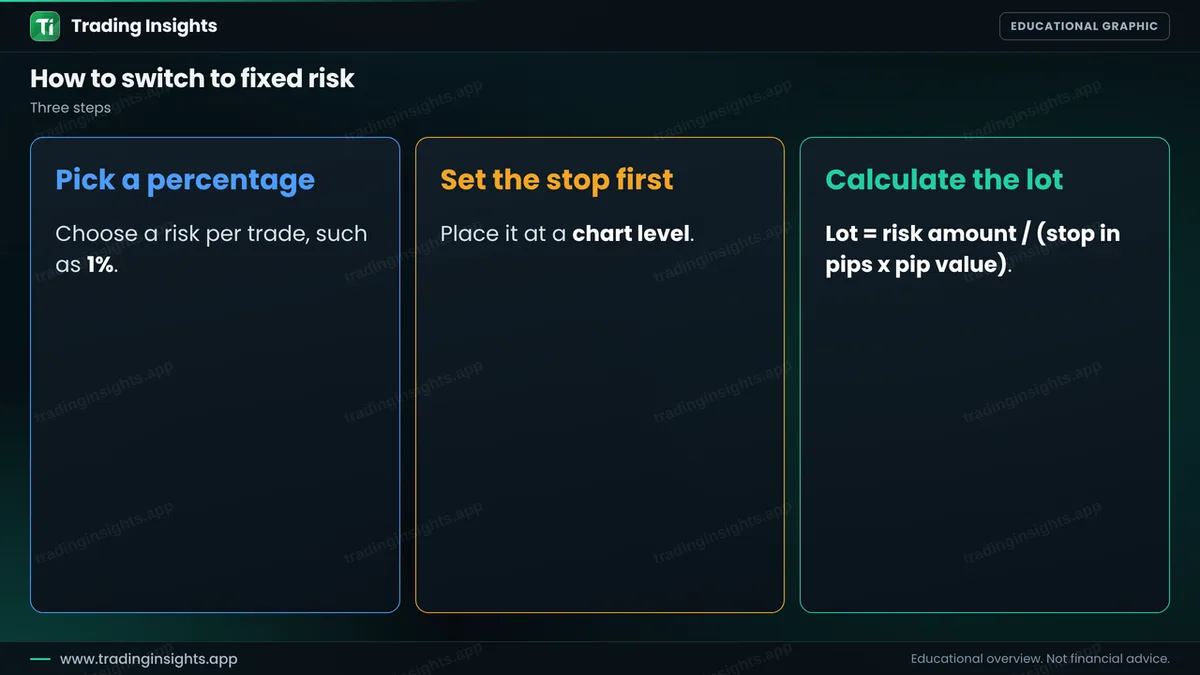
- Pick a percentage. Choose a risk per trade, such as 1% or less.
- Set the stop first. Place it at a chart level. See stop loss and take profit.
- Calculate the lot. Lot = risk amount / (stop in pips x pip value per lot). Use the position size calculator to check, and see how to calculate position size.
Over time, the account grows or shrinks, and the dollar risk follows it. A 1% risk on a $12,000 account is $120, and on an $8,000 account it is $80. This is a built-in way to reduce size after losses and increase it gradually after gains.
Illustrative example: two traders, same account
This is an illustrative example with simple numbers on EUR/USD. Two traders each have $10,000. The first always trades 0.50 lot. The second risks 1% ($100) per trade. Pip value is about $10 per pip per lot, or $5 per pip at 0.50 lot.
On the first trade, the stop is 20 pips. The fixed-lot trader loses 20 x $5 = $100. The fixed-risk trader uses $100 / (20 pips x $10) = 0.50 lot, so the loss is also $100.
On the second trade, the stop is 80 pips. The fixed-lot trader still holds 0.50 lot and loses 80 x $5 = $400, or 4% of the account. The fixed-risk trader uses $100 / (80 pips x $10) = 0.125 lot, and the loss stays at about $100.
With a 1 to 2 ratio, the fixed-risk trader's win on either trade pays about $200. After ten trades with varying stops, the fixed-lot account will swing much more, and one run of wide-stop losers can do serious damage.
Fixed risk in practice
Fixed risk does not remove losses. It only makes each one a known, small piece of the account. A 1% loss streak of five trades costs about 5%, which most traders can recover from. The same streak with oversized fixed lots on wide stops could cost 15% or more.
Two practical points help. First, some brokers allow only certain lot steps, such as 0.01, so round down and not up. Second, pip value differs on pairs quoted in other currencies, such as USD/JPY or EUR/GBP, so use a calculator for those pairs. If your stop is very wide, the correct lot may be too small to trade, and the right response is to skip the trade, not to widen your risk.
Common mistakes
- Using the same lot because it feels simple. Simple does not mean safe, because the stop changes the loss. Calculate the lot from the stop each time.
- Choosing the lot first and fitting the stop to it. This puts the stop in the wrong place. Set the stop at a chart level, then size the trade.
- Forgetting that the pip value depends on the pair. The $10 per pip figure suits USD-quoted pairs only. Check the value for other pairs.
- Not updating the risk amount as the balance changes. The dollar risk should follow the account. Recalculate it regularly.
Frequently asked questions
What is fixed lot sizing?
It means that you trade the same lot size on every trade, no matter the stop distance.
What is fixed risk sizing?
It means that you risk the same percentage of your account on every trade, and change the lot size according to the stop.
Which method is safer?
Fixed risk is safer, because the loss on each trade stays within a known limit. Fixed lot lets the loss vary with the stop. Neither removes the risk of losing.
How do I calculate the lot for fixed risk?
Risk amount divided by the stop in pips times the pip value per lot. For $100 risk and a 40-pip stop on EUR/USD, that is $100 / (40 x $10) = 0.25 lot.
Your next step
Look at your last ten trades and write down the dollar loss each one would have had at its stop. If the numbers vary a lot, switch to fixed risk for the next trade. Pick 1% or less, set the stop first and use the position size calculator.
This is education, not financial advice. Trading carries risk, and position sizing limits losses but does not remove them. The charts are illustrative and not real market data.


