
The 1% rule in forex says you should not risk more than 1% of your account balance on any single trade. "Risk" means the amount you lose if your stop loss is hit, not the size of the position. It is not a law, and some traders use a lower or slightly higher number, but it is a sensible starting point for most beginners.
This article explains what the rule means, shows what losing streaks cost at different risk levels, and walks through how to calculate position size from your stop.
What the 1% rule says
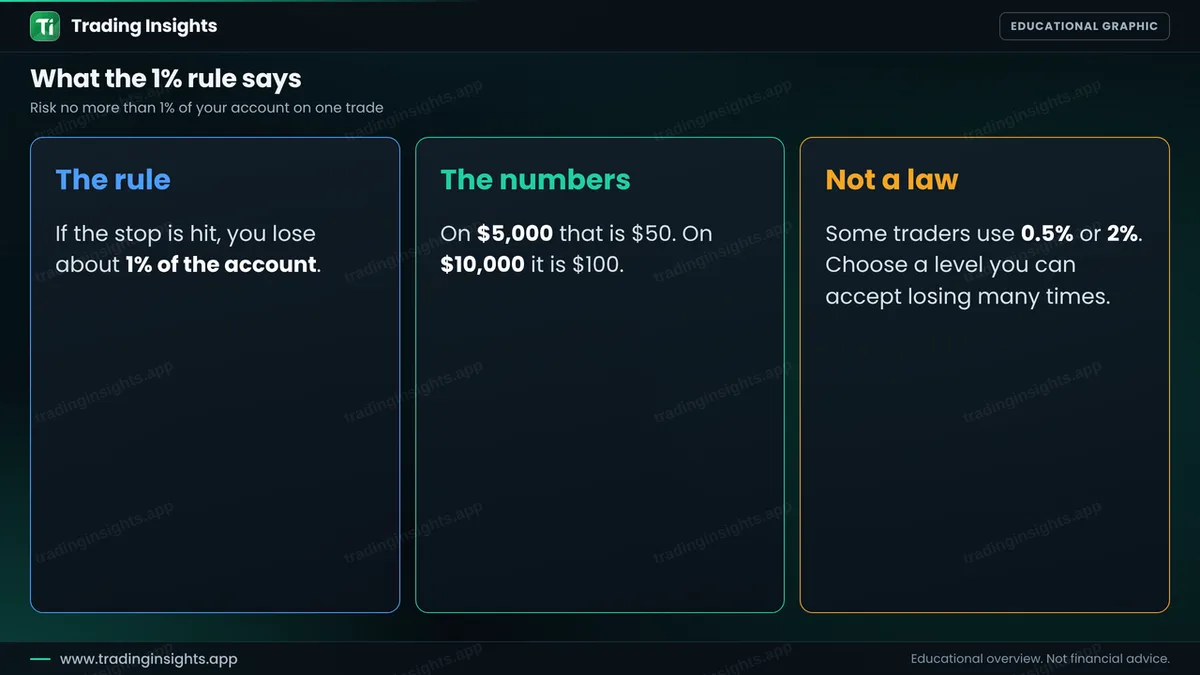
On a $5,000 account, 1% is $50. On a $10,000 account, it is $100. You can open a large position or a small one, as long as the distance to the stop makes the loss about that amount.
This links the rule to position sizing and to how to calculate position size. Some traders choose 0.5%, and others 2%. The right number is one that you can accept losing many times in a row without panic.
Why small risk per trade matters: ten losses in a row
Losing streaks are normal, even for good strategies. See losing streaks in trading. The risk per trade decides whether a streak is a nuisance or a disaster.
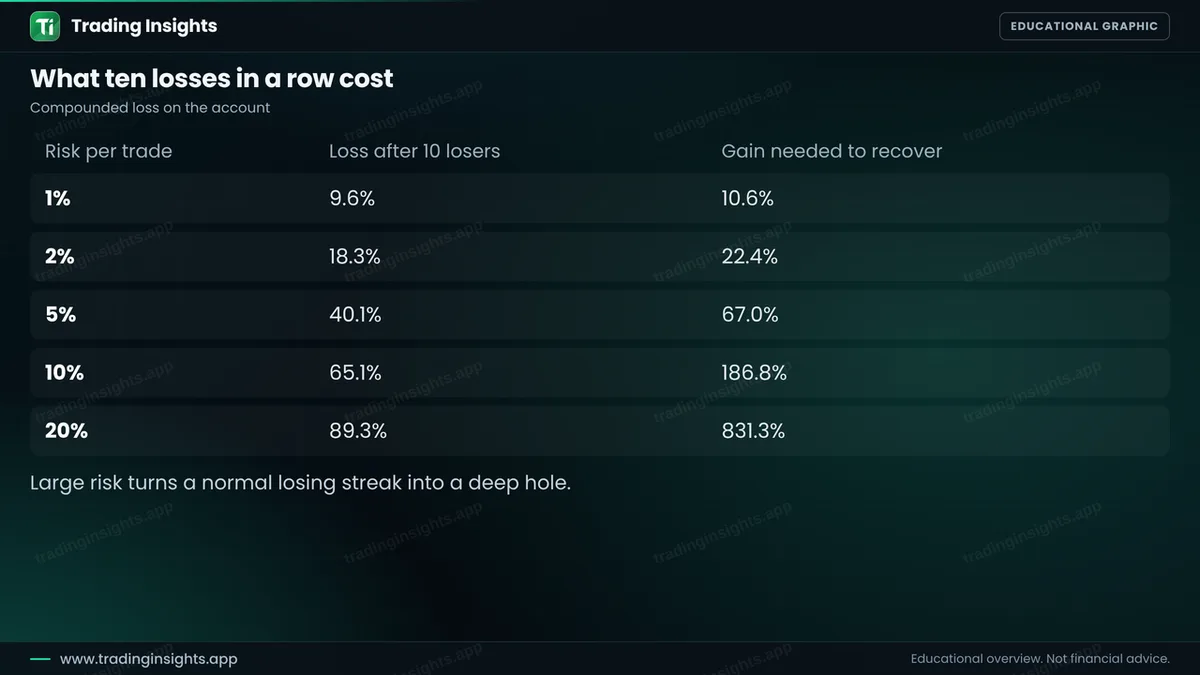
At 1% risk, ten losses in a row cost 9.6% of the account, and a gain of 10.6% brings it back. At 5% risk, the same streak costs 40.1%, and you need a gain of 67% to recover. At 10%, the loss is 65.1%, and the account must nearly triple.
The numbers are not linear, because each loss is taken from a smaller balance. This is why large risk is so dangerous: the hole gets deeper than the effort needed to climb out. See drawdown and risk of ruin.
How to apply the 1% rule step by step
The method works from the stop, not from the lot size.
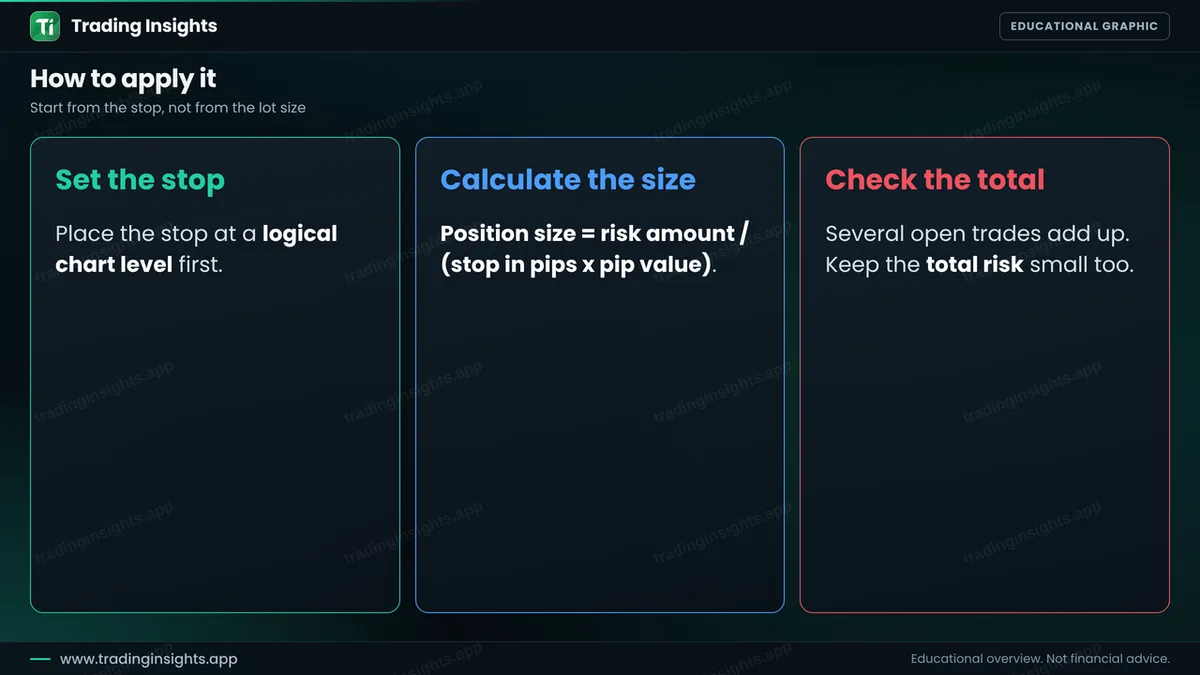
- Set the stop. Place it at a logical level on the chart, where your idea is wrong. See stop loss and take profit.
- Calculate the size. Position size = risk amount / (stop in pips x pip value per lot). See how to calculate pip value.
- Place the target. Pick a target at a level that gives at least twice the risk, so one win covers two losses.
- Check the total. Several open trades add up, and correlated pairs can behave as one. Keep the total risk small too. See currency correlation.
- Do not change the stop to fit the size. If the stop is too wide for your size, take a smaller position, or skip the trade.
Illustrative example: sizing a trade with 1% risk
This is an illustrative buy on EUR/USD. You enter at 1.0850, place the stop at 1.0825 (25 pips) below a recent swing low, and set the target at 1.0900 (50 pips), a ratio of 1:2.
With a $10,000 account risking 1% ($100), the position size is $100 / (25 pips x $10 per pip per lot) = about 0.4 lot. A win pays about $200, and a loss costs about $100.
If the same chart only allowed a 50-pip stop, the maths changes the lot size, not the risk: $100 / (50 pips x $10 per pip per lot) = about 0.2 lot. The wider the stop, the smaller the position. You can run your own numbers in the position size calculator.
What changes the answer: costs and account size
The loss on a stopped trade is slightly larger than the stop distance because of spread and slippage. Allow a small margin, or size a little under your limit.
On a small account, 1% is a small amount of money, and some pairs may not allow a tiny enough position for a wide stop. In that case, skip the trade instead of risking more. See trading with a small account.
Common questions about the rule
- Is 1% too small to make money? On a small account, the profits are small, but the survival odds are higher. See realistic forex trading goals.
- Should I raise it after wins? Keep it fixed. Raising it after wins is a path to overconfidence.
- Should I lower it after losses? Some traders reduce the size in a losing streak. That is acceptable if it is a written rule, and not a reaction.
Two traders, one strategy
Two traders have $10,000 each, and each has the same strategy with a 40% win rate and a 1:2 ratio. The first risks 1% ($100) per trade, and the second risks 10% ($1,000). Both hit a losing streak of eight trades, which is not unusual.
The first trader loses about 7.7% of the account and still has about $9,230. The second loses about 57% and has about $4,300, and needs a gain of roughly 130% to recover. The strategy was identical, and the risk per trade made the difference between a bad week and a failed account.
Common mistakes
- Choosing the lot size first and the stop later. The stop then becomes a guess. Start from the chart, then calculate the size.
- Moving the stop further away to keep the position size. The loss is then larger than planned. Take a smaller position instead.
- Opening several trades that are the same bet. Three EUR/USD-type trades at 1% each can act like a 3% risk. Count correlated trades together.
- Raising the risk after a win or to recover a loss. This is how small losses become large ones. Keep the percentage fixed in your written plan.
Frequently asked questions
What is the 1% rule in forex?
It is a risk rule: do not risk more than 1% of your account balance on a single trade, measured by the loss if your stop is hit. It controls the damage from any one trade.
Is the 1% rule a law?
No. Some traders use 0.5% or 2%. Choose a level that you can accept losing many times in a row.
How do I calculate the position size?
Risk amount divided by the stop distance in pips times the pip value per lot. For example, $100 / (25 pips x $10 per pip per lot) = about 0.4 lot on a $10,000 account.
Does the rule ensure profit?
No. It limits the damage of losing streaks and keeps you in the game, but you still need a strategy with an edge.
Your next step
Write your risk percentage in your trading plan today, then calculate the lot size for your next planned trade from the stop before you place the order.
This is education, not financial advice. Trading carries risk, and no method removes it. The charts are illustrative and not real market data.


