
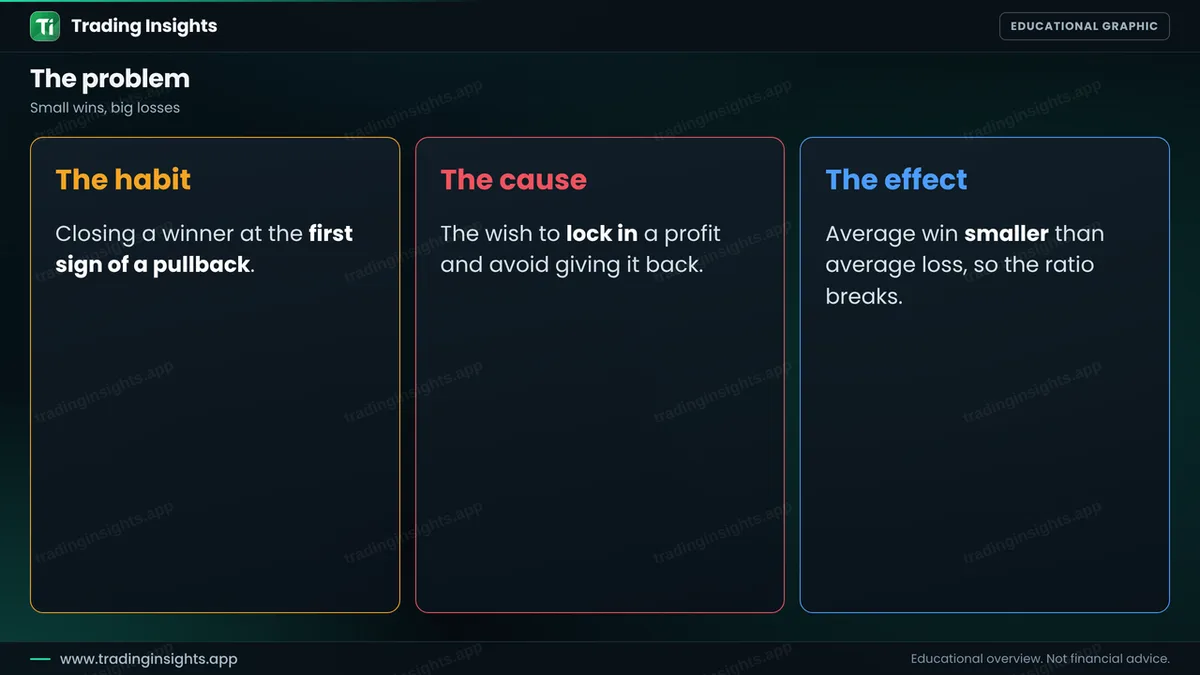
Cutting winners short means closing a profitable trade at the first sign of a pullback, long before the plan says to. Traders do it because a profit on the screen feels fragile and the fear of giving it back is strong. The result is small wins and large losses, even with a decent win rate. This article explains why it happens, what it does to the numbers, and how to let profits run with rules.
Why traders exit winning trades too early
The reason is psychological. A profit that is on the screen feels real, and the fear of losing it is strong. Closing it brings relief, and the trader feels clever. A loss, on the other hand, feels like a failure, so the trader waits.
This is loss aversion in action: the pain of giving back a gain, or of accepting a loss, outweighs the logic of the plan. The result is a lower average win than average loss, and a risk-to-reward ratio that no longer matches the plan. See the risk-to-reward ratio.
What cutting winners short does to the numbers
The effect is bigger than it looks. Imagine a trader who wins half of her trades and risks 1R (one unit of risk) on every trade.
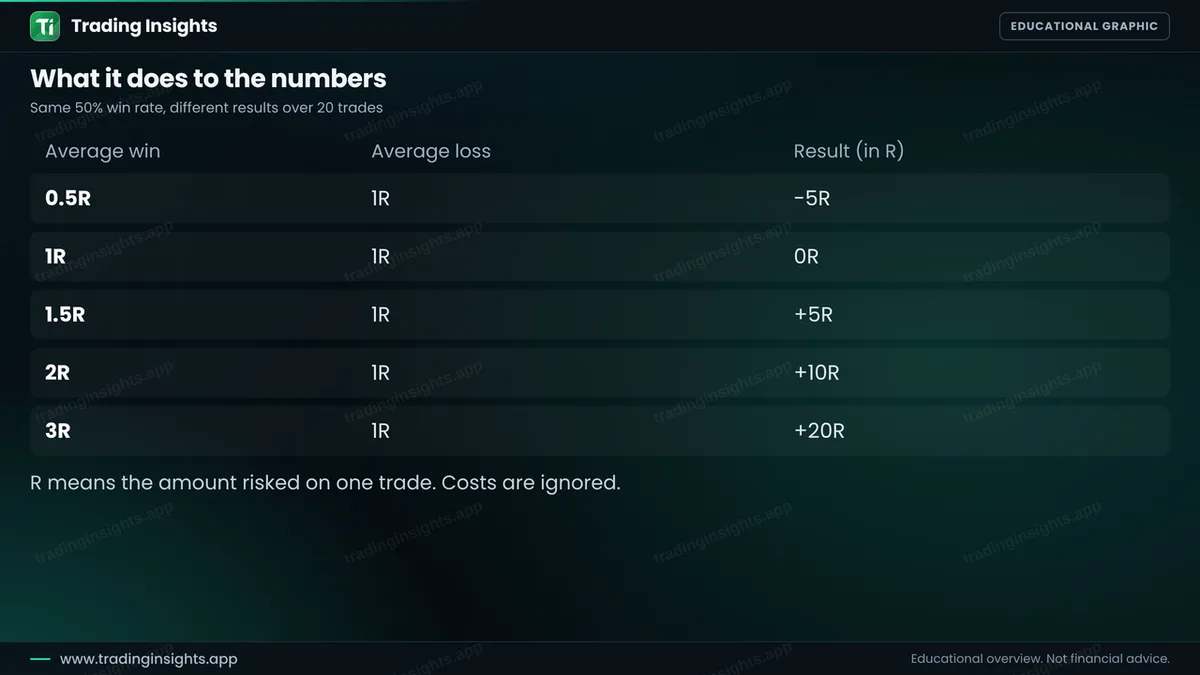
With a 50% win rate, 10 wins and 10 losses give a loss of 5R if the average win is only 0.5R, break-even at 1R, and a gain of 10R at 2R. The win rate is the same, but the account is not.
This is the idea behind trading expectancy. Cutting winners short makes it very hard to have a positive expectancy, since the strategy must win far more often to make up for it. Costs, such as the spread, make it worse.
How to let profits run
The fix is to take the decision out of the moment.
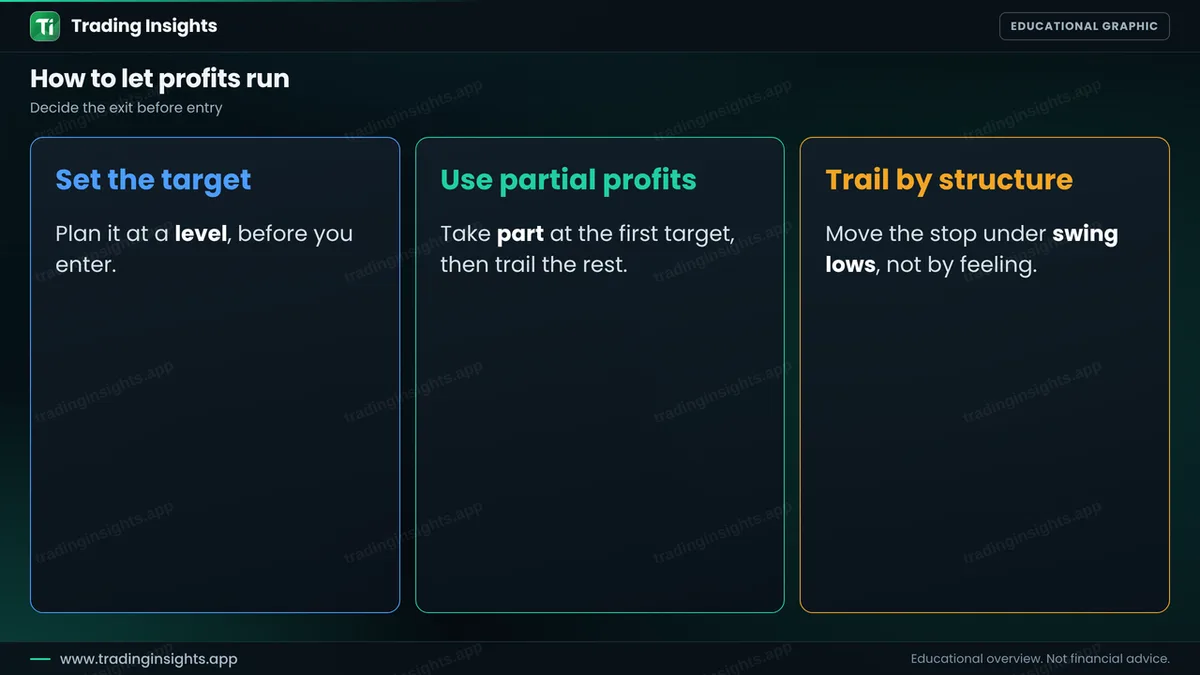
- Set the target before entry. Place it at a level on the chart, and enter only if the ratio is worth it. See stop loss and take profit and Fibonacci extension targets.
- Use partial profits. Close part at the first target, for example half at 1R, and trail the rest. This takes care of the urge to "lock in" some gain. See taking partial profits.
- Trail by structure. Move the stop under swing lows in an uptrend, and not because of a feeling. See trailing and break-even stops and swing highs and lows.
- Use small risk. When the amount at stake is small, it is easier to stay calm. See the 1% rule.
- Review exits. In your journal, compare where you exited with where price went afterwards. See trading journal metrics.
Illustrative example: closing early vs following the plan
This is an illustrative example, not a real trade. A trader buys EUR/USD with a 30-pip stop and a 60-pip target. With a $10,000 account risking 1% ($100), the position size is $100 / (30 pips x $10 per pip per lot) = about 0.33 lot.
After 20 pips of profit, price pulls back 8 pips, and he closes the trade at +20 pips, about $66. Price then runs to the target. Had he waited, the win would have paid about $200, three times as much, while a loss would still have cost about $100.
Next time, he has a rule: close half at +30 pips (1R), move the stop to break-even, and trail the rest under the last swing low. The pullback does not worry him, because the plan covers it.
Rules that help you hold a winner
A few small habits make holding easier:
- Write the exit plan before you click buy or sell, including the target and the trailing rule.
- Hide the profit-and-loss figure and watch the chart instead, so that the dollar amount does not drive the decision.
- Check the trade at set times, such as the close of each H1 or H4 candle, not every minute.
- Size the position so that a full loss is a small, planned amount.
The other side: do not let a profit turn into a loss
Letting profits run does not mean ignoring danger. If the structure breaks, or the setup is invalidated, exit. The aim is not to hold every trade to the target, but to decide the rules in advance, so that your exits follow the chart and not your nerves.
A break-even stop after a set gain is a rule, and a panicked close at the first red candle is a reaction. The first is acceptable, and the second is the habit to avoid.
Common mistakes
- Closing a winner because it "might" reverse. Anything might happen. Close when the setup is invalidated, not when you feel nervous.
- Moving the stop to break-even too early. Normal noise will take you out. Wait until price has cleared a real swing.
- Moving the target further away near the goal. This is greed, not planning. See greed in trading.
- Judging a trade only by the result. A winning trade with a panic exit is still a bad habit. Review the exit rule, not just the profit.
Frequently asked questions
Why do traders cut winners short?
Because of the fear of giving back a gain, and the relief of locking in a profit, a form of loss aversion.
What does it do to my results?
It lowers the average win relative to the average loss, which can turn a good win rate into a losing strategy.
How can I let profits run?
Set the target before entry, take partial profits, and trail the stop by structure.
Should I never close early?
You should close when the setup is invalidated, but by a rule, not by a feeling.
Your next step
Open your journal and list your last twenty winning trades. For each one, write the planned target, where you exited, and where price went afterwards. If your average win is much smaller than planned, choose one fix from this article and apply it to your next ten trades. You can size them with the position size calculator.
This is education, not financial advice. Trading carries risk, and no method guarantees results. The charts are illustrative and not real market data.


