
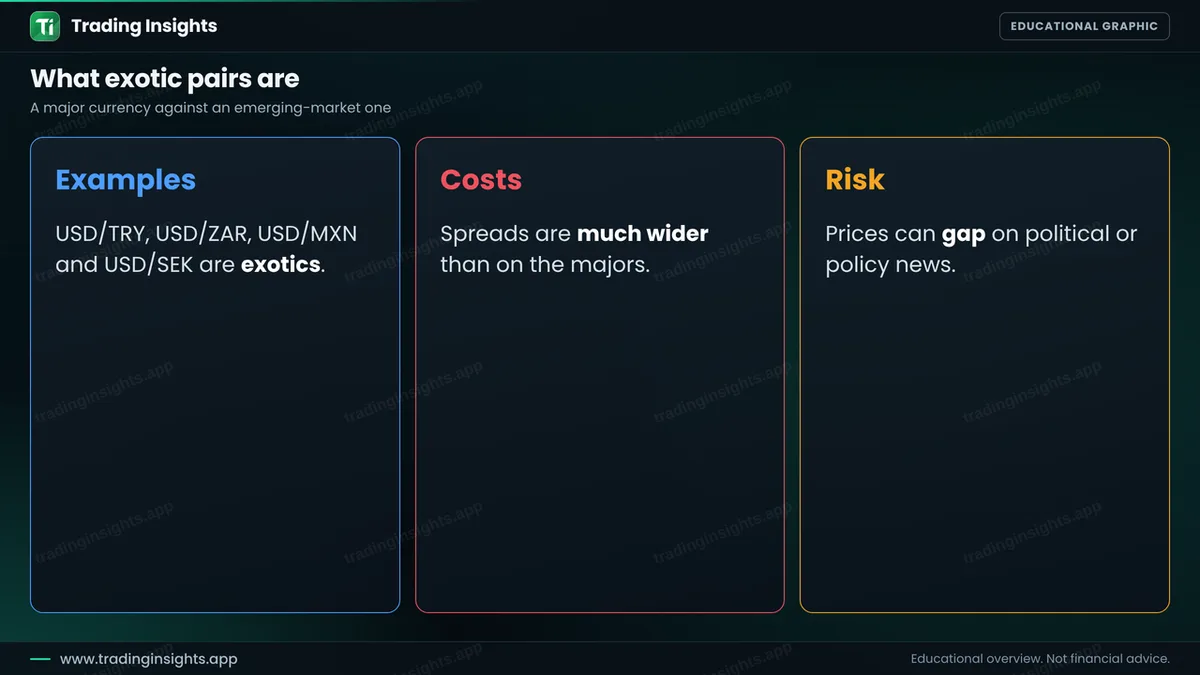
Exotic currency pairs are a major currency, usually the dollar or the euro, against the currency of a smaller or emerging economy, such as USD/TRY, USD/ZAR, USD/MXN and USD/SEK. They can move a lot and often offer large swaps, but spreads are wider, gaps are more likely and fills can be poor. For most beginners the answer is to trade the majors first. This article explains the costs and risks so you can decide for yourself.
What exotic currency pairs are
The split into majors, minors and exotics is explained in forex currency pairs explained. Exotics trade far less than the majors, so the market is thinner: fewer buyers and sellers at each price.
A thin market leads to wider spreads and sometimes to poor fills. These currencies are also more exposed to political events, policy changes and capital flows, so large and sudden moves are more likely.
Exotic pair risks and costs
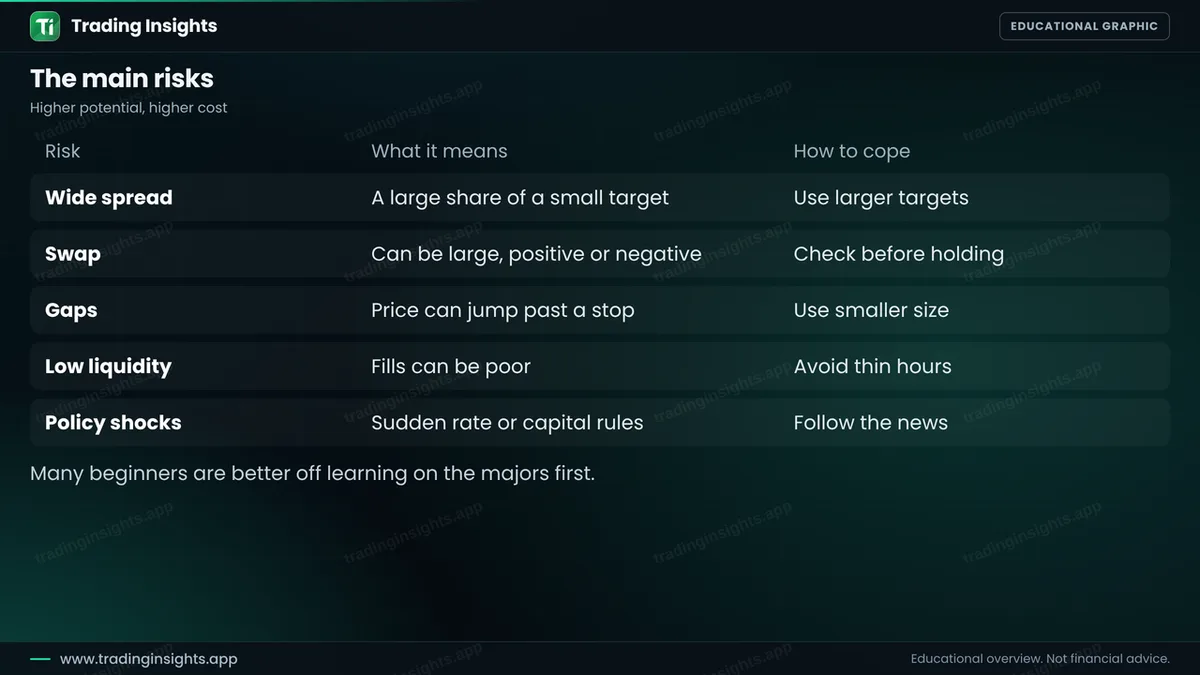
- Wide spread. A 30-pip spread on a pair that you hope will move 100 pips is a third of your target. See forex trading costs and fixed vs variable spreads.
- Swap. Swaps on exotics can be large, and positive or negative depending on direction. They add up on trades held for weeks. See forex swap and rollover and the carry trade.
- Gaps. Prices can jump past a stop, especially around elections, central bank surprises and weekends. See slippage.
- Low liquidity. Fills can be poor, and spreads can widen sharply in thin hours. See low-liquidity periods.
- Policy shocks. A government may change rates or capital rules suddenly, and the currency can move many percent in a day.
Why a high swap is not free money
A high carry can look attractive, but it often exists because the market sees a high risk of the currency falling. The swap does not pay for a large, fast move against you.
Before you trade an exotic for its swap, compare the daily swap with the size of a normal daily move. If one bad day can erase weeks of swap, the swap is not the main factor in the trade.
How to trade exotic pairs: step-by-step rules
If you still want to trade them, treat them as a special case with stricter rules.
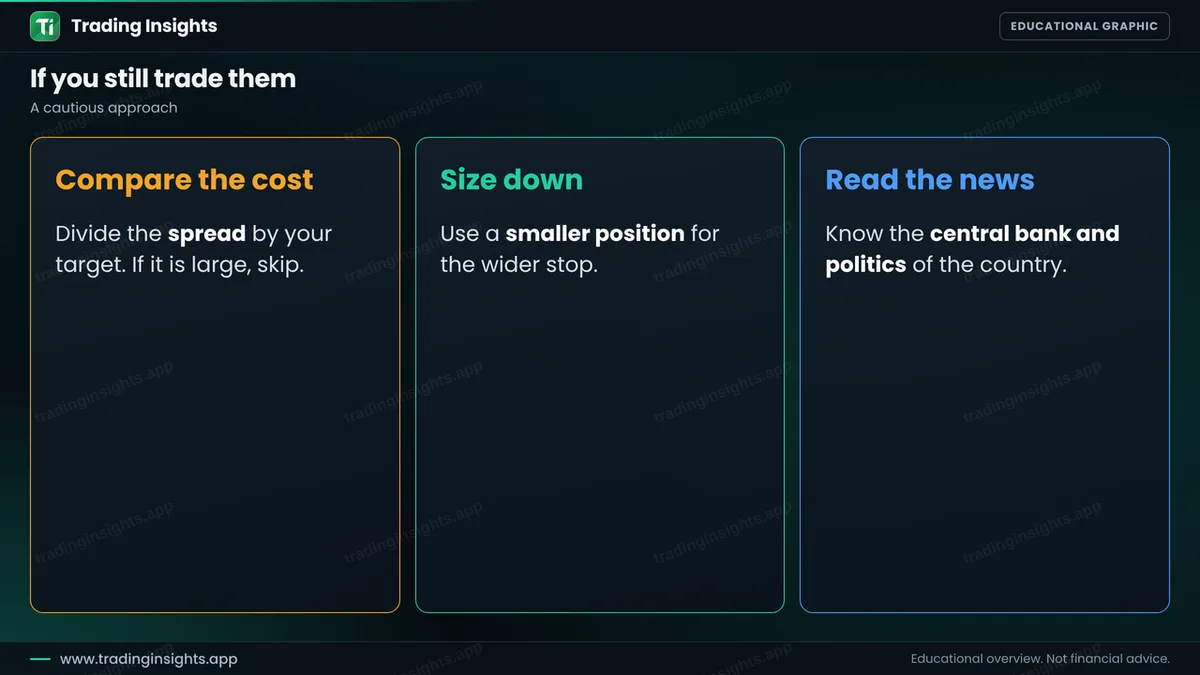
- Compare the cost. Divide the spread by your target. If the result is large, skip the trade.
- Size down. A wider stop needs a smaller position. See how to calculate position size and ATR stop loss.
- Read the news. Follow the central bank and the politics of the country. See central banks and forex.
- Check the pip value. It is not always $10 per lot, and the position size calculator handles this for you. See how to calculate pip value.
- Keep risk low. Consider less than the usual 1%. See the 1% rule.
Where to place the stop and target
Exotics need wider stops, because normal swings are larger and spreads are wide. Place the stop beyond a clear swing point and add the spread to the distance, since you pay it on the way in. Then reduce the position size so that the money at risk stays the same.
For the target, use the cost test: the spread should be a small part of the distance to the target. If the spread takes more than about a fifth of it, the trade starts at a heavy disadvantage.
What makes an exotic trade invalid
- The spread is much wider than usual when you want to enter.
- A central bank meeting, election or major policy announcement is close.
- It is a weekend or thin session, when gaps are more likely.
- You cannot size the trade correctly because the pip value is unclear.
Illustrative example: same setup, different risk
A trader sees USD/ZAR rising and plans a 150-pip target with a 60-pip stop. The spread is 40 pips, so more than a quarter of the target is gone at once, and the effective stop is wider than 60 pips.
After a surprise political headline, price jumps 300 pips in minutes and fills the stop far below its level. Instead of the planned 60-pip loss, the loss is several times larger.
On a major pair, the same setup would have a spread of about 1 pip, and a gap of this size would be very unusual. The setup was the same, but the risk was not.
Should beginners trade exotic pairs?
For most beginners, no. The majors offer tighter spreads, better liquidity and more predictable behavior, and they are enough to learn a strategy. Exotics are not a shortcut to bigger profits, since the costs and the gap risk are also bigger.
If you are curious, test your plan on a demo account first. See demo vs live accounts.
Common mistakes
- Ignoring the spread in the target math. A wide spread can eat a large share of the target. Divide spread by target before every trade.
- Chasing the swap and ignoring the currency risk. The swap does not cover a large move. Judge the chart first.
- Using a tight stop in a thin market. Normal noise will hit it. Use a wider stop and a smaller size.
- Holding through elections and policy meetings with a large position. Gaps happen on these events. Reduce size or stay out.
Frequently asked questions
What is an exotic currency pair?
It is a pair of a major currency, such as the dollar or euro, with the currency of a smaller or emerging economy. Examples are USD/TRY, USD/ZAR and USD/MXN.
Why are spreads so wide on exotics?
The market is thinner, with fewer participants, so brokers charge more to cover the risk and the lower liquidity. Spreads can widen further at quiet hours or around news.
Are exotic pairs good for beginners?
Usually not. The costs and the gap risk are higher, so most beginners learn on the majors first.
Can I earn swap on exotics?
Sometimes, depending on the direction, but the swap does not protect you from a large move against your position. In the other direction, the swap may be a cost.
Your next step
Open your platform and compare the spread of EUR/USD with one exotic pair at the same time of day. Divide each spread by a typical 100-pip target and see how much of it the cost takes.
This is education, not financial advice. Trading carries risk, and no method guarantees results. The charts are illustrative and not real market data.


