
The spread is the one cost you pay on every trade, win or lose, so the type of spread your broker offers shapes your results more than most beginners expect. Fixed spreads stay the same under normal conditions, while variable spreads move with market liquidity. Neither is better for everyone. Variable spreads are often cheaper on average but can widen sharply around news, and fixed spreads are easier to plan with but are often priced higher. The right choice depends on how often you trade and how large your targets are. Terms such as spread and slippage are explained in the glossary.
Fixed vs variable spreads: the two types
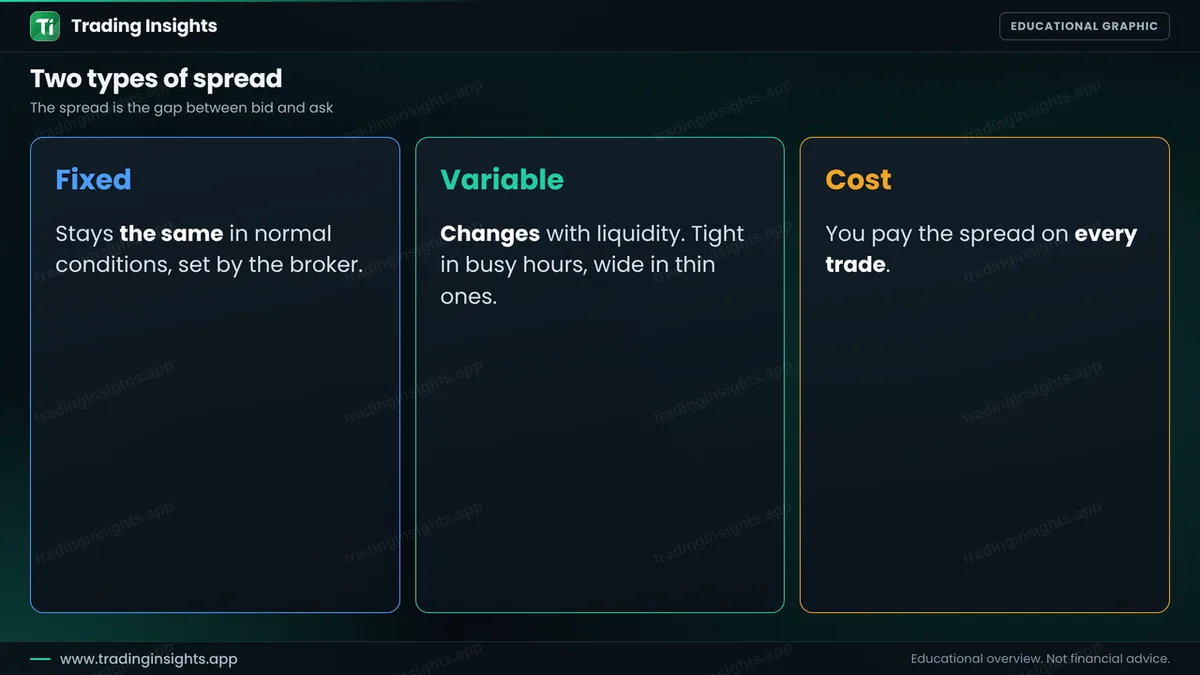
Each time you open a trade, you pay the gap between the bid and the ask price. With a fixed spread, the broker quotes the same gap under normal conditions, for example 1.5 pips on EUR/USD. With a variable (floating) spread, the gap follows liquidity. It can be 0.1 pip in a busy London session and several pips at rollover or in thin hours.
Fixed vs variable spread: side by side
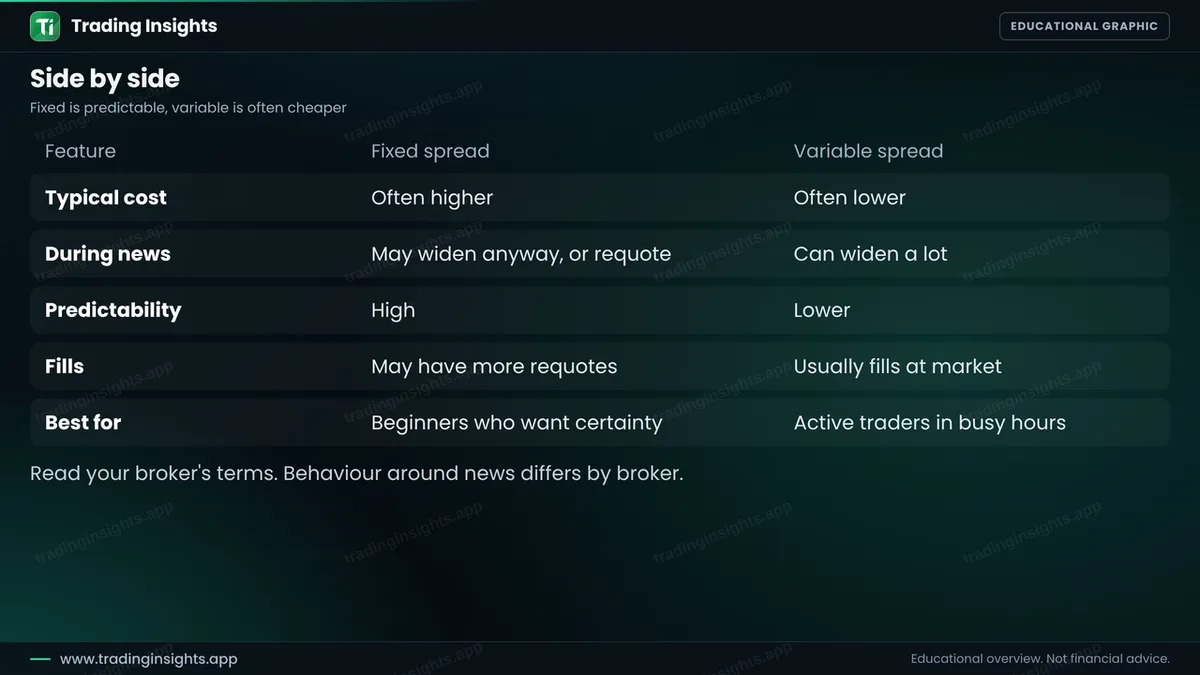
- Typical cost. Variable spreads are often lower on average, especially in busy hours. Fixed spreads are often higher, because the broker prices in the risk of wider moments.
- Around news. Variable spreads can widen sharply. A fixed spread may stay the same on paper, but some brokers requote or reject orders in fast markets, or the spread may widen anyway. Read the terms.
- Predictability. A fixed spread is easier to plan with, since you know the cost before you click.
- Fills. How orders are filled depends on the broker's model.
Some accounts offer a very tight spread plus a separate commission. The total cost is the spread plus the commission, so compare the total and not only the first number. Exact spreads and commissions vary by broker, so check the live figures on your own platform.
Why the choice matters more for some traders
The effect of the spread depends on the size of your target. A scalper aiming for 8 pips gives up a large share of each trade to the spread, while a swing trader aiming for 100 pips barely notices it. The same 1.5 pips is 19% of one target and 1.5% of the other. This is why scalpers care so much about the average spread in their trading hours, and why swing traders may prefer a fixed spread for the sake of predictability.
The spread also eats into your stop. If you place a stop 15 pips below the chart price on a buy, you fill at the ask, which is higher than the chart's bid price by the spread. Your real distance to the stop is the stop distance plus the spread. With a 0.6-pip spread, that is a small difference. With a 4-pip spread at a news release, it can be a quarter of the stop.
How to choose a spread type
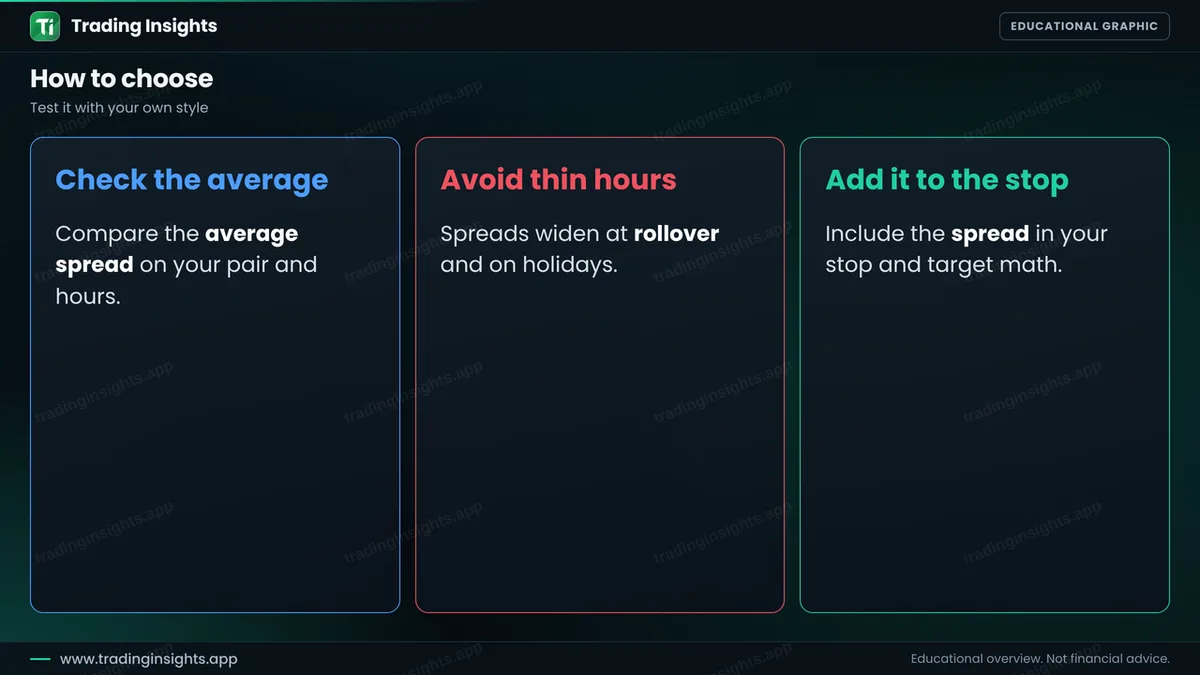
- Check the average. Compare the average spread on your pair and trading hours, not the best number in the advertisement.
- Avoid thin hours. Spreads widen at rollover, on holidays and late in the day.
- Add the spread to your math. A 10-pip stop with a 2-pip spread is a very different cost from a 40-pip stop.
- Match your style. A scalper is very sensitive to the spread, and a swing trader much less so.
- Check execution terms for requotes, rejections and slippage in fast markets.
Two illustrative examples
These are made-up examples that show the effect of spreads. They are not real accounts.
Illustrative example 1 (win, fixed spread). A trader on a fixed 1.5-pip spread buys EUR/USD with a 15-pip stop and a 30-pip target, both measured net of the spread. The account is $6,000 and the risk is 1%, or $60, so the size is 60 / (15 x 10) = 0.40 lot. The spread costs 0.40 x 1.5 x 10 = $6, already inside the fill. Price rises far enough to deliver a net 30 pips, and the trade makes 0.40 x 30 x 10 = $120. The cost was known and steady.
Illustrative example 2 (loss, variable spread). Another trader uses a variable-spread account and buys EUR/USD just before a news release. The account is $4,500 and the risk is 1%, or $45. The plan is a 15-pip stop below the chart price, so the size is 45 / (15 x 10) = 0.30 lot. The spread has jumped from 0.6 to 4 pips, so the fill is 4 pips above the chart price, and the real distance to the stop is 19 pips. Price falls to the stop, and the loss is 0.30 x 19 x 10 = $57, which is 1.27% of the account and above the plan. The trader should have waited for the spread to normalise.
Common mistakes
- Choosing only by the lowest advertised number. The best figure is often a rare moment. Compare the average spread in your own hours.
- Ignoring commissions on raw-spread accounts. A tight spread plus a commission can cost more than a wider all-in spread. Add them up per trade.
- Trading at rollover or news without checking the spread. It can be several times wider. Look at the live spread before you click.
- Assuming a fixed spread removes slippage. Orders can still be requoted or filled at worse prices in fast markets. Read the broker's execution terms.
Pre-trade checklist
- What is the live spread on this pair right now?
- Is it in line with the average for this time of day?
- Is there news in the next few minutes?
- Did I add the spread to my stop distance and my sizing?
- If the account charges a commission, is it counted in the total cost?
- Does my target still make sense after the cost?
Frequently asked questions
What is a fixed spread?
It is a spread that stays the same under normal conditions, as set by the broker. Brokers may still have rules for fast markets.
What is a variable spread?
It changes with market liquidity, tight in busy hours and wider in thin hours or during news. A fixed spread stays the same, but a variable spread can double or more around major data releases. Check the live spread before you place an order.
Which is cheaper?
Variable spreads are often cheaper on average, but they can widen sharply. Compare the total cost, including any commission.
Does the spread matter for a swing trader?
Less than for a scalper, since targets are larger, but it is a cost on every trade. Check it before entering.
Your next step
Record the live spread on your main pair at three times of day for a week: the London open, New York afternoon and rollover. Compare the average with the advertised figure, then enter your usual stop into the position size calculator to see how the cost changes your plan.
This guide to fixed and variable spreads is for education only and is not financial advice. Trading carries a real risk of loss, and spreads, commissions and fills vary by broker.


