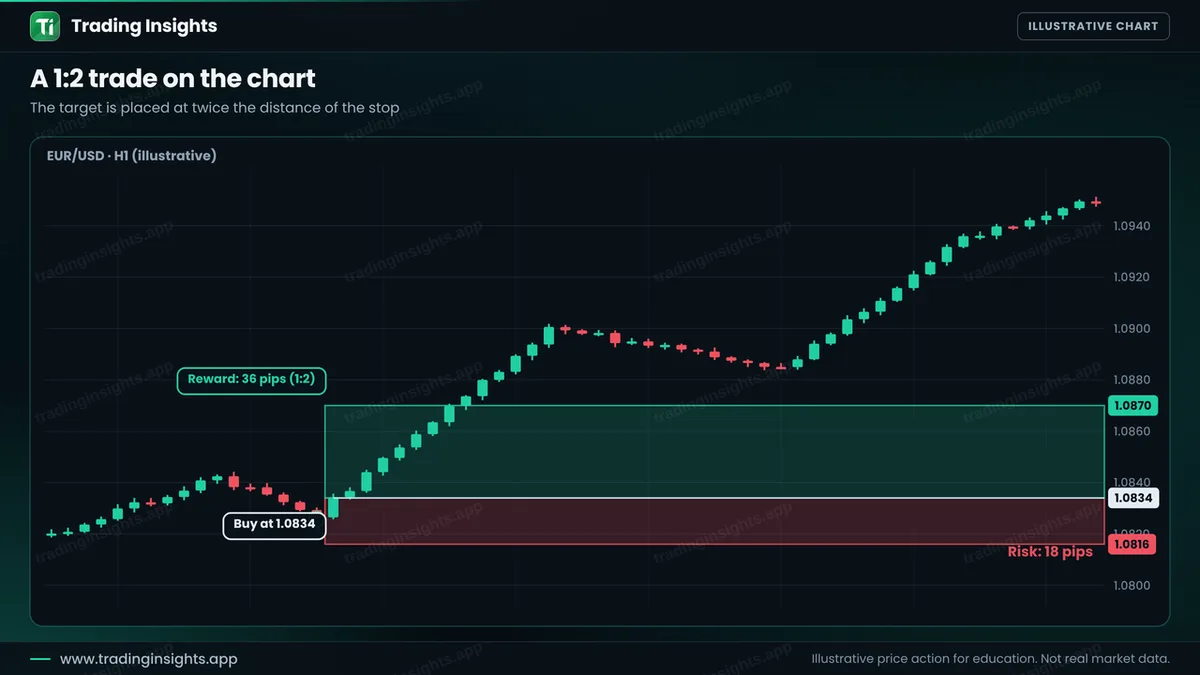
The risk-to-reward ratio compares how much you can lose on a trade with how much you aim to gain. If your stop is 18 pips away and your target is 36 pips away, the ratio is 1:2: you risk one unit to gain two. It is one of the simplest risk tools, and it has a direct link to how often you need to win to break even. This guide shows the formula, a worked example, a table of break-even win rates, and a full trade plan with a stop, a target and a lot size.
The formula
Risk is the distance from entry to the stop loss. Reward is the distance from entry to the take profit. The ratio is reward divided by risk.
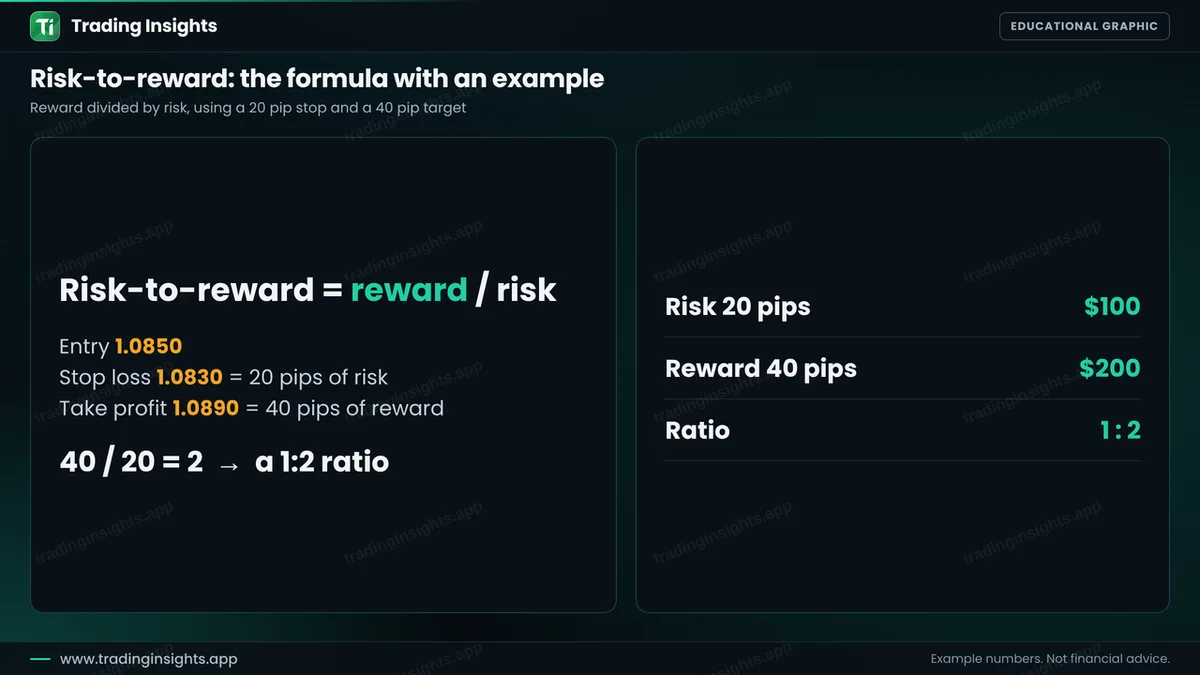
If the stop is hit you lose 18 pips, and if the target is hit you gain 36 pips. The ratio is calculated before you enter, which is the whole point: it tells you if the trade is worth taking before any money is at risk. You can test numbers in the risk-reward calculator. For another angle on the same topic, see how to calculate risk-to-reward ratio.
Win rate and the break-even point
A better ratio lets you be wrong more often. The break-even win rate is 1 / (1 + ratio), with the ratio as reward divided by risk, before costs.
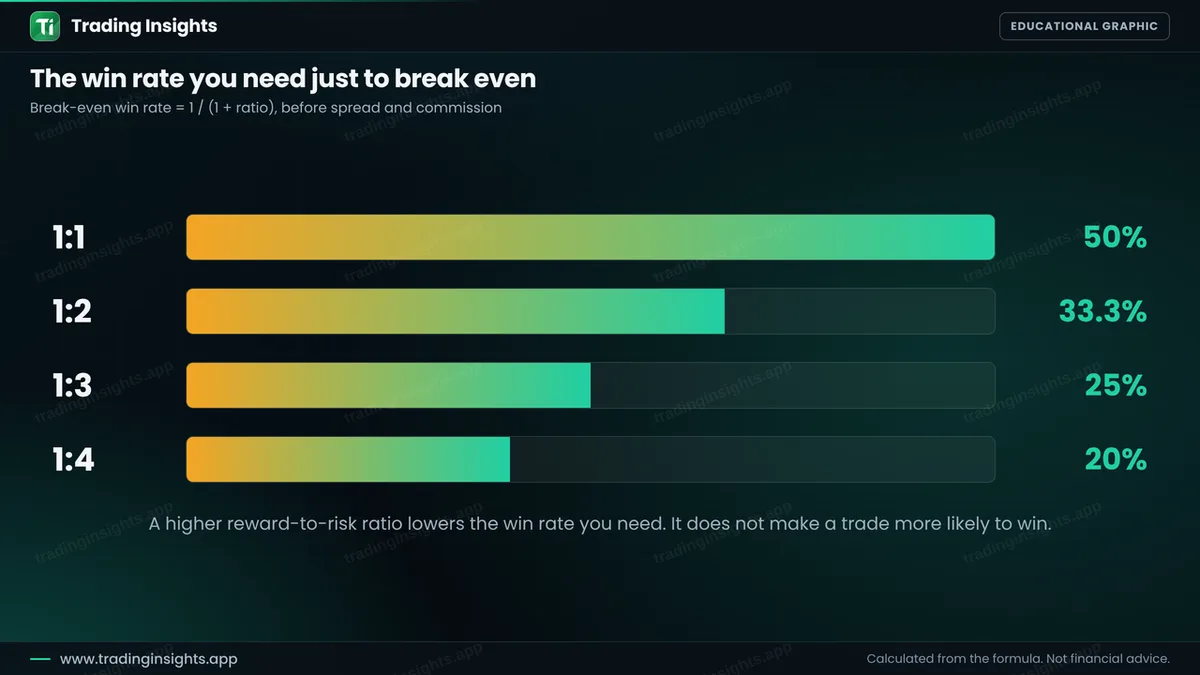
- 1:1 needs a 50% win rate.
- 1:2 needs about 33%.
- 1:3 needs 25%.
- 1:4 needs 20%.
These figures ignore spread, commission and slippage, which raise the real number a little. They also do not say that a high ratio is always better. A target that is too far away is hit less often, so the win rate drops, and the real edge is the combination of both. A strategy that wins 40% of the time at 1:2 earns money, and one that wins 40% at 1:1 loses it. To go further see expectancy.
A 1:2 trade: worked example
- Entry: 1.0834.
- Stop loss: 1.0816 (18 pips).
- Take profit: 1.0870 (36 pips). Ratio 1:2.