
The most common stop-loss mistakes in forex are placing the stop by feel, using the same pip distance on every pair, putting it exactly at an obvious level, and moving it after entry. Almost every trader uses a stop, and almost every trader is unhappy with some of their stops. They are too tight and price reverses after hitting them, or too wide and the loss is large. The idea of a stop is rarely the problem. The placement is, and the fixes are simple once you know them.
Why stop losses fail
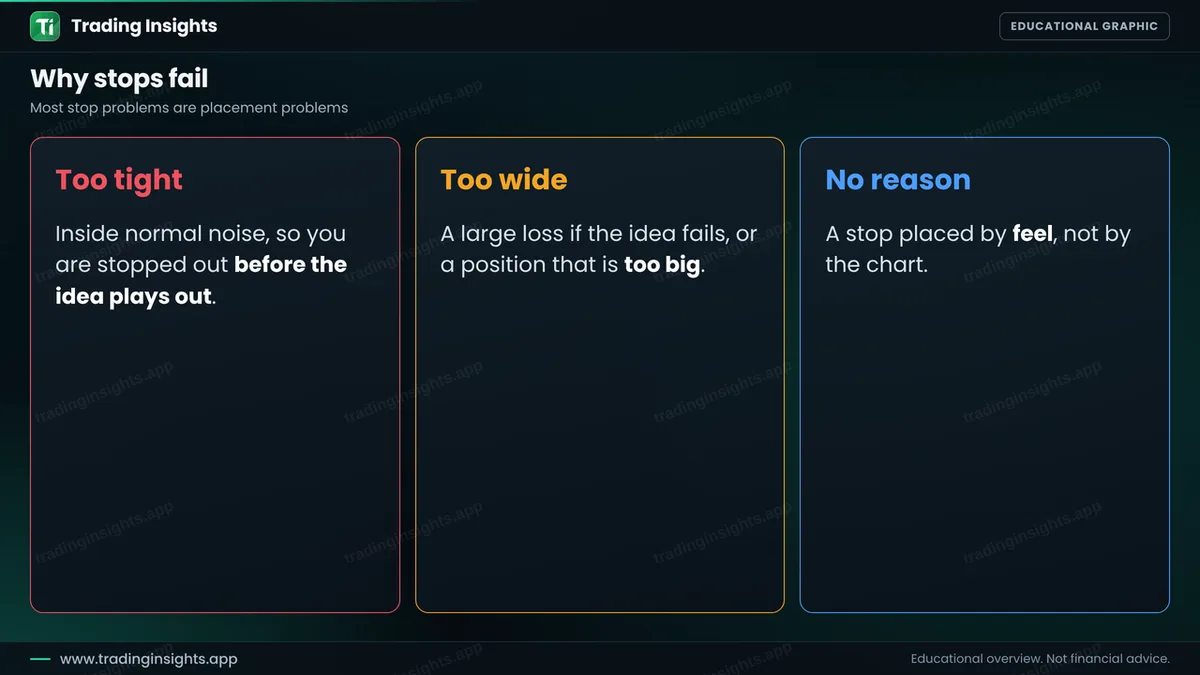
A stop has one job: to mark the point where your idea is wrong. If it is placed inside normal noise, it is hit by random moves. If it is placed far away to avoid being hit, the loss grows, or the position must be tiny. And if it is chosen by feel, it has no link to the chart.
The basics of stops and targets are in stop loss and take profit, and a tool for setting the distance is in ATR stop loss.
Common stop-loss mistakes and how to fix them
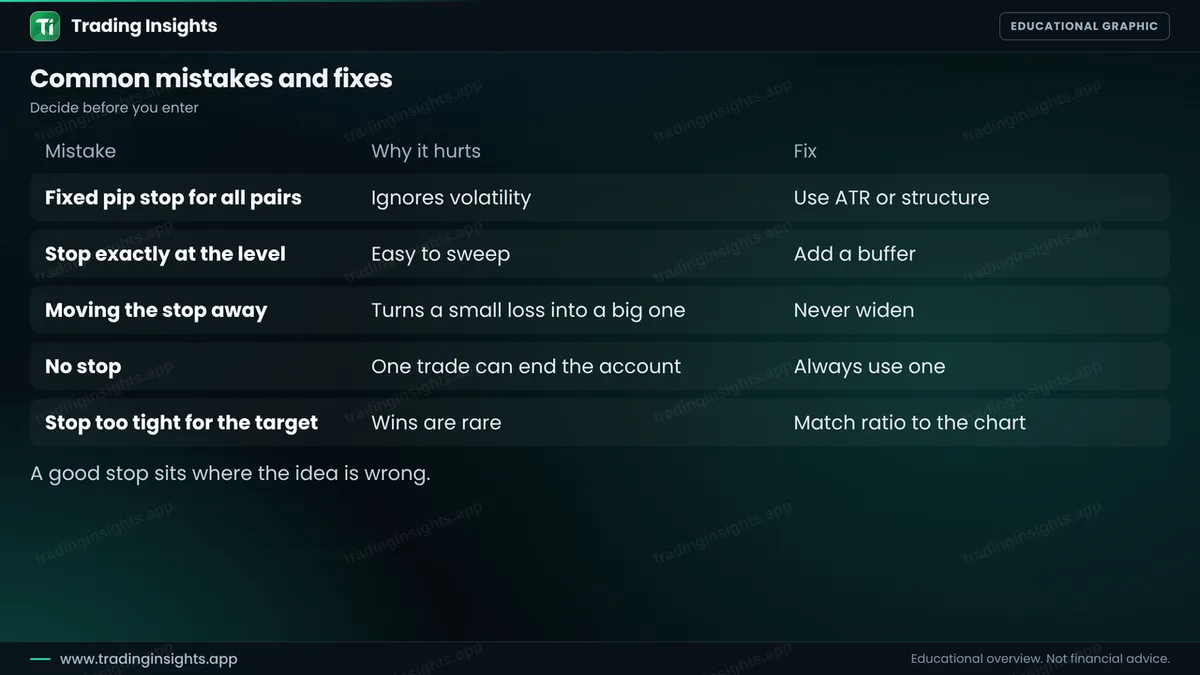
- A fixed pip stop for every pair. A 20-pip stop may be sensible on EUR/CHF and silly on GBP/JPY. Use the ATR or the structure, since the volatility differs. See forex volatility.
- A stop exactly at the level. Stops cluster at obvious levels, and price often sweeps them. Place the stop beyond the level with a buffer. See stop hunting.
- Moving the stop away. A stop that is moved further after entry is no longer a stop, it is hope. It turns a planned small loss into a large one. See anchoring and the sunk cost fallacy.
- No stop at all. One bad trade or a news gap can end the account. See drawdown and risk of ruin.
- A stop too tight for the target. If the stop is tight but the target is far, the trade rarely gets there. The ratio must fit the chart. See the risk-to-reward ratio.
- Ignoring the spread. On a tight stop, the spread is a big part of the risk. See forex trading costs.
How to place a stop loss step by step
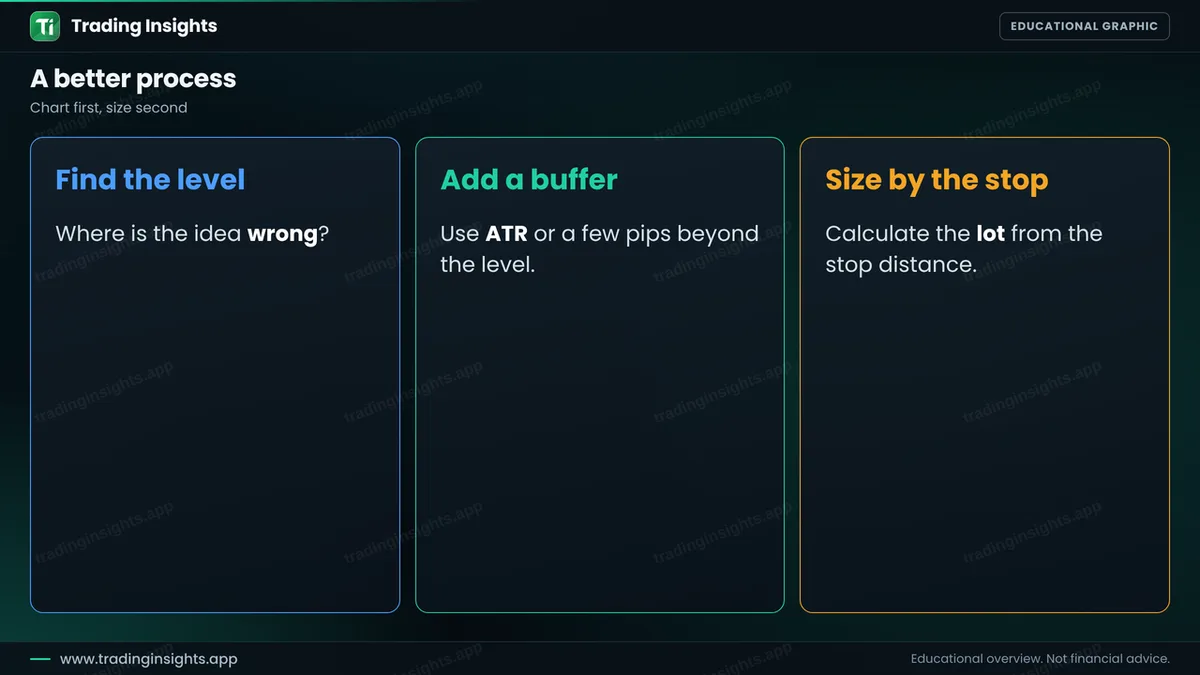
The key is the order: the stop comes from the chart, and the size follows from the stop. Many traders do it in reverse. They choose the lot first and fit the stop to it, so the stop ends up in a bad place.
- Find the level. Ask where the idea is wrong. For a buy at a support, it is below the support.
- Add a buffer. Use a fraction of the ATR, or a few pips, beyond the level.
- Size by the stop. Calculate the lot from the distance, so that the loss is 1% or less. See how to calculate position size.
- Check the ratio. If the target does not offer a good reward for this stop, skip the trade.
- Do not touch it. You may move the stop in the direction of profit, but only by a rule. See trailing and break-even stops.
How to check that your stop makes sense
Before you enter, ask three questions. Is the stop beyond a level that, if broken, really means the idea is wrong? Is the distance larger than a typical candle on your timeframe, so that ordinary noise does not reach it? And can you accept the dollar loss if it is hit?
If any answer is no, change the trade, not the stop: find a better entry, reduce the size, or skip it.
What makes a stop invalid
A stop stops working as a plan when you move it away from price, remove it, or set it by how much you can bear to lose instead of where the idea fails. News gaps can also jump past it, so keep the size modest.
An illustrative example of a better stop
This is an illustrative example on GBP/USD. A trader buys near a support at 1.2700 and places a 15-pip stop because that is "his usual stop". The pair normally moves 90 pips a day, and the stop is hit by a dip. Price then rises 100 pips.
Next time, he checks the ATR (12 pips on H1 in this case) and places the stop 20 pips below the support, at 1.2680. With entry at 1.2702, the total distance is 22 pips, and the target is 44 pips higher at 1.2746.
With a $10,000 account risking 1% ($100), the position size is $100 / (22 pips x $10 per pip per lot) = about 0.45 lot. A win pays about $200, and a loss costs about $100. With the old 15-pip stop, the same risk would have meant about 0.67 lot, so the wider stop means a smaller position. His risk is the same, and the trade has room to work. You can check your own numbers with the position size calculator.
Common mistakes
- Choosing the lot before the stop. The stop then fits the lot, not the chart. Place the stop first and calculate the lot from it.
- Using the same pip number for every pair. Pairs move different distances. Base the stop on the ATR or the structure.
- Widening the stop after entry. It turns a small planned loss into a large one. Decide in advance, and move it only toward profit.
- Placing stops right at round numbers and obvious levels. Price likes to sweep them. Add a buffer beyond the level.
Frequently asked questions
Where should I place my stop loss?
At the point where your trade idea is wrong, with a buffer beyond the level. Base the distance on the chart and the ATR, not on a fixed number of pips.
Why does price hit my stop and then reverse?
Stops cluster at obvious levels, and price often sweeps them. A buffer beyond the level and a smaller position can help, though some stops will still be hit.
Is it ever acceptable to trade without a stop?
For most retail traders, no. A stop limits the loss when a trade or a news gap goes wrong, and it removes the temptation to hope.
Should I move my stop?
Only in the direction of profit, and by a rule such as a trail or a move to break-even. Never move it further away.
Your next step
Open your last five trades and look at each stop. For every one, write down the chart reason for its position. If you cannot, use the steps above on your next trade and place the stop before you choose the lot.
This is education, not financial advice. Trading carries risk, and a stop does not protect you from gaps or slippage. No method guarantees results. The charts are illustrative and not real market data.


