
Stop hunting in forex is the idea that large players or brokers push price on purpose to trigger traders' stops. Whether or not anyone targets ordinary accounts is hard to prove, but one thing is certain: obvious stops are easy to hit. This article explains why, and how to place stops that survive normal noise without taking more risk.
What stop hunting means
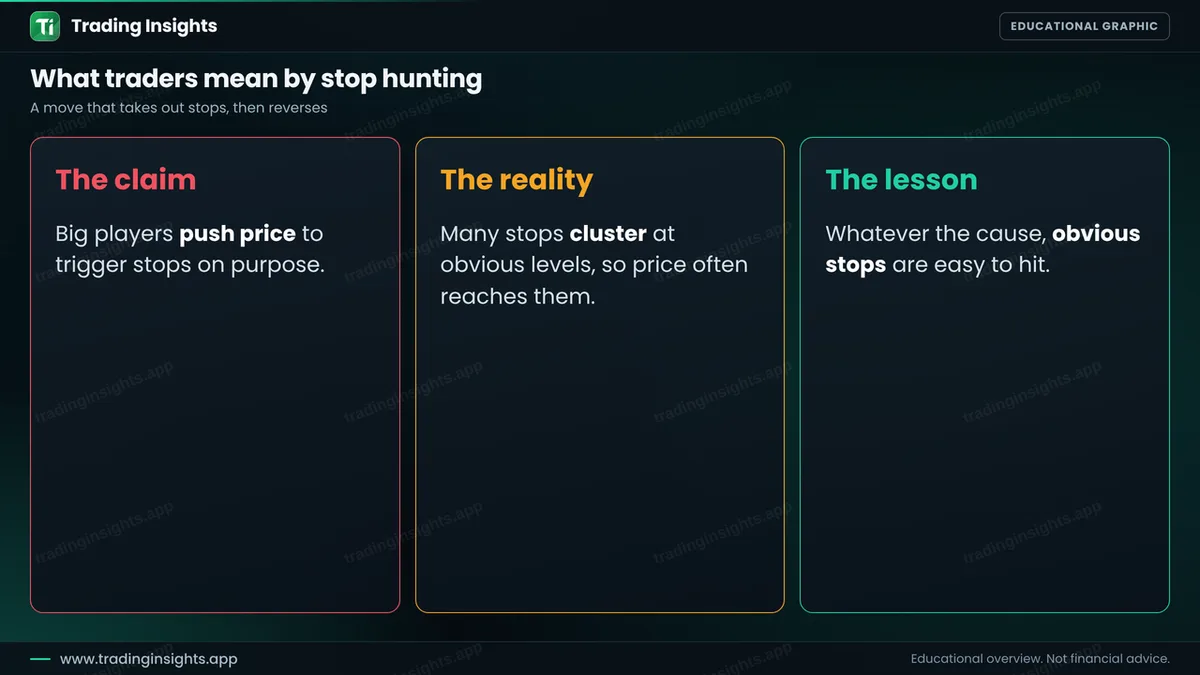
"My stop was hit by two pips, and then price went exactly where I expected." Almost every trader has said this. Many conclude that someone is hunting their stops. The truth is more complicated, and more useful.
The claim is that large players or brokers push price to trigger stops on purpose. In a decentralized market, it is hard to prove that any single trader can do this for an ordinary retail account, and you should be careful with explanations that blame others for every loss.
What is certain is that many traders place stops at the same obvious places. Large orders need liquidity, and clusters of stops are a source of it, so price often moves to those areas. See liquidity sweeps and liquidity pools. Whether you call it a hunt or a sweep, the practical lesson is the same.
Where stops tend to cluster
- Just beyond round numbers. See round numbers.
- Just under a swing low or over a swing high. The textbook place. See swing highs and lows.
- Equal highs and lows. Many traders use them as levels. See equal highs and lows.
- A fixed distance. A "10-pip stop" chosen without the chart.
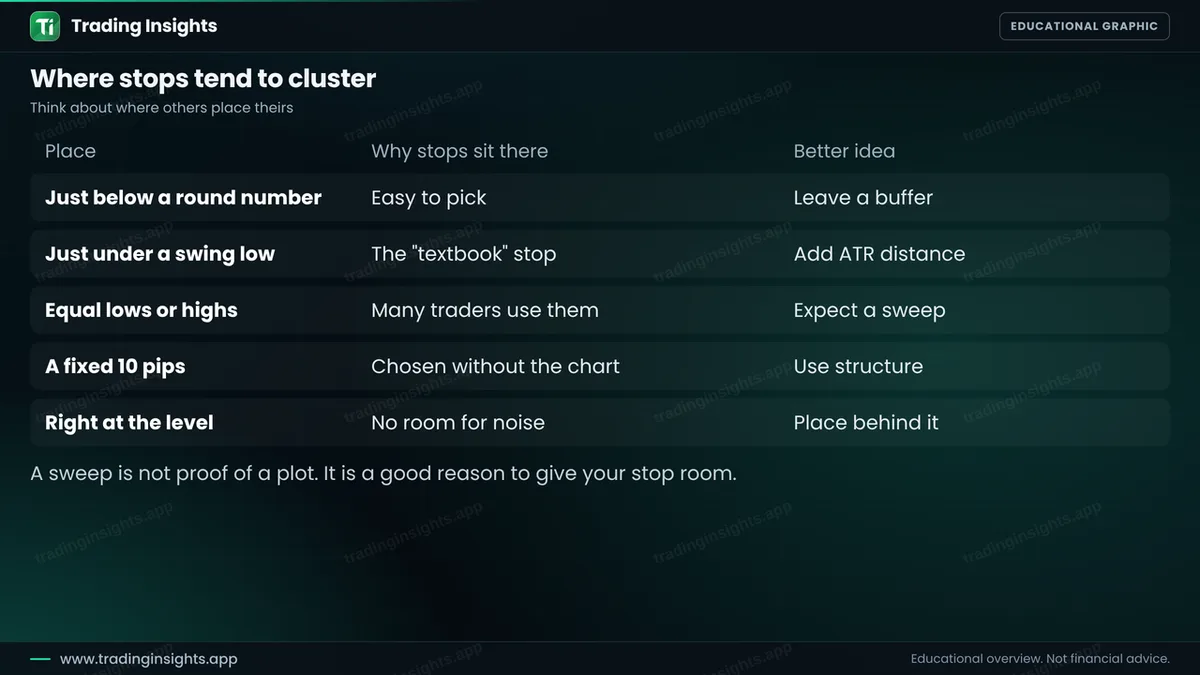
When price sweeps these areas and returns, it looks like a hunt. It is also a pattern that you can trade, as in the Wyckoff spring.
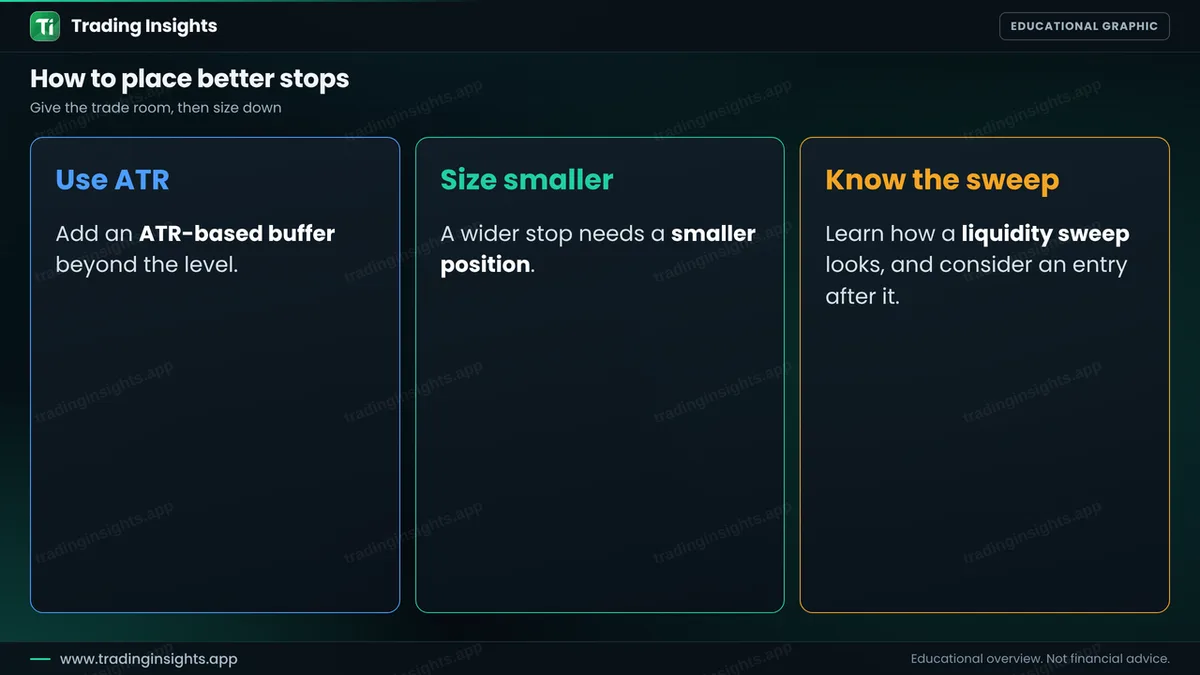
How to place better stops
- Use ATR. Add a buffer, for example 0.5 to 1 times the ATR, beyond the level. See ATR stop loss.
- Size smaller. A wider stop needs a smaller position, so the risk stays the same. See how to calculate position size.
- Use structure. Place the stop behind a level, where the idea is wrong, and not at the level. See stop loss and take profit.
- Consider waiting. Entering after a sweep and a return can give a tighter stop and a better entry.
- Do not remove the stop. The cure for a hit stop is not no stop. See anchoring and the sunk cost fallacy.
Illustrative example: a tight stop versus an ATR stop
This is an illustrative example, not a real trade. A trader sees support at 1.0800 on EUR/USD and buys at 1.0810 after a bullish candle. Plan A puts the stop at 1.0795, just below the level (15 pips). Plan B uses an ATR of 12 pips and puts the stop at 1.0782, which is the level minus 18 pips (28 pips from entry). The target is 1.0870 (60 pips).
Both plans risk 1% of a $10,000 account ($100), so the size changes:
| Plan | Stop | Stop distance | Position size |
|---|---|---|---|
| A: tight | 1.0795 | 15 pips | $100 / (15 x $10) = about 0.67 lot |
| B: ATR buffer | 1.0782 | 28 pips | $100 / (28 x $10) = about 0.36 lot |
Price dips to 1.0791, which takes out plan A and misses plan B, and then rallies. With plan B, a win of 60 pips pays about $215, and a loss costs about $100. The dollar risk is the same, and the trade has room to work. Of course, price may also fall further, and then plan B loses its $100 as planned.
Stop hunt or normal volatility?
After a stop-out it is tempting to see a plot, but the market also moves in ordinary ranges. A simple check is the ATR: if the dip beyond your stop was smaller than one ATR, it was within normal noise, and the stop was probably too close.
Another check is the news calendar. Spreads widen and prices spike around major releases, and stops can be hit by a spike that is gone a minute later. If you trade near events, give the stop more room or stay out. See stop loss and take profit for how to choose the level.
Keep a record in your journal. If most of your stops are hit by small amounts and then price reverses, the lesson is a wider stop with a smaller size, not the end of using stops.
Common mistakes
- Blaming others for every stop-out and changing nothing. The cause is often a stop at an obvious spot. Review your placement.
- Placing the stop exactly at the level. Price often tests a level by a few pips. Put the stop beyond it, where the idea is wrong.
- Widening the stop without reducing the size. The loss gets bigger than planned. Recalculate the position size for the new distance.
- Moving the stop further away after entry, or removing it. A stop is a promise made before emotion. One large loss can erase many small gains.
Frequently asked questions
Is stop hunting real?
Prices often move to areas where stops cluster, which looks like hunting. Whether someone does it on purpose for retail accounts is hard to prove.
How do I avoid getting stopped out by a sweep?
Place the stop beyond the level with an ATR-based buffer, and reduce the position size to keep the risk the same.
Should I trade without a stop to avoid it?
No. A stop protects your account from large losses. Give it room, but keep it.
What is a liquidity sweep?
It is a quick move beyond a level where stops sit, followed by a return. See the liquidity sweep article for details.
Your next step
Look at your last ten stopped-out trades in your journal and measure how far price went beyond your stop before it reversed, if it did. Compare that distance with the ATR. If it was smaller, test an ATR buffer and a smaller size on your next trades, and use the position size calculator.
This is education, not financial advice. Trading carries risk, and a wider stop does not prevent losses. The charts are illustrative and not real market data.


