
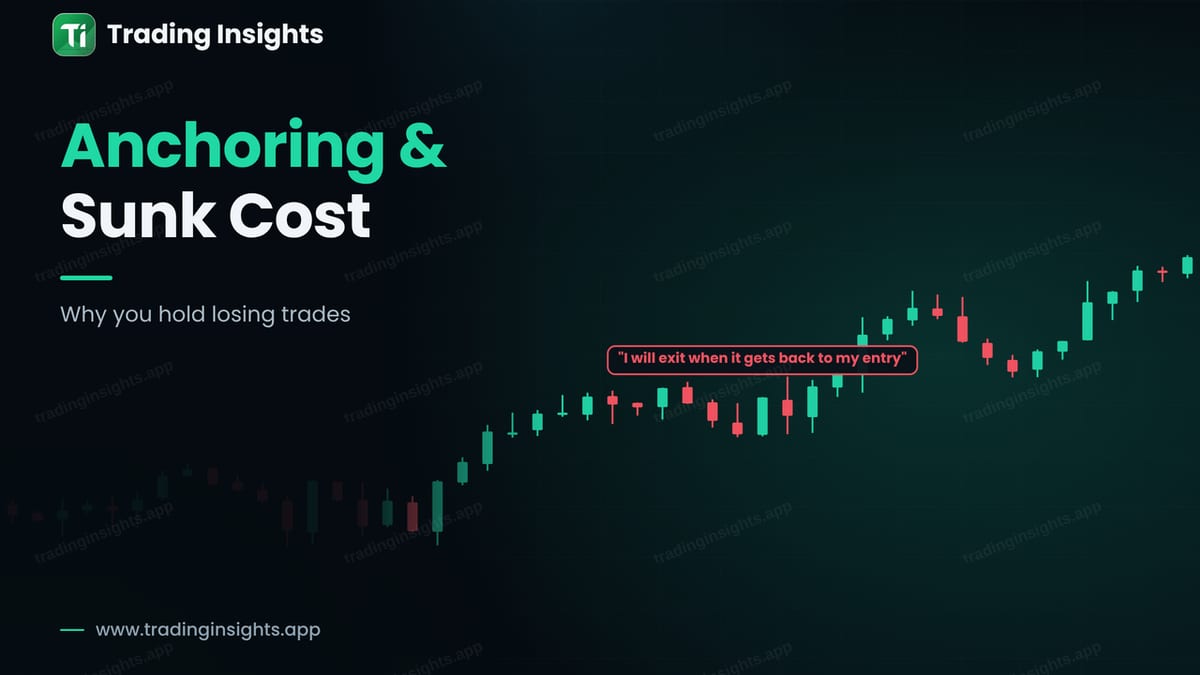
Anchoring bias and the sunk cost fallacy are two mental traps that make traders hold losing trades too long. A trade moves against you, you tell yourself that you will get out when price returns to your entry, and you remove the stop to give it room. Hours later the loss is bigger, and you still wait for the same number. The fix is to judge every open trade by what the market is doing now, not by where you got in.
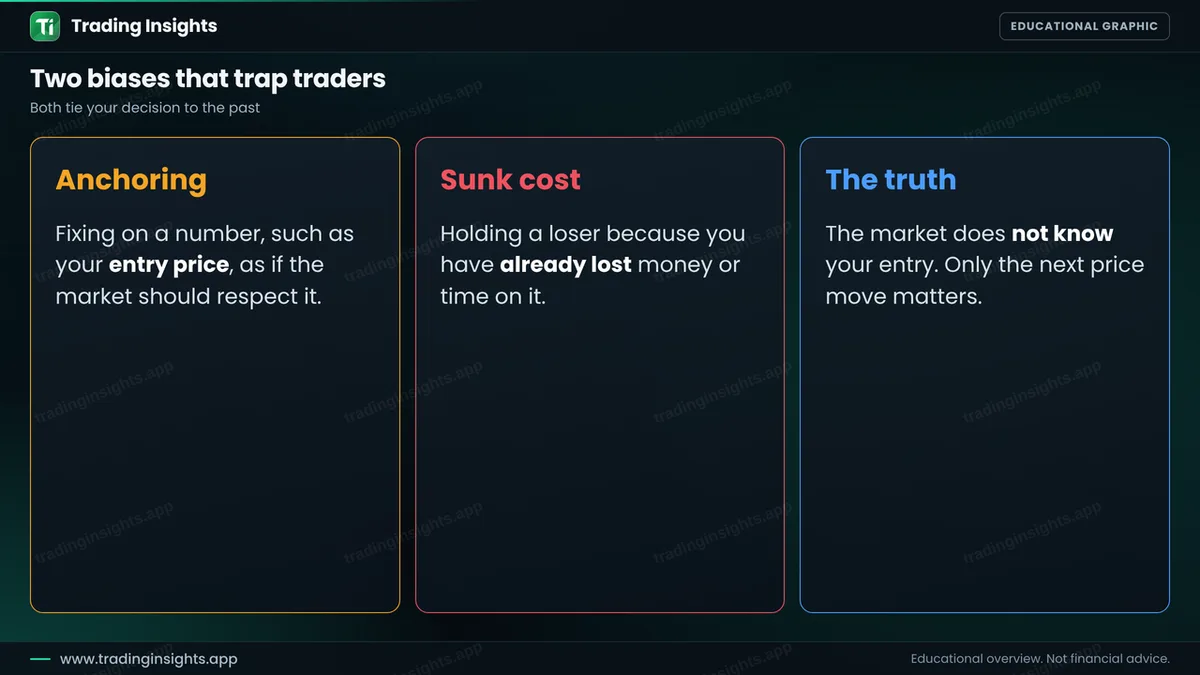
Two biases that trap traders
Anchoring is the tendency to fix on a particular number, often the first one you saw. In trading, the entry price is the usual anchor: "I will sell when it gets back to 1.0850." The market does not know or care where you entered.
The sunk cost fallacy is the urge to continue with something because of what you have already invested. A trader who has lost 50 pips thinks, "I cannot close now, or the loss will be real." But the loss is already there, whether or not the trade is closed. Only the next move matters.
These biases feed other problems, such as loss aversion and revenge trading.
How anchoring and sunk cost show up in your trades
The biases hide in everyday thoughts. Each one has a more objective answer.
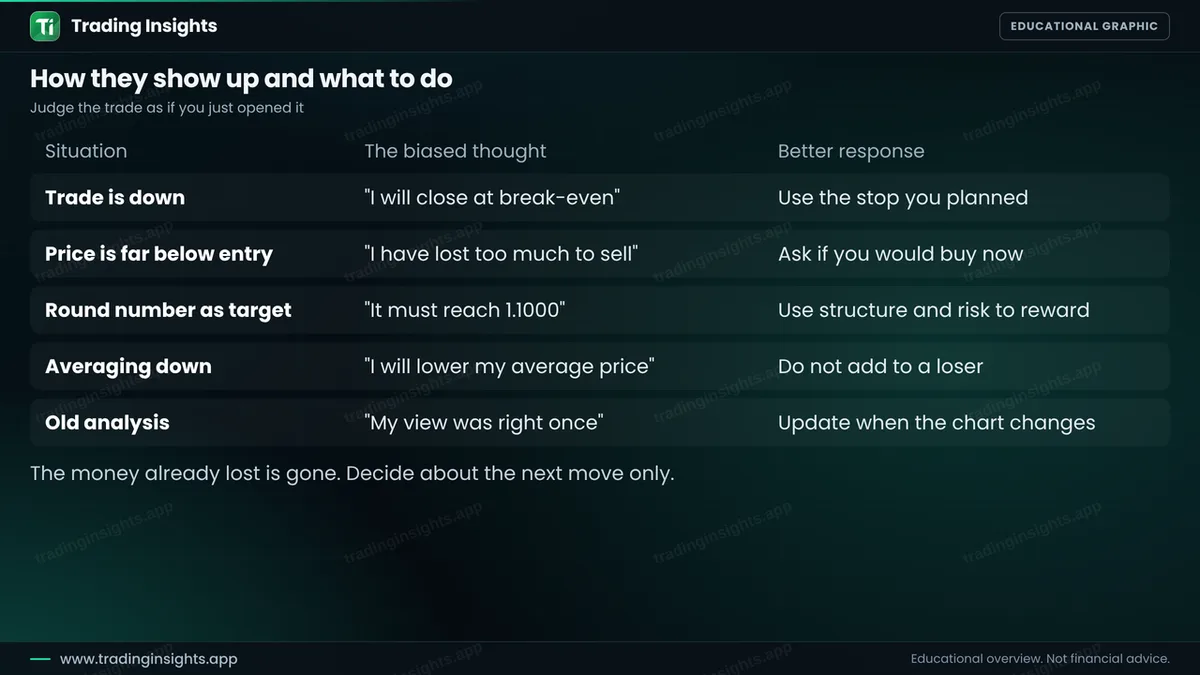
Averaging down is a clear example: adding to a loser to lower the average price is an attempt to bring the exit closer to your anchor. It increases the risk on a trade that is already wrong. See the martingale article for how this can go wrong.
Moving a stop further away does the same, and it breaks the plan. See stop loss and take profit.
Other warning phrases are worth noticing:
- "I just need it to get back to even."
- "I have spent hours on this analysis."
- "It has to turn around soon."
- "If I close now, I have wasted the whole week."
How to stop anchoring on your entry price
The fix is to make decisions that do not depend on your entry price.
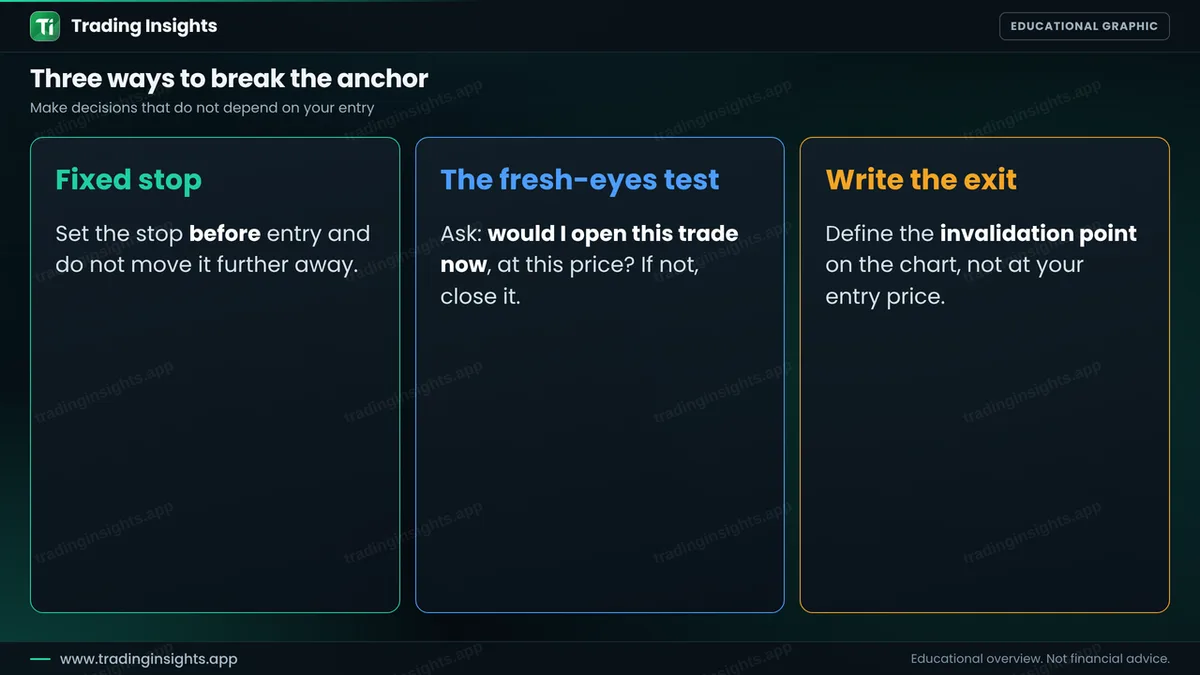
- Set a fixed stop. Place it before entry, at a chart level where the idea is wrong, and never move it further away. See how to build a forex trading plan.
- Use the fresh-eyes test. Ask: "If I had no position, would I open this trade now, at this price?" If the answer is no, close it.
- Write the exit as a chart level. Define the invalidation point from the structure, not from the entry price. See support and resistance.
- Size small. When the loss is small, it is easier to take. See the 1% rule.
- Review. Check in your journal how often "waiting for break-even" helped, and how often it made the loss larger.
Illustrative example: the cost of moving the stop
This is an illustrative example with simple numbers. A trader with a $10,000 account buys EUR/USD at 1.0850 with a stop at 1.0820 (30 pips). Risking 1% ($100), the position size is $100 / (30 pips x $10 per pip per lot) = about 0.33 lot. If the stop is hit, the loss is about $100.
Instead, price falls to 1.0820 and he moves the stop down to 1.0790, "to give it room". Then he says, "I will close at break-even." Price falls to 1.0750. He has now lost 100 pips on a trade that had a 30-pip plan. At 0.33 lot, that is about $330, or 3.3% of the account, more than three times the planned risk.
A trader using the fresh-eyes test would have asked at 1.0820 whether she would buy now, below the support that failed. The answer was no, so she closes with a loss of about $100 and looks for the next setup.
A pre-trade and in-trade routine
Before entry, write down three things: the stop level, the reason the trade is wrong if price reaches it, and the position size from the position size calculator. Do this before you click buy or sell, when you are calm.
While the trade is open, do not ask "where did I enter?" Ask "would I take this trade now?" If the stop is hit, mark it in your journal as a normal cost, not a failure. A closed loss is part of the business, and a small one leaves you free to act on the next setup.
Common mistakes
- Waiting for break-even as a goal. The market owes you nothing. Close by the plan, not by the entry price.
- Moving the stop further away. It turns a small loss into a large one. Move a stop only in the direction of profit.
- Adding to a losing trade to lower the average price. It raises risk on a wrong idea. Add only to winners, with a plan.
- Staying in because of the time spent on the analysis. Hours of work are a sunk cost. Judge the trade by the chart today.
Frequently asked questions
What is anchoring bias in trading?
It is the tendency to fix on a number, such as the entry price, and to base decisions on it, even though the market does not know it.
What is the sunk cost fallacy?
It is the urge to continue with a trade because of what you have already lost or invested, instead of judging the trade by what happens next.
Why do I hold losing trades?
Often because of loss aversion, anchoring on the entry price and the hope of getting out at break-even. A fixed stop set in advance helps.
What is the fresh-eyes test?
Ask whether you would open the same trade now at the current price. If not, the reason to stay is probably the past.
Your next step
Look through your last ten losing trades and mark each one where you moved a stop, averaged down or waited for break-even. Count how much extra loss those choices added. Then write one rule, such as "never move a stop further away", and put it at the top of your trading plan.
This is education, not financial advice. Trading carries risk, and no method guarantees results. The charts are illustrative and not real market data.


